

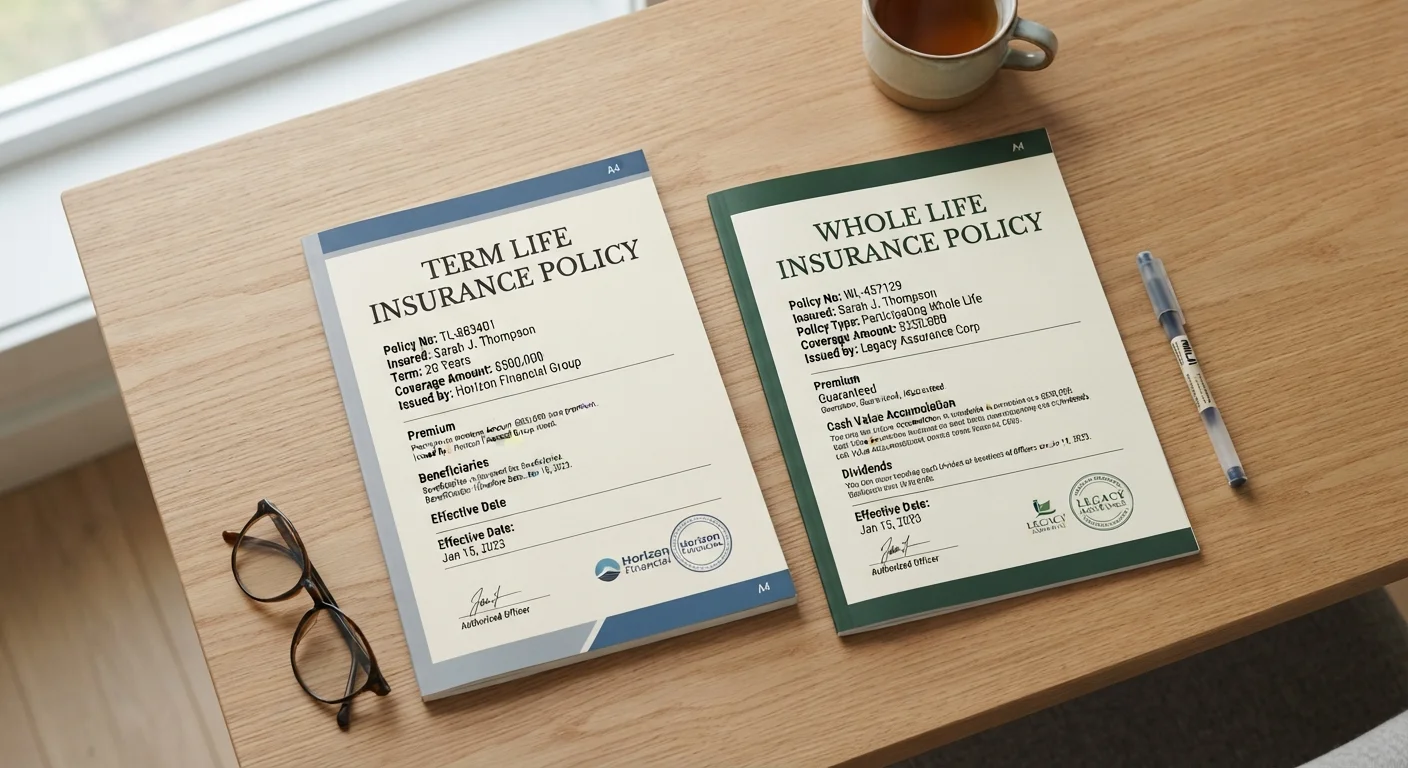
Option A
Term Life Insurance
Straightforward, affordable coverage for a defined period.
Best for: People who need a death benefit during specific high-responsibility years, such as while raising children or paying off a mortgage.
Option B
Whole Life Insurance
Lifelong coverage with a built-in savings component.
Best for: People who want permanent coverage that never expires and a policy that accumulates cash value over time.
How Each Policy Type Works
Life insurance is a contract: you pay premiums, and the insurer pays a death benefit to your beneficiaries if you die while the policy is in force. The core difference between term and whole life is how long that coverage lasts and what else — if anything — the policy does beyond paying a death benefit. For a broader foundation, see our plain-language overview of how insurance works.
Term Life
A term policy covers you for a fixed period — commonly 10, 20, or 30 years. If you die within that term, the insurer pays the death benefit. If the term ends and you are still living, the coverage simply stops (some policies allow renewal or conversion, though terms vary widely by insurer). Premiums are fixed for the duration of the term you choose, and the policy has no savings or investment element.
Whole Life
Whole life insurance does not expire. As long as premiums are paid, the policy remains active for the rest of your life. A portion of each premium goes toward a cash value account that grows at a modest, guaranteed rate set by the insurer. This cash value can be borrowed against or, in some cases, withdrawn — though doing so reduces the death benefit and may have tax implications. Because of this added component and the lifelong guarantee, premiums are substantially higher than term for an equivalent death benefit.
| Criterion | Term Life | Whole Life |
|---|---|---|
| Coverage duration | Fixed term (e.g., 10–30 years) | Lifelong (while premiums paid) |
| Typical premium cost | Lower | Significantly higher |
| Cash value component | None | Yes, grows over time |
| Death benefit | Paid if death occurs in term | Paid whenever death occurs |
| Premium stability | Fixed for the term | Fixed for life |
| Policy complexity | Simple, straightforward | More complex |
| Suitable time horizon | Specific financial obligations | Permanent, lifelong needs |
Cost and Cash Value: What You're Actually Paying For
Premium cost is often the first thing people notice when comparing these two options. A healthy 35-year-old might pay roughly $30–$50 per month for a 20-year term policy with a $500,000 death benefit. A whole life policy with the same death benefit could run several hundred dollars per month — sometimes five to ten times as much. These figures are illustrative; actual premiums depend on your age, health, the insurer, and specific policy terms.
~5–10×
Whole life premium vs. equivalent term
Industry sources generally estimate whole life premiums at roughly five to ten times the cost of a comparable term policy for the same death benefit amount.
54%
U.S. adults with life insurance coverage
According to LIMRA's 2023 Insurance Barometer Study, roughly 54% of American adults reported having some form of life insurance.
The higher cost of whole life buys two things: a guarantee that coverage never lapses due to age, and a cash value component. However, the cash value grows slowly in the early years because a large share of early premiums covers administrative costs and insurer overhead. Policyholders who surrender a whole life policy in the first several years often receive back less than they paid in.
Term insurance, by contrast, is purely a risk-transfer tool. You are paying for financial protection during a defined window — nothing more. If the term ends and you never needed the benefit, you got peace of mind, not a refund. That trade-off is a feature of insurance generally, not a flaw specific to term policies.
If you are still building familiarity with how policies are structured, our introduction for first-time insurance buyers walks through the fundamentals.
Which Situations Each Type Tends to Suit
There is no single correct answer for everyone. These policies serve different purposes, and for some people both may even have a role at different life stages.
Term life tends to be a practical fit when:
- You have dependents relying on your income and want to replace it if you die prematurely.
- You carry a large debt — such as a mortgage — that others would inherit or struggle with.
- Your budget is limited and you want the most coverage per premium dollar.
- Your need for coverage has a logical endpoint, such as when children reach adulthood or a loan is paid off.
Whole life may be worth exploring when:
- You want a death benefit that is guaranteed regardless of when you die.
- You are thinking about estate planning and want a predictable asset to pass to heirs.
- You have already maxed out other tax-advantaged accounts and are considering the cash value component as part of a broader financial plan.
- You have lifelong financial dependents — such as a disabled child — who will always need support.
It is worth noting that life insurance decisions interact with broader financial planning. A licensed financial adviser or insurance professional can help evaluate which structure aligns with your specific goals. You can also explore how life insurance compares to other coverage types in our article on the differences between health and life insurance.
Convertible Term Policies: A Middle Path
Some term policies include a conversion option that allows you to switch to a whole life or other permanent policy without undergoing a new medical exam. This can be useful if your health changes during the term and you later decide you want lifelong coverage. Conversion terms, deadlines, and availability vary significantly by insurer and policy, so review the specific contract language carefully.
This article is for general informational purposes only and does not constitute personalized financial, insurance, or legal advice. Coverage terms, premiums, and features vary by insurer and individual circumstances. Consult a licensed insurance professional or financial adviser before making decisions about your own coverage.
The content on this site is for informational purposes only and is not a substitute for professional advice. Always consult a qualified professional for guidance specific to your situation.