

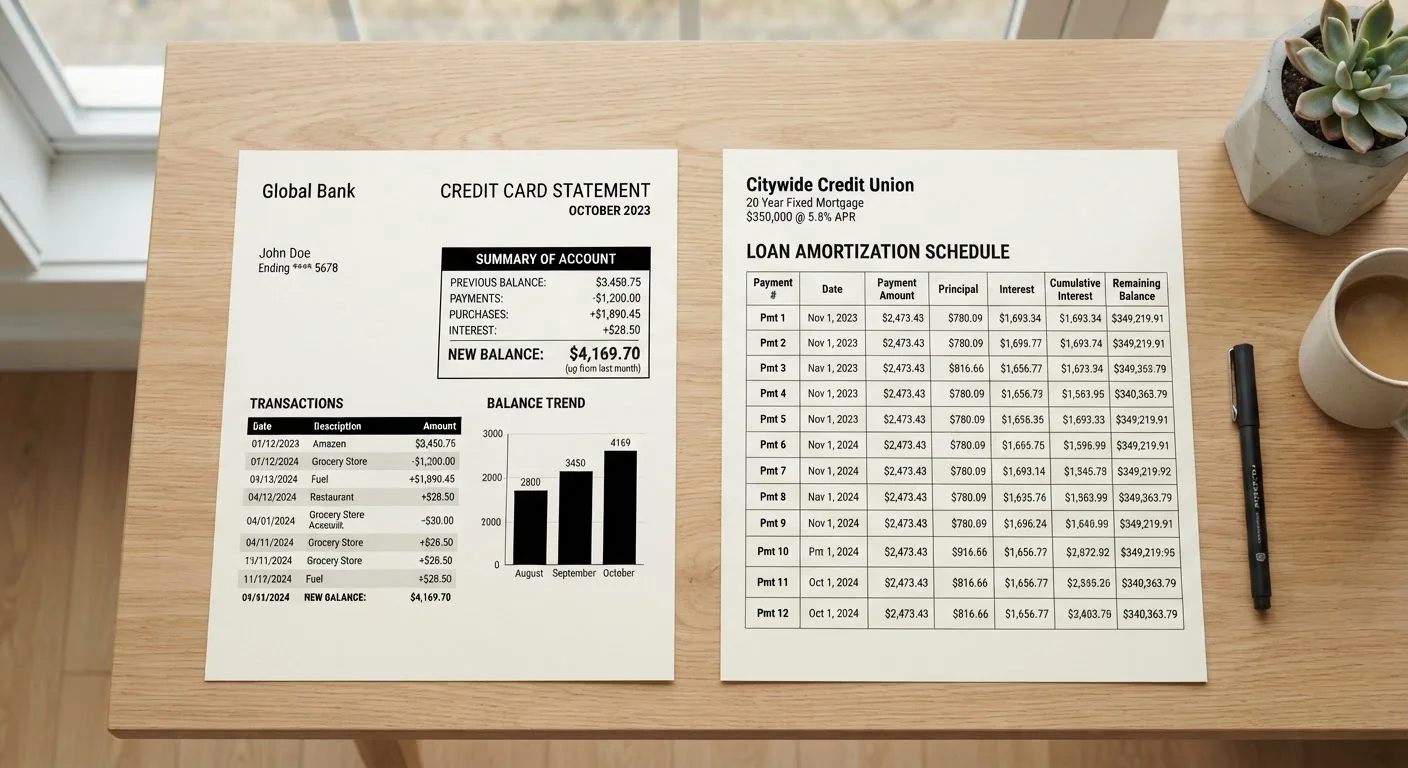
Option A
Revolving Debt
The flexible, open-ended credit line you can use repeatedly.
Best for: Ongoing or unpredictable expenses where borrowing needs fluctuate month to month.
Option B
Instalment Debt
The structured, fixed-schedule loan with a clear end date.
Best for: One-time, defined borrowing needs where a predictable payoff timeline matters.
What Makes These Two Types of Debt Different
Not all debt works the same way. Two of the most common forms — revolving debt and instalment debt — follow very different rules about how money is borrowed, how interest accrues, and when the debt ends. Understanding those mechanics helps you read your own financial picture more clearly.
Revolving debt is structured around a credit limit. You can borrow up to that limit, repay some or all of what you owe, and then borrow again — repeatedly, without reapplying. Credit cards and home equity lines of credit (HELOCs) are the most familiar examples. The balance fluctuates based on your spending and payments, and there is no predetermined payoff date.
Instalment debt works differently. You borrow a fixed amount, and a lender sets a repayment schedule — typically equal monthly payments over a set number of months or years. Auto loans, student loans, mortgages, and personal loans are all instalment debt. Once you make all the scheduled payments, the account closes.
For a broader introduction to how these categories fit into personal finance, see our overview of personal debt types.
| Criterion | Revolving Debt | Instalment Debt |
|---|---|---|
| Structure | Open-ended credit line | Fixed loan amount |
| Repayment schedule | Flexible; minimum payment required | Fixed monthly payments |
| End date | None — account stays open | Defined from the start |
| Interest calculation | Daily on remaining balance | Amortized over loan term |
| Can reborrow funds | Yes, up to the credit limit | No — must reapply |
| Affects utilization ratio | Yes — directly | No — not typically |
| Common examples | Credit cards, HELOCs | Auto loans, mortgages, personal loans |
How Interest Accumulates Differently
The way interest builds up is one of the starkest differences between these two debt types.
With revolving debt, interest is typically calculated daily on your current balance. If you carry a balance from month to month, interest compounds on whatever you haven't paid. A higher balance means more interest — and if minimum payments barely cover the interest charges, the principal can stay elevated for a long time.
With instalment debt, interest is usually front-loaded through a process called amortization. In the early months of a loan, a larger share of each payment goes toward interest and a smaller share reduces the principal. That ratio gradually flips over time. The key distinction is that the total interest you'll pay over the life of the loan is predictable from day one, assuming you follow the standard payment schedule.
~$6,500
Average US credit card balance per cardholder
According to Federal Reserve and industry data, the average revolving credit card balance carried by US households with card debt has hovered around this range in recent years.
20%+
Typical APR on revolving credit card debt
The Federal Reserve tracks average credit card interest rates; rates on accounts assessed interest have exceeded 20% annually in recent reporting periods.
This difference matters when thinking about the long-term cost of carrying each type of debt. Revolving balances can quietly grow more expensive the longer they sit unpaid. Instalment loans, by contrast, don't penalize you simply for holding the debt — as long as you make payments on schedule.
How Each Type Affects Your Credit
Both revolving and instalment accounts appear on your credit report, but credit scoring models treat them differently.
Credit utilization — the ratio of your revolving balances to your total revolving credit limits — is one of the most heavily weighted factors in common credit scoring models. Keeping utilization low on revolving accounts (generally understood to be below 30%, though lower tends to be better) can positively influence your score. Instalment loan balances are not factored into utilization calculations in the same way.
On the other hand, successfully repaying an instalment loan over time builds a track record of on-time payments, which also contributes positively to your credit history. Missing payments on either type of debt can cause significant score damage.
Having both types of accounts in good standing is often associated with a stronger credit profile, because it demonstrates you can manage different kinds of debt responsibly. This is sometimes called credit mix. For more on how credit accounts work together, explore our credit and banking hub.
Credit Mix Is One of Several Scoring Factors
Credit scoring models like FICO weigh several factors: payment history, amounts owed (including utilization), length of credit history, new credit inquiries, and credit mix. No single factor determines your score in isolation. Opening or closing accounts solely to adjust your mix isn't generally recommended without understanding the full picture.
It's also worth understanding how the secured or unsecured nature of a debt interacts with these mechanics — our article on secured vs. unsecured debt covers that dimension in detail.
This article is for general informational purposes only and is not personalised financial or legal advice. Consider consulting a licensed financial professional for guidance specific to your situation.
The content on this site is for informational purposes only and is not a substitute for professional advice. Always consult a qualified professional for guidance specific to your situation.