

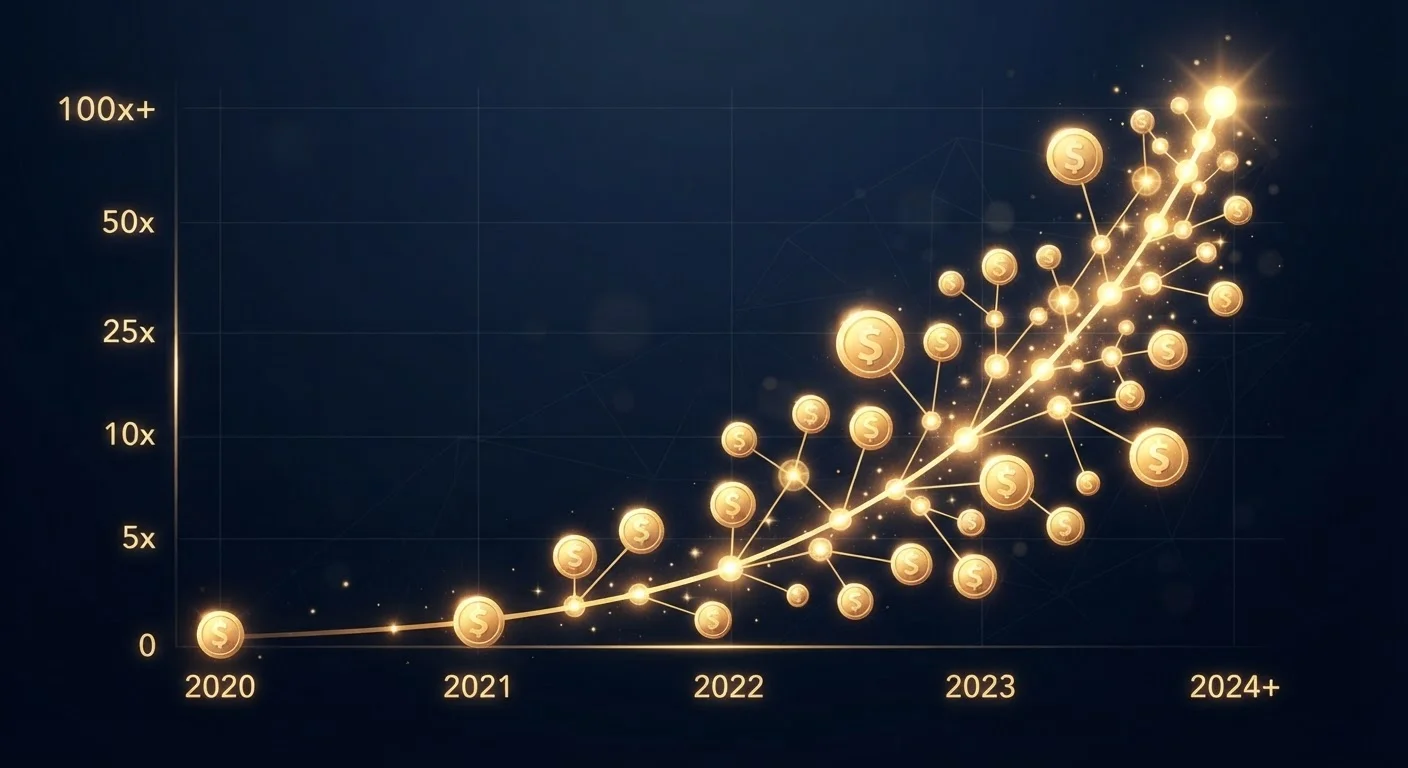
How Compounding Actually Works
The mechanics are straightforward once you see them in action. Suppose you deposit $1,000 in an account earning 5% interest per year, compounded annually. After year one, you earn $50 in interest — your balance is now $1,050. In year two, you earn 5% on $1,050, not the original $1,000, so you earn $52.50. Your balance becomes $1,102.50. That extra $2.50 might seem trivial, but the pattern compounds year after year.
By year 20, that original $1,000 has grown to roughly $2,653 — more than doubled — without any additional deposits. The growth isn't linear; it accelerates. The longer the timeline, the steeper the curve.
This is meaningfully different from simple interest, where you'd earn exactly $50 every year and end up with $2,000 at year 20. Compounding adds $653 more — purely from earning interest on interest.
For a deeper look at how APY reflects compounding in real savings and loan products, see our plain-language guide to interest rates, APR, and APY.
72
Rule of 72: years to double money
Divide 72 by the annual interest rate to estimate doubling time — a widely used approximation in financial education.
Daily
Most common compounding frequency on savings
Many US savings accounts compound interest daily, meaning balances grow slightly faster than accounts compounding monthly or annually.
20%+
Average credit card APR in recent years
According to Federal Reserve data, average credit card interest rates in the US have exceeded 20% annually in recent periods, amplifying compounding costs on carried balances.
Why Time Is the Critical Variable
Compounding doesn't distribute its benefits evenly across time. The first years produce modest gains; the later years produce much larger ones. This is why financial educators often emphasize starting early — not because small amounts are magic, but because time is what allows compounding to build real momentum.
Consider two hypothetical savers. The first starts setting aside money at age 25 and stops at 35 — ten years of contributions. The second waits until 35 and contributes for 30 years straight. Depending on the rate of return, the first saver can end up with a comparable or even larger balance at retirement — purely because their money had more time to compound. This pattern appears repeatedly in financial modeling and illustrates the asymmetric value of time in compounding.
The practical implication: delaying saving doesn't just mean missing contributions — it means missing compounding cycles that are very difficult to make up later.
“Compound interest is the eighth wonder of the world. He who understands it, earns it; he who doesn't, pays it.”
— Attributed to Albert Einstein, Widely cited in financial education contexts; original attribution is unverified but the principle is mathematically sound
Compounding on Debt: The Other Side of the Equation
Everything that makes compound interest appealing in savings makes it damaging in debt. Credit cards are a common context where compounding works against the borrower. When you carry a balance, interest is typically calculated daily on the outstanding amount. Any unpaid interest gets added to the principal, and next month's interest is charged on that higher balance.
A $3,000 credit card balance at an 20% annual interest rate, carried without any payments, would grow to roughly $4,385 after two years — nearly $1,400 in added interest. The debt compounds whether or not you're paying attention to it.
Understanding this dynamic can help contextualize why the structure of debt — not just the rate — matters. Habits that quietly erode saving progress often coexist with compounding debt, which makes the gap between where someone is and where they want to be grow faster than expected.
Check the APY, Not Just the Rate
When comparing savings accounts, the APY (Annual Percentage Yield) is the more useful figure because it already accounts for compounding frequency. Two accounts with the same stated interest rate but different compounding schedules will produce different APYs. For a full breakdown of these terms, see our reference on interest rates, APR, and APY.
Putting the Concept to Work
Understanding compounding is useful regardless of where you are financially. For savers, it reframes the value of consistency and early action — even imperfect saving, started sooner, tends to outperform perfect saving started late. For people managing debt, it clarifies why carrying balances is expensive in ways the interest rate alone doesn't fully communicate.
A few practical anchors worth knowing: the Rule of 72 lets you estimate how long it takes money to double — divide 72 by the annual interest rate. At 6%, money roughly doubles in 12 years. At 3%, it takes about 24. It's a rough estimate, not a financial projection, but it gives a useful intuition for rate differences.
For those building savings habits from scratch, it's worth reading about different saving approaches — lump-sum, automated, and pay-yourself-first — to understand which mechanics pair well with a compounding mindset. And if common misconceptions are getting in the way, saving myths that trip people up before they start addresses several of them directly.
This article is for general informational and educational purposes only and does not constitute personalized financial, investment, tax, or legal advice. For guidance specific to your situation, consult a licensed financial professional.
Frequently Asked Questions
Simple interest is calculated only on the original principal. Compound interest is calculated on the principal plus any interest already accumulated. Over long periods, compound interest produces significantly larger totals than simple interest at the same rate.
It depends on the account or loan terms. Common compounding periods include daily, monthly, quarterly, and annually. More frequent compounding means interest accumulates slightly faster. The APY figure on savings accounts accounts for compounding frequency.
Yes — and it can be costly. On credit cards and loans, unpaid interest gets added to your balance, and future interest is then charged on that larger amount. This is why carrying a revolving credit card balance can grow quickly even if no new purchases are made.
Earlier contributions have more time to generate interest, and that interest has more time to generate its own interest. Even modest amounts saved early can outpace larger amounts saved later because compounding needs time to accelerate.
The Rule of 72 is a quick mental math shortcut: divide 72 by the annual interest rate to estimate how many years it takes for money to roughly double. At 6% annual interest, money doubles in approximately 12 years. It is an approximation, not a guarantee.
Inflation reduces the purchasing power of money over time, so the real value of your compounded savings depends on how the interest rate compares to the inflation rate. If inflation runs higher than your savings rate, the real value of your balance may actually decline.
The content on this site is for informational purposes only and is not a substitute for professional advice. Always consult a qualified professional for guidance specific to your situation.