

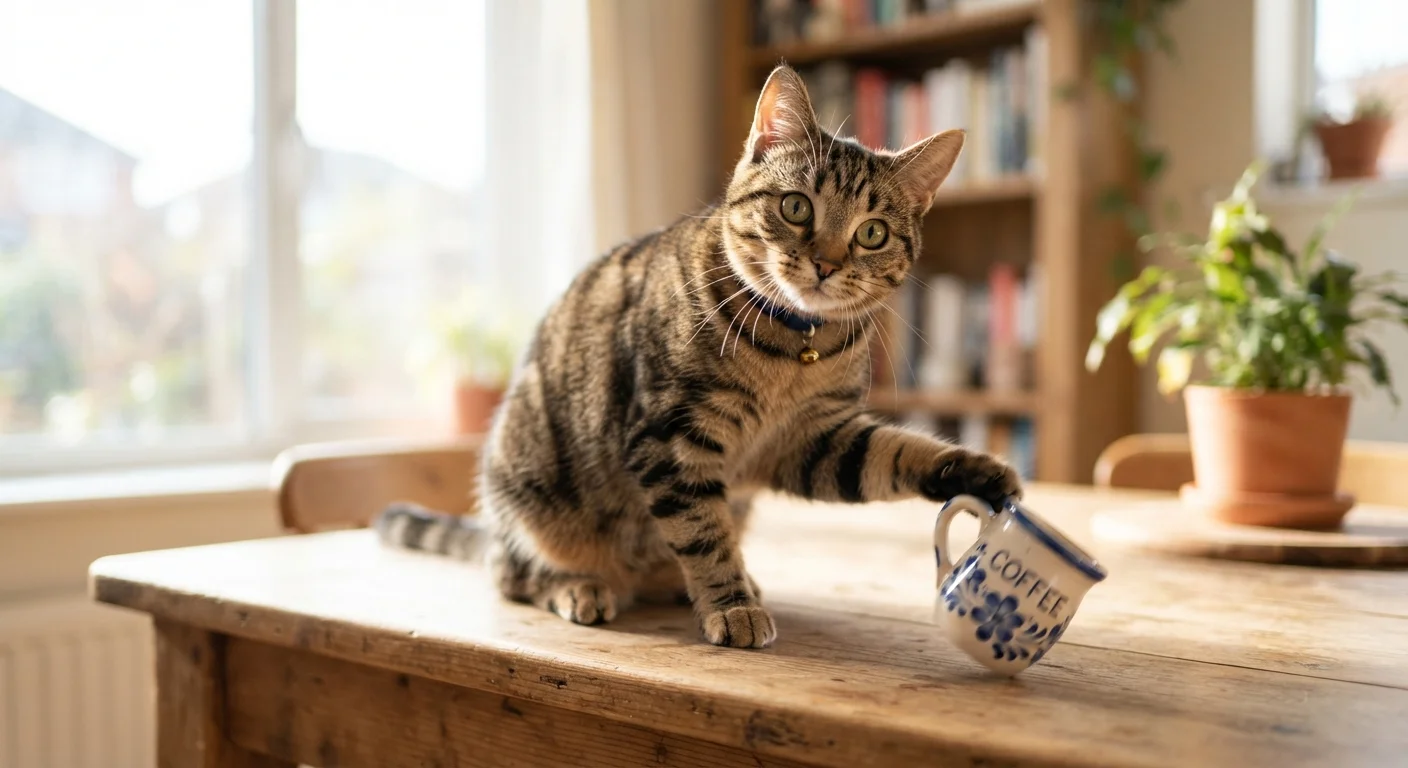
It's Not Random — It's Instinct
Watch a cat carefully before it pushes something off a shelf and you'll notice it isn't an accident. There's often a slow, deliberate paw extension, sometimes a test nudge, then the final shove. That sequence is rooted in predatory instinct.
Domestic cats are hardwired hunters. In the wild, a cat uses its paws to investigate and test objects before committing — tapping something to see if it moves, bites back, or runs away. A pen rolling off a desk, a phone skidding across a counter — these moving objects trigger the same neural circuits that fire when a cat is hunting small prey. The behavior isn't misbehavior; it's a hunter doing what hunters do.
Give Cats a Legal Outlet for Batting
Keep a small basket of cat-safe objects — lightweight balls, crinkle toys, or foil balls — on a low surface your cat can access freely. Redirecting the batting instinct to designated items reduces the appeal of your belongings.
This instinct also explains why cats are drawn to objects at the edge of surfaces. Items balanced at a boundary are easier to interact with — and their fall produces a satisfying response.
Attention-Seeking Is a Real Motive
Beyond instinct, cats are skilled social learners. If knocking a glass off the counter reliably makes a human appear, react, and engage — even if that reaction is frustration — the cat has discovered a very effective communication strategy.
Cats that lack sufficient interaction or playtime are especially likely to use this tactic. From the cat's perspective, a dramatic "no!" or a scramble to catch a falling object is a rewarding outcome. The behavior gets reinforced each time it produces a response.
The lesson for owners: a low-key, minimal reaction — calmly picking up the object without making eye contact or speaking — removes the social reward. Over time, a non-response makes the behavior less useful to the cat.
Curiosity and Environmental Exploration
Cats interact with their world primarily through their paws and mouths. Knocking an item off a table is also a form of investigation — testing gravity, watching how objects behave, and gathering sensory feedback. Kittens and younger cats do this most often, but the impulse persists into adulthood.
74%
Indoor cats showing object manipulation behavior
A survey of cat behavior studies cited by the Journal of Veterinary Behavior indicates the majority of indoor cats regularly interact with household objects using their paws.
2x
Higher activity in under-stimulated cats
Behavioral research consistently shows cats with fewer enrichment opportunities engage in attention-seeking and displacement behaviors at roughly twice the rate of enriched cats.
Objects with unpredictable movement are especially compelling. This is why pens, earrings, hair ties, and remote controls are frequent victims — their weight and shape make their motion interesting and variable.
Providing appropriate outlets for this curiosity — puzzle feeders, wand toys, foraging mats, or rotating a small selection of toys — can significantly reduce the frequency of table-clearing episodes.
Older Cats and Sudden Behavior Changes
If a cat that rarely knocked things over suddenly begins doing so frequently, especially in combination with increased vocalization or disorientation, it may be worth a veterinary evaluation. Cognitive dysfunction and hyperthyroidism can both increase restless or repetitive behaviors in senior cats. This is general information — a vet is the right person to assess any individual cat.
What You Can Do About It
Understanding the "why" makes solutions clearer. Since the behavior stems from instinct, boredom, and social learning, the most effective responses target all three.
- Increase structured play. Two 10–15 minute interactive play sessions per day help discharge predatory energy in a directed way.
- Secure or relocate tempting objects. Fragile or important items belong in closed cabinets, not on open surfaces where a curious paw can reach them.
- Reduce the social reward. Avoid animated reactions. Calm, consistent non-responses over time can extinguish attention-seeking versions of the behavior.
- Enrich the environment. Cat trees, window perches, and puzzle feeders give cats meaningful things to interact with throughout the day.
If the behavior is sudden, escalating, or accompanied by other changes — such as increased vocalization, appetite changes, or restlessness — it's worth a conversation with your veterinarian to rule out underlying health factors.
“Cats are not being vindictive when they knock things over. They're being cats — following instincts shaped over thousands of years. Understanding that changes how owners respond, and that change matters.”
— Dr. Karen Overall, Veterinary behaviorist and author of works on applied animal behavior
Frequently Asked Questions
That eye contact is intentional. Your cat has likely learned that this behavior gets your attention, so the pre-swipe glance is a deliberate check to see if you're watching. It's a form of social communication, not defiance.
It can be. Cats with insufficient mental and physical stimulation may knock objects off surfaces as a form of self-entertainment. Increasing playtime and providing puzzle feeders or interactive toys often reduces the frequency.
No — punishment is generally ineffective with cats and can damage your bond. Cats don't associate corrections with past actions. Redirection, enrichment, and removing tempting objects are more effective approaches.
Younger cats and highly active breeds tend to knock things over more often due to higher prey drive and energy levels. However, any cat can exhibit this behavior regardless of age or breed.
Rarely, but a sudden increase in restless or destructive behavior can signal anxiety, hyperthyroidism, or cognitive changes in older cats. If the behavior changes sharply or is accompanied by other symptoms, a veterinary checkup is a good idea.
The content on this site is for informational purposes only and is not a substitute for professional advice. Always consult a qualified professional for guidance specific to your situation.