

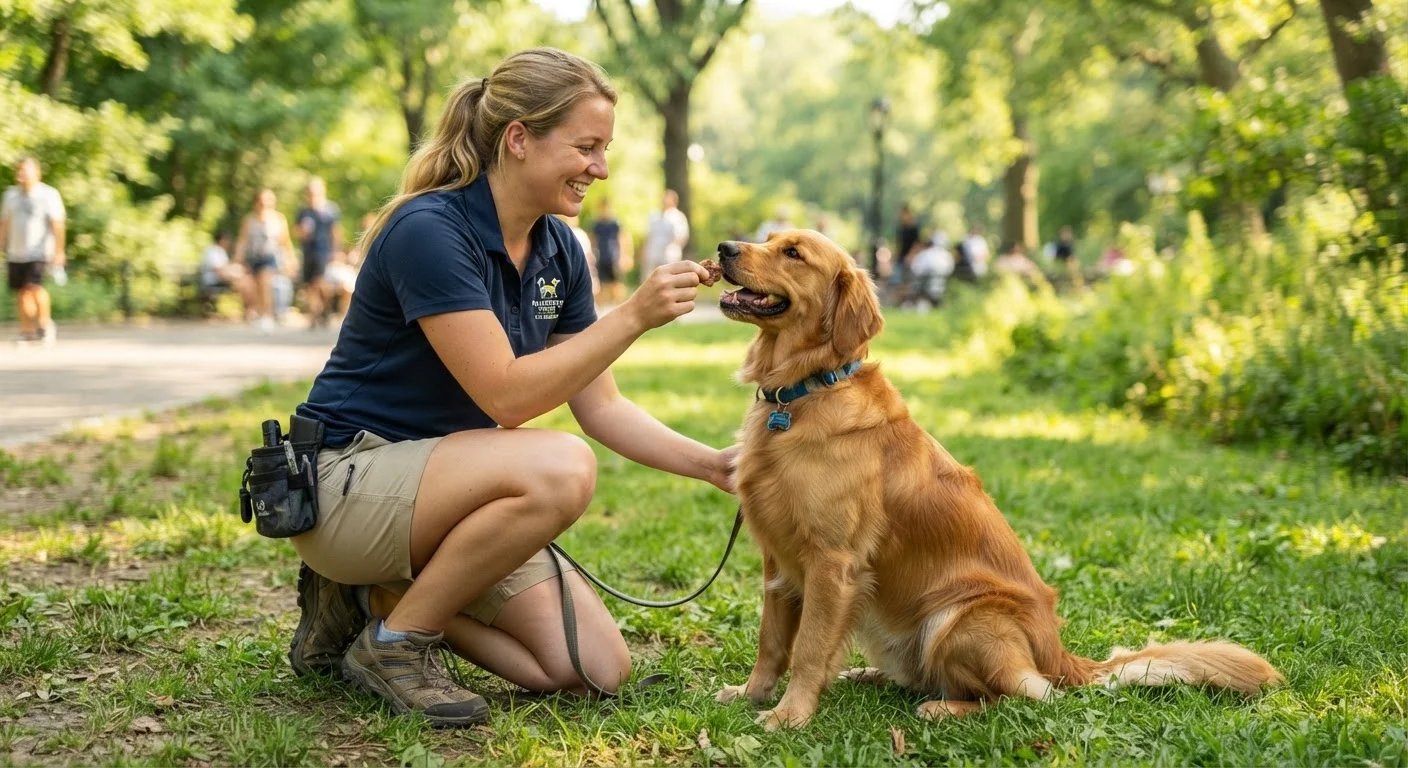
Our Verdict
The scientific evidence consistently favors positive reinforcement as both the more effective and more humane approach to dog training. Dominance-based methods carry measurable welfare risks and are built on an outdated theoretical foundation. For the vast majority of everyday training goals, reward-based techniques deliver durable results while strengthening the dog-owner relationship.
| Best for | Recommended |
|---|---|
| Owners training a puppy or newly adopted dog from scratch | Positive Reinforcement |
| Dogs showing fear, anxiety, or stress-related behaviors | Positive Reinforcement |
| Owners seeking fast initial compliance at the cost of long-term welfare | Neither — consult a certified behaviorist |
| Families with children wanting a safe, collaborative training approach | Positive Reinforcement |
Two Very Different Philosophies
Every dog training method sits somewhere on a spectrum defined by two competing ideas about how animals learn and how humans should relate to them. Positive reinforcement training rewards desired behaviors — using treats, praise, or play — so the dog is motivated to repeat them. Dominance-based training operates on the premise that dogs seek to assert social rank over their owners, and that handlers must establish themselves as the "alpha" through physical corrections, pressure, and control.
These aren't just stylistic differences. They reflect fundamentally different assumptions about dog cognition, motivation, and the nature of the human-dog relationship — assumptions that decades of animal behavior research have tested and, in many cases, substantially revised.
Where the Dominance Theory Went Wrong
The dominance model gained mainstream traction through mid-20th-century observations of captive wolves, which appeared to show rigid pack hierarchies enforced through aggression. The idea was then extended to domestic dogs, implying that dogs constantly vie for status and require a firm human "pack leader."
Animal behaviorists have since identified serious problems with this framework. Research on free-ranging wolves in natural environments shows that wolf packs are typically family units with cooperative rather than coercive social structures. More critically, dogs are not wolves — they diverged from a common ancestor roughly 15,000 years ago and have undergone substantial behavioral changes through domestication. Applying wolf-pack logic to domestic dogs is, in the words of many researchers, a category error.
Alpha Rolls and Scruff Shakes Carry Real Risks
Physical dominance techniques — such as pinning a dog on its back (alpha roll) or grabbing it by the scruff — can trigger defensive aggression and cause injury to both dog and handler. Dogs subjected to these techniques frequently show signs of fear and anxiety that can persist long after the interaction. These methods are not recommended by any major veterinary or animal behavior organization.
Prominent organizations including the American Veterinary Society of Animal Behavior (AVSAB) have published position statements opposing the use of dominance theory to explain or modify pet dog behavior, citing both its scientific inaccuracies and its welfare implications.
What the Research Actually Shows
Multiple studies have examined the outcomes of different training approaches on dog behavior and welfare. Key findings include:
- Aversive methods increase stress indicators. Dogs trained with punishment-based tools — including choke chains, prong collars, and alpha rolls — show elevated cortisol levels, more stress-related behaviors (lip-licking, yawning, avoidance), and in some studies, higher rates of aggression toward both strangers and owners.
- Positive reinforcement produces reliable results. Research published in journals such as Applied Animal Behaviour Science consistently finds reward-based training to be at least as effective as aversive methods for teaching obedience commands, and often more durable over time.
- The method affects the relationship. Dogs trained with positive reinforcement tend to show stronger engagement with their owners and lower anxiety scores in behavioral assessments.
92%
Trainers favoring reward-based methods
A survey of certified professional dog trainers found the large majority primarily use positive reinforcement techniques in their practice.
2–3×
Increased aggression risk with punishment
Studies in Applied Animal Behaviour Science found dogs trained with aversive methods were significantly more likely to display aggression toward owners compared to those trained with reward-based approaches.
For practical everyday tasks like loose-leash walking, reward-based techniques give owners clear, repeatable steps. Our guide to loose-leash walking demonstrates how positive reinforcement is applied to one of the most common training challenges.
Comparing the Two Approaches
The table below summarizes the key differences across criteria that matter to everyday dog owners.
| Positive Reinforcement | Dominance-Based Training | |
|---|---|---|
| Theoretical foundation | Learning theory (operant & classical conditioning) | Outdated wolf-pack hierarchy model |
| Scientific support | Strongly supported by peer-reviewed research | Largely discredited by animal behavior science |
| Dog welfare outcomes | Lower stress; improved wellbeing indicators | Elevated cortisol; increased fear and aggression risk |
| Training effectiveness | Reliable, durable behavior change | May produce compliance; behavior often fear-driven |
| Human-dog bond | Strengthens trust and engagement | Can damage trust and increase avoidance behaviors |
| Professional endorsement | Recommended by AVSAB, AVMA, and CCPDT | Opposed by major veterinary and behavior organizations |
Practical Takeaways for Dog Owners
Understanding the evidence is useful, but most owners want to know what to actually do. A few grounded principles:
- Start with rewards. Food treats, play, and praise are powerful motivators for dogs. Mark desired behavior precisely (a clicker or a short verbal cue like "yes" works well) and reward immediately.
- Set the dog up to succeed. Training sessions work best when kept short — 5 to 10 minutes — and conducted in low-distraction environments before gradually adding complexity.
- Address the root cause of problem behaviors. Many behaviors labeled as "dominance" (jumping, pulling, resource guarding) have clearer explanations in unmet exercise needs, anxiety, or simple lack of training history.
- Seek professional guidance when needed. If your dog shows aggression, severe fear, or behaviors that haven't responded to basic training, consult a certified professional — look for credentials from organizations such as the Certification Council for Professional Dog Trainers (CCPDT) or the International Association of Animal Behavior Consultants (IAABC).
Choosing a Trainer: What to Look For
When evaluating a trainer or training program, ask directly which tools and techniques they use. Trainers who rely on positive reinforcement will typically describe using treats, praise, and play — and will avoid recommending choke chains, prong collars, or physical corrections. Credentials from CCPDT or IAABC indicate the trainer has met recognized professional and ethical standards.
This article is for general informational purposes. For dogs with serious behavioral concerns, always consult a qualified veterinary behaviorist or certified animal behavior consultant.
The content on this site is for informational purposes only and is not a substitute for professional advice. Always consult a qualified professional for guidance specific to your situation.