

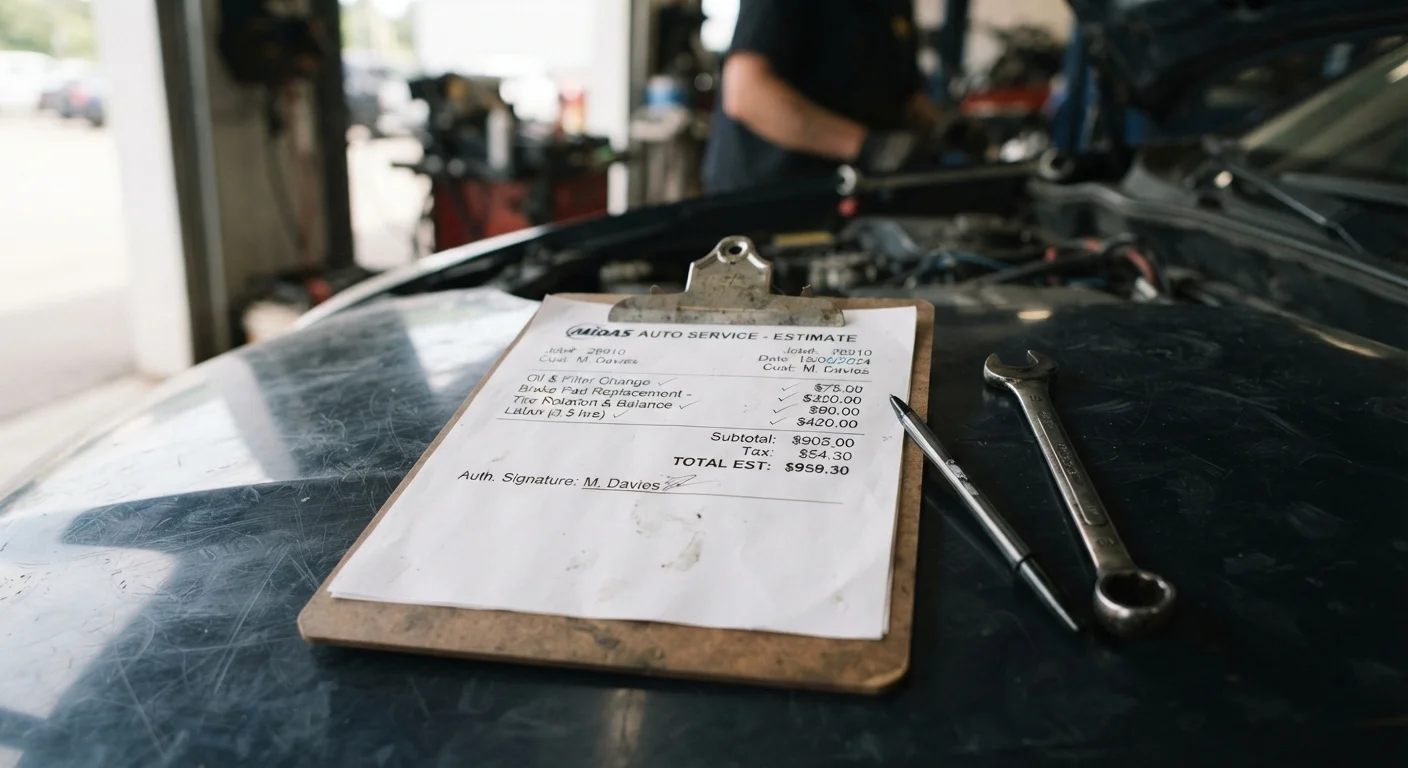
The Three Core Line Items Every Quote Should Show
Every honest service quote - whether from a dealership service department or an independent garage - should break down into three distinct categories: parts, labor, and fees. If a quote hands you only a single total number, ask the shop to itemize it before signing anything.
Parts lists the physical components being replaced, such as brake pads, an air filter, or a sensor. Each part should show a unit price and quantity. Note whether the quote specifies OEM (Original Equipment Manufacturer) or aftermarket parts, as this affects both cost and, in some cases, warranty coverage.
Labor reflects the technician's time. Most US shops use a flat-rate system: industry guides assign a standard number of hours to each job type, and that figure is multiplied by the shop's hourly rate. A brake pad replacement might be quoted at 1.5 labor hours even if the actual job takes 55 minutes. This system is standard and not inherently unfair - but it's useful to understand.
Fees is the category most drivers overlook. Common additions include a diagnostic fee, shop supplies, hazardous waste disposal (for fluids and batteries), and taxes. Ask what each line covers if it isn't clearly labeled.
~$150/hr
Average US auto repair shop labor rate
According to AAA, average US shop labor rates range roughly from $75 to over $150 per hour depending on region and shop type, with dealership rates typically higher.
2 in 3
Drivers who feel uncertain about repair invoices
A Consumer Reports survey found that a significant share of vehicle owners feel they lack enough information to confidently evaluate a repair estimate.
Decoding the Diagnostic Fee
A diagnostic fee - sometimes listed as a 'vehicle inspection fee' or 'evaluation charge' - is what the shop charges for the technician's time to identify the problem before any repair begins. Modern vehicles rely on electronic control modules, and reading fault codes accurately requires both software tools and expertise. The fee compensates for that work.
What to watch for: some shops advertise 'free diagnostics' but fold that cost into the repair price. Others charge separately and offer to credit the diagnostic fee toward the repair if you proceed. Neither approach is wrong, but you should ask which policy applies before authorizing the inspection.
Ask Before the Inspection Begins
Confirm the diagnostic fee amount and whether it will be credited toward any repair you authorize - before you hand over your keys. Getting this in writing, even as a note on the shop's work order, prevents misunderstandings when the invoice arrives.
If the shop cannot clearly explain what the diagnostic process involves or why it costs what it does, that is worth noting before you authorize anything further.
Red Flags and What You're Entitled to Ask
A trustworthy shop welcomes informed customers. Here are questions you are fully entitled to ask before approving any work:
- Can I have my old parts back? In most states, shops must return replaced parts on request. This lets you verify the part was actually changed.
- Is this repair urgent, or can it wait? Not all issues flagged on a vehicle inspection are emergencies. Understanding the urgency helps you prioritize spending.
- What happens if I don't fix this now? A mechanic should be able to explain the consequence of deferring a repair - whether it's a safety risk, accelerating damage, or simply an inconvenience.
- Is this estimate binding? Written estimates that you sign are generally binding up to the quoted amount; shops must contact you for approval before exceeding it.
Before committing to any major repair, it's worth understanding which jobs genuinely require a professional and which you might manage yourself. Similarly, if your car is still being financed or you're considering buying, the same careful document-reading mindset applies - see our guide on what to review before signing at a dealership.
Authorizing Work and What Comes Next
Once you approve a quote, get a copy of the signed authorization. When you pick up the vehicle, compare the final invoice line-by-line against the original estimate. If additional work was required - say, a corroded bolt that added time - the shop should have called you mid-job for approval. If extra charges appear that you weren't notified about, you have grounds to dispute them.
Keep your service records, including quotes and invoices, in a folder or a simple phone photo. A documented maintenance history supports resale value and helps future mechanics understand what's already been addressed. Approaching a repair quote the same way you'd approach any important document - carefully, with questions - keeps you in control of the process from start to finish.
Your Rights Vary by State
US auto repair consumer protections differ significantly from state to state. Some states cap how much a final bill can exceed a written estimate without customer approval; others have fewer formal requirements. It's worth looking up your state's Bureau of Automotive Repair or equivalent consumer protection agency so you know what protections apply to you.
This article is for general informational purposes only. Specific consumer protection rules for auto repair vary by state; consult your state's consumer affairs office or a licensed professional for guidance relevant to your situation.
Frequently Asked Questions
A diagnostic fee covers the technician's time and tools used to identify what is wrong with your vehicle. It is separate from any repair costs. Some shops will waive or credit the fee if you authorize the repair, but this varies - always ask upfront.
Labor refers to the cost of the technician's time to perform the repair. Most shops charge a flat-rate labor hour - a standardized time value from an industry guide - multiplied by their hourly shop rate. This means you pay for the job, not necessarily the exact minutes it took.
A shop should not exceed a written estimate without contacting you first for authorization. Many states have consumer protection laws requiring shops to notify customers if additional costs arise. Always get your quote in writing to protect yourself.
OEM (Original Equipment Manufacturer) parts are made by or for your vehicle's manufacturer, while aftermarket parts are produced by third-party companies. OEM parts generally cost more; aftermarket parts can be quality alternatives but vary by brand. Ask which type is being quoted.
For significant or unexpected repairs - particularly those over a few hundred dollars - getting a second estimate is reasonable and common practice. Shops understand this, and comparing quotes can help you verify both pricing and the diagnosis itself.
Shop supplies is a catch-all fee covering consumables like rags, fluids, and fasteners used during the repair. It is usually a small percentage of the labor cost. Ask for clarification if this charge seems disproportionately large.
The content on this site is for informational purposes only and is not a substitute for professional advice. Always consult a qualified professional for guidance specific to your situation.