

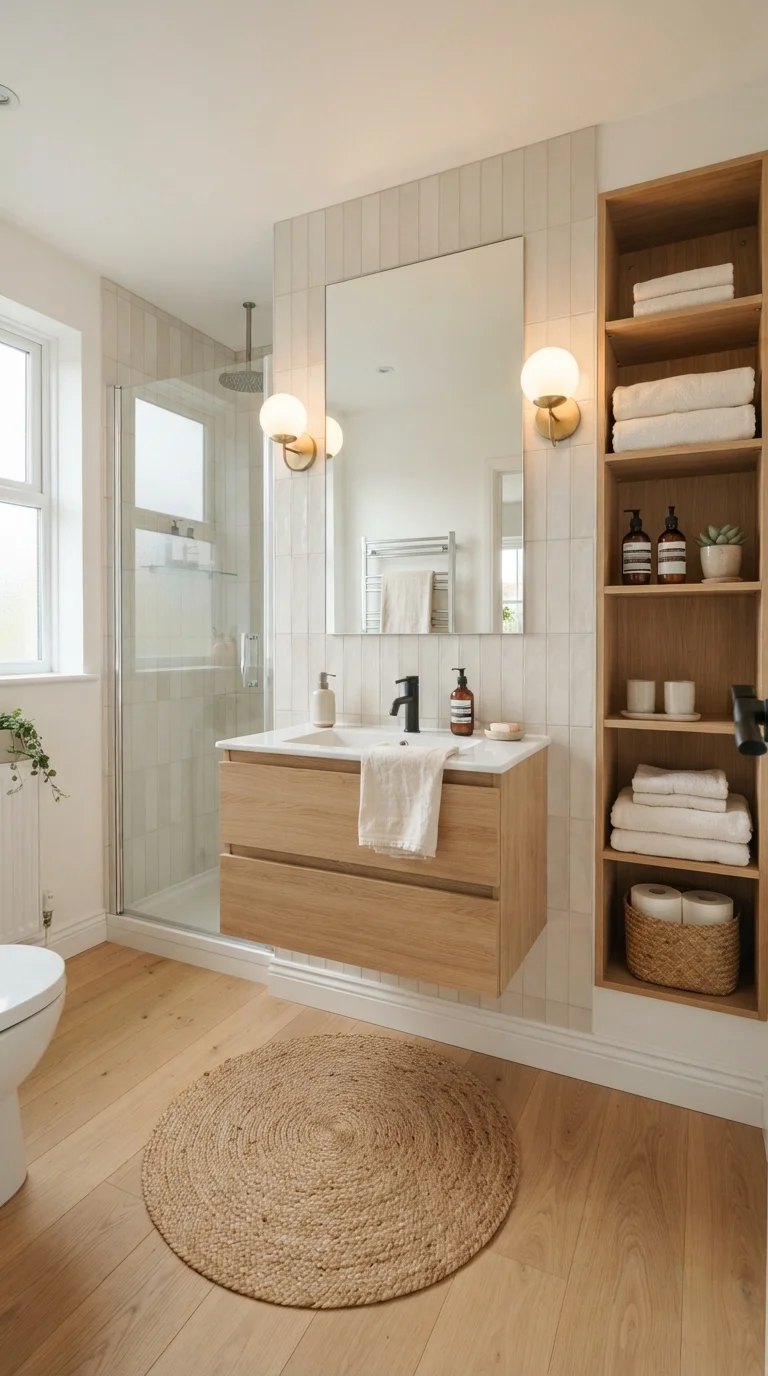
Why small changes make a large difference in bathrooms
Bathrooms present a unique design challenge: they're among the most-used rooms in any home, yet they're often the smallest. Because every surface is visible from one vantage point, even minor adjustments — a different bulb temperature, a repositioned mirror — register immediately. You don't need a gut renovation to meaningfully change how a bathroom feels. You need targeted changes that work with light, proportion, and visual flow.
The upgrades below are organized to minimize disruption. Some are afternoon projects; others may involve a professional for one step. All of them address real spatial and sensory factors rather than cosmetic trends. If you're also thinking about storage and organization principles that apply beyond the bathroom, the Home Organization hub covers room-by-room strategies worth exploring.
Reposition or upgrade your lighting
Most bathrooms rely on a single overhead fixture, which casts unflattering downward shadows and makes even a well-decorated room feel flat. Adding flanking sconces at roughly eye level — around 60 to 65 inches from the floor — on either side of the mirror distributes light evenly across the face and eliminates harsh shadows. This arrangement, sometimes called Hollywood or vanity lighting, is the standard used in professional makeup studios for good reason.
Color temperature matters just as much as position. Bulbs labeled 2700K–3000K produce a warm white light that reads as clean without being harsh. Anything cooler can make grout lines look dingy and cast a clinical tone over the whole room. If rewiring isn't practical, plug-in sconces with cord covers are a low-disruption alternative that requires no electrical permit in most jurisdictions — though always confirm local code requirements before any electrical work.
Flanking sconces at eye level eliminate shadows and transform how a bathroom feels.
Hang a larger or better-placed mirror
A mirror that's undersized for the wall it occupies is one of the most common missed opportunities in small bathrooms. A larger mirror — ideally spanning most of the vanity width — reflects more light back into the room and creates a genuine sense of depth. The visual effect is that the room appears to extend beyond the wall.
If you're replacing an existing mirror, consider a frameless design or a frame that matches your wall color closely: it will feel integrated rather than like a separate object. Frameless mirrors also tend to read as larger than they are. Make sure the mirror is mounted so the top edge sits a few inches above the tallest household member's eye line — mirrors mounted too low frequently make a room feel shorter.
A mirror spanning the full vanity width can make a small bathroom appear twice as deep.
Change tile orientation or grout color
If you're retiling — or choosing tile for a partial refresh like a tub surround — orientation matters more than most people realize. Horizontal tile patterns emphasize width, which suits some layouts, but in narrow bathrooms they can make the ceiling feel lower. Vertical stacking or a vertical subway pattern draws the eye upward, adding perceived height without changing a single structural dimension.
Grout color also plays a significant role. Dark grout on light tile creates a grid that breaks the visual surface into small units, which can feel busy in a confined space. Matching or near-matching grout allows the tile to read as a continuous surface, which feels calmer and more expansive. This principle applies to floor tile too: large-format floor tiles with minimal grout lines visually enlarge the floor plane.
Vertical tile orientation and matched grout color make walls read as taller and more continuous.
Replace hardware and fixtures strategically
Towel bars, toilet paper holders, cabinet pulls, and faucets are small individually, but when they share a finish they create a cohesive look that signals intention. Mismatched metals — say, a brushed nickel faucet next to a chrome towel ring — introduce visual noise that makes a room feel unfinished, even if everything is otherwise clean and organized.
Choosing a single metal finish and updating all hardware at once is one of the most cost-effective ways to elevate a bathroom's feel. It doesn't require plumbing or electrical work for most pieces. Faucet replacement is more involved and may require a plumber depending on your setup, so assess your comfort level honestly and consult a licensed professional if you're unsure. Hardware changes alone — pulls, towel bars, robe hooks — are well within reach for most DIYers.
Unified hardware finishes eliminate visual noise and make a bathroom look cohesively designed.
Clear surfaces and add concealed storage
Countertop clutter is one of the fastest ways to make a small bathroom feel cramped, regardless of how well it's designed. The concept of negative space — areas deliberately left clear — applies directly here: open counter surface signals room to breathe. If you're unfamiliar with terms like negative space or zone method as they apply to home organization, the Home Organization Glossary provides plain-language definitions worth bookmarking.
Recessed medicine cabinets, under-sink organizers, and narrow over-toilet shelving units all add functional storage without expanding the room's footprint. Decanting everyday items — cotton rounds, soap, a toothbrush — into a single, intentional tray keeps the counter usable while still feeling curated rather than chaotic. The goal isn't minimalism for its own sake; it's making every visible item earn its place.
Clearing counter surfaces and adding concealed storage makes a small bathroom feel calm and spacious.
Introduce a cohesive color strategy
Paint is among the least expensive ways to change how a room feels, and in a bathroom the effect is amplified because every surface is visible from one standing position. Light, muted tones — soft whites, warm greiges, pale sage — reflect more light and recede visually. Painting walls, ceiling, and trim in a single tone (or very close tones) removes the visual boundaries that make a small room feel boxed in.
That said, dark colors aren't off-limits in a small bathroom. A deep, rich tone applied consistently — walls, ceiling, and all — can create an intentionally intimate, spa-like quality. What tends to fail is contrast: a dark wall with bright white trim emphasizes every edge and corner, making dimensions feel more apparent rather than less. Whichever direction you choose, use a satin or semi-gloss finish for durability and moisture resistance.
A single-tone color strategy — light or dark applied consistently — removes visual boundaries in tight spaces.
Putting it all together
You don't need to tackle every upgrade at once. Start with lighting — it influences how every other element in the room reads — then address the mirror, and work outward from there. Hardware and color changes can follow once the foundational elements are set.
Test paint colors under bathroom lighting
Always apply paint swatches and observe them under your bathroom's actual lighting conditions — not in the store or in another room. Bathroom lighting, especially warm incandescent or LED equivalents, shifts color noticeably. Let swatches dry fully before deciding, as wet paint reads several shades darker than the cured finish.
For households where the bathroom is shared and different people have different preferences, approaching changes collaboratively — and leaving some flexibility in storage systems — helps the space work for everyone. The shared spaces organization guide offers practical frameworks for navigating those conversations.
When to call a licensed professional
Some bathroom upgrades — including any work involving electrical wiring, plumbing supply lines, or structural changes — typically require permits and licensed tradespeople in most US jurisdictions. Always check your local building department's requirements before starting a project. Tasks like painting, hardware swaps, and mirror hanging generally don't require permits, but when in doubt, verify with your local authority having jurisdiction (AHJ).
Small bathrooms reward deliberate choices. Each element you refine compounds with the others, and the cumulative effect is a space that feels considered, functional, and genuinely comfortable — regardless of its square footage.
The content on this site is for informational purposes only and is not a substitute for professional advice. Always consult a qualified professional for guidance specific to your situation.