

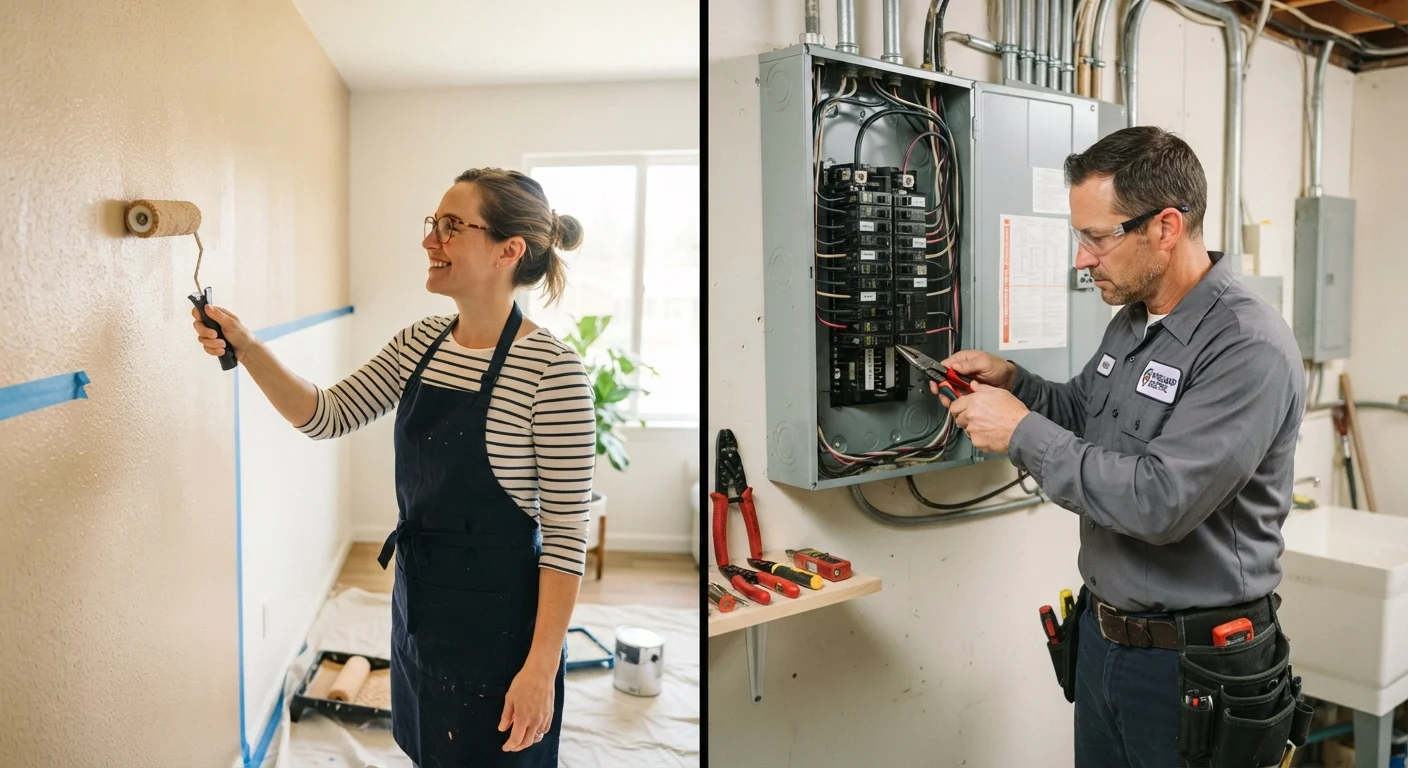
Why the DIY vs. Hire Decision Really Matters
Taking on home repairs yourself can feel satisfying and economical — and often it genuinely is. But some projects carry real risks: injury, property damage, failed inspections, or voided insurance coverage. Understanding where the line sits isn't about doubting your skills; it's about making a clear-eyed assessment before you pick up a tool.
The key factors to weigh are safety risk, legal requirements, and technical complexity. A task that scores high on any one of those three usually warrants a licensed tradesperson. Our guide to DIY myths explores how well-intentioned shortcuts can lead to bigger repair bills — worth reading alongside this one.
Licensing Requirements Vary by State
What requires a licensed contractor in one U.S. state may be permitted as DIY work in another. For example, some states allow homeowners to do their own electrical work in a primary residence with an inspection, while others prohibit it entirely. Always check your local building authority's rules before starting any project that could fall into a grey area.
Projects That Are Generally Safe to DIY
Many everyday home maintenance tasks fall well within the ability of a careful, informed homeowner. These are typically cosmetic, low-voltage, or reversible repairs that don't touch structural systems or regulated utilities.
Paint interior and exterior surfaces yourself when no structural prep work is involved.
Painting is low-risk, requires no permits, and is highly forgiving — mistakes can simply be repainted. It's one of the highest-value DIY tasks in terms of cost savings relative to effort.
Handle minor drywall patching for holes under roughly six inches in diameter.
Small patches don't affect structural integrity and require no permits. With the right mesh patch kit and joint compound, results can be nearly invisible after sanding and painting.
Replace fixtures like faucets, showerheads, and light switches yourself — with caution.
Swapping like-for-like fixtures generally doesn't require permits and involves manageable risk when the water or power is properly shut off beforehand. Attempting more complex re-routing, however, crosses into licensed territory.
Hire a licensed electrician for any work inside your electrical panel or involving new circuits.
Incorrect wiring is a leading cause of residential fires. Licensed electricians are trained to work safely on live systems and are required by code in virtually every U.S. jurisdiction for panel-level work.
Always use a licensed plumber or gas fitter for gas line connections or modifications.
Gas leaks are invisible and can cause explosions or carbon monoxide poisoning. Even small errors in fittings can have life-threatening consequences, and most jurisdictions require licensed work with inspection.
Consult a structural engineer before removing any interior wall.
Load-bearing walls support the weight of the structure above them. Removing one without proper assessment and temporary shoring can cause the ceiling or floor above to sag or collapse.
For a full checklist of routine maintenance tasks organized by season, see our seasonal home maintenance guide.
Work That Requires a Licensed Tradesperson
Certain categories of home work are regulated precisely because mistakes can be catastrophic. In most U.S. jurisdictions, the following types of projects require a licensed contractor and, in many cases, a permit and inspection.
~51,000
Home electrical fires per year in the U.S.
According to the U.S. Fire Administration, electrical fires cause thousands of injuries and billions in property damage annually — many linked to improper wiring.
~$4,000+
Typical cost to correct unpermitted work
Industry estimates suggest homeowners commonly spend thousands correcting unpermitted renovations discovered during real estate transactions or insurance claims.
Electrical panel work and new circuit installation must be handled by a licensed electrician. Even replacing an outlet on an older wiring system can be hazardous without proper diagnostic knowledge. Similarly, any work involving gas lines — including installing or relocating appliances — requires a licensed plumber or gas fitter. A leak that goes undetected can be fatal.
Structural modifications, such as removing walls (especially load-bearing ones), adding dormers, or underpinning a foundation, must involve a qualified structural engineer and licensed contractor. Guessing incorrectly about whether a wall is load-bearing can cause a partial collapse.
Permits are a related consideration. Our article on which home projects require official approval explains when permits are legally required and what happens if you skip them — including impacts on insurance and resale.
“The permit process exists to protect homeowners, not inconvenience them. An inspection gives you documented proof that the work was done correctly — and that matters enormously when you sell the home or file an insurance claim.”
— National Association of Home Inspectors, Professional home inspection trade organization
Quick Wins: Actions You Can Take Today
Before starting any project, run through these practical steps to make a confident, informed decision.
For patch-and-paint jobs that genuinely are DIY-friendly, our drywall repair guide walks through the right technique for every hole size.
This article is for general informational and educational purposes only. Requirements for permits, licensed trades, and safety codes vary by U.S. state and local jurisdiction. Always verify applicable rules with your local building authority before beginning any home project, and consult a qualified licensed professional for work involving electrical, gas, plumbing, or structural systems.
The content on this site is for informational purposes only and is not a substitute for professional advice. Always consult a qualified professional for guidance specific to your situation.