

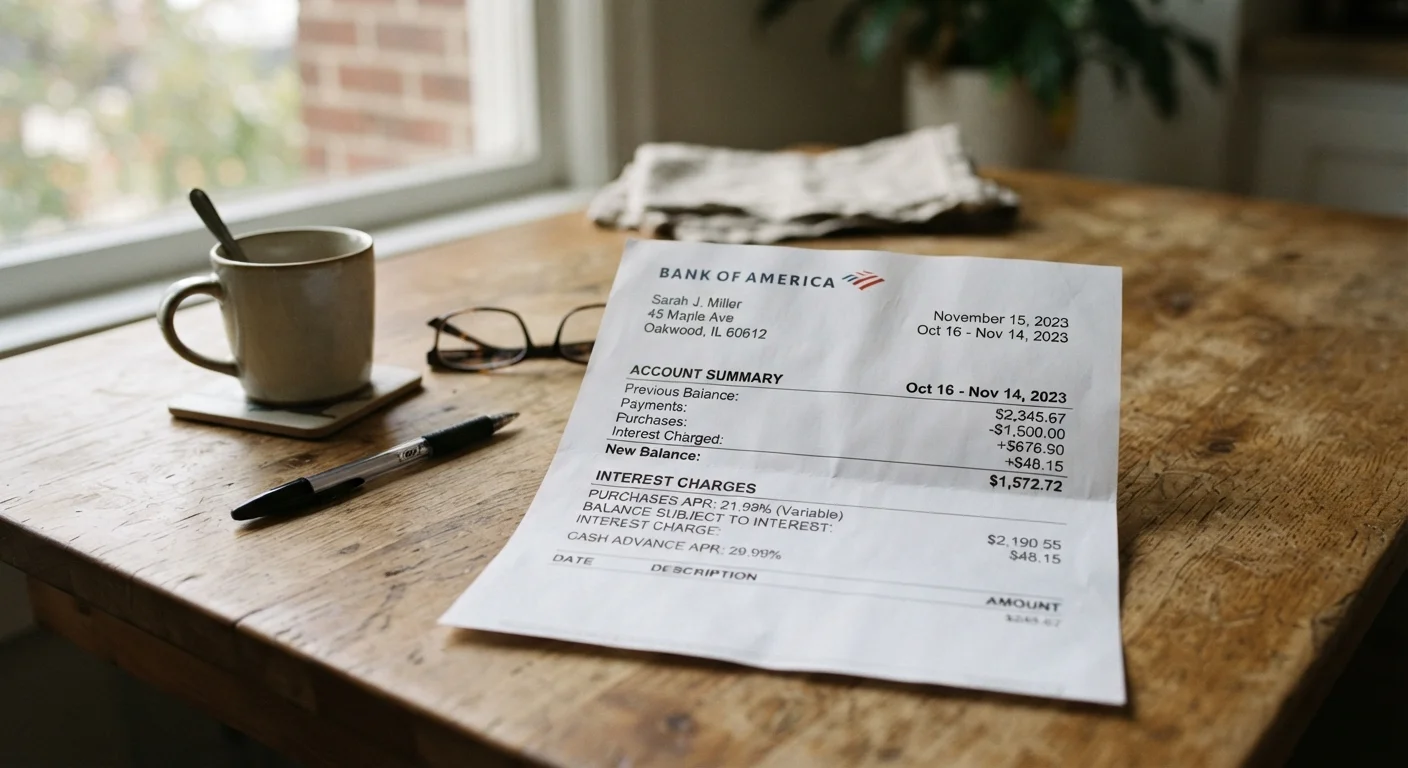
How APR Is Applied to Your Balance
The word annual in APR can be misleading. Your card issuer isn't waiting until the end of the year to calculate interest — the charge appears on every monthly statement that carries an unpaid balance.
Here's the mechanics: the issuer divides your APR by 365 to produce a daily periodic rate. That rate is multiplied by your average daily balance — a running average of what you owed each day during the billing cycle — and then multiplied by the number of days in the cycle.
As a simple example: a 24% APR works out to a daily rate of roughly 0.066%. On an average daily balance of $1,000 over a 30-day cycle, the interest charge would be about $19.73. It doesn't sound dramatic until a balance compounds over several months.
~20–22%
Average credit card APR in the US
The Federal Reserve tracks average credit card interest rates and has reported rates in this range in recent years, varying by card type and creditworthiness.
29.99%
Common penalty APR ceiling
Many card agreements list a penalty APR of up to 29.99%, which can be applied after missed payments per card terms.
21 days
Minimum grace period required by law
The Credit CARD Act of 2009 requires issuers that offer a grace period to provide at least 21 days between statement close and the payment due date.
For a broader look at how APR compares to related terms like APY, see this plain-language reference on interest rate terms.
The Grace Period: Why Paying in Full Matters
Most credit cards include a grace period — a window between your statement closing date and your payment due date, which federal law sets at a minimum of 21 days for cards that offer one. If you pay your entire statement balance before the due date, the issuer does not charge interest on those purchases.
This means a 24% APR costs you exactly $0 in interest if you consistently pay in full. The APR only becomes a real expense when a balance rolls over to the next cycle.
Set Up Autopay for the Full Balance
Automating your full statement balance payment each month is one of the most reliable ways to avoid interest charges entirely, regardless of your card's APR. Even a single missed full payment can restart interest accrual and, in some cases, trigger a higher penalty rate.
One important nuance: once you carry a balance, many issuers suspend the grace period on new purchases as well. That means new charges begin accruing interest immediately — not just the leftover balance — until the account is paid back to zero.
Multiple APRs on a Single Card
Your credit card agreement likely lists several different APRs, not just one. The most common are:
- Purchase APR: The standard rate applied to everyday spending.
- Cash advance APR: Almost always higher than the purchase rate, and it typically starts accruing from the day you take the advance — no grace period.
- Balance transfer APR: May be promotional (sometimes 0% for a set period) or higher than the standard rate, depending on the offer.
- Penalty APR: A higher rate triggered by missed payments or other violations of card terms.
How Payments Are Applied to Multiple Balances
If your card has balances at different APRs — for example, a promotional balance transfer rate and a standard purchase rate — federal law requires that any payment above the minimum be applied to the highest-rate balance first. This rule has been in effect since the Credit CARD Act of 2009 and is designed to protect cardholders from being trapped paying off low-rate balances while high-rate debt compounds.
When you make a payment above the minimum, federal rules require card issuers to apply the excess to the balance with the highest APR first. This is a consumer protection established by the Credit CARD Act of 2009.
APR vs. the True Cost of Carrying a Balance
Because credit card interest compounds daily, the effective annual rate you actually pay is slightly higher than the stated APR. A card with a 20% APR, with daily compounding, has an effective annual rate closer to 22.1%. The gap is modest but real.
APR also doesn't include fees — annual fees, late payment fees, or foreign transaction fees add to the cost of card ownership without appearing in the APR figure. When comparing cards, consider the full picture of fees alongside the stated rate.
Understanding your APR is one piece of a larger credit puzzle. For context on how your payment behavior and credit utilization connect to your credit score, see Credit Scores Decoded.
This article is for general informational purposes only and does not constitute personalized financial or legal advice. For guidance specific to your situation, consider speaking with a licensed financial professional.
Frequently Asked Questions
APR is the annual interest rate a card issuer charges on balances you don't pay off each month. It stands for Annual Percentage Rate. The higher the APR, the more interest accrues on any unpaid balance.
No. Credit cards include a grace period — typically at least 21 days — between the statement closing date and your payment due date. If you pay the full statement balance before the due date, no interest is charged regardless of your APR.
Card issuers divide your APR by 365 to get a daily periodic rate. That rate is multiplied by your average daily balance and the number of days in the billing cycle to produce the interest charge on your statement.
Cards often carry separate APRs for purchases, cash advances, and balance transfers. Cash advance APRs are frequently higher and often start accruing immediately with no grace period.
On a mortgage or personal loan, APR is broader than the interest rate because it folds in certain fees. On a credit card, the APR and the interest rate are generally the same number — fees are listed separately.
A penalty APR is a higher rate a card issuer can apply if you miss payments or violate other card terms. Federal rules require issuers to review the account after six months of on-time payments before any reduction can be considered.
The content on this site is for informational purposes only and is not a substitute for professional advice. Always consult a qualified professional for guidance specific to your situation.