

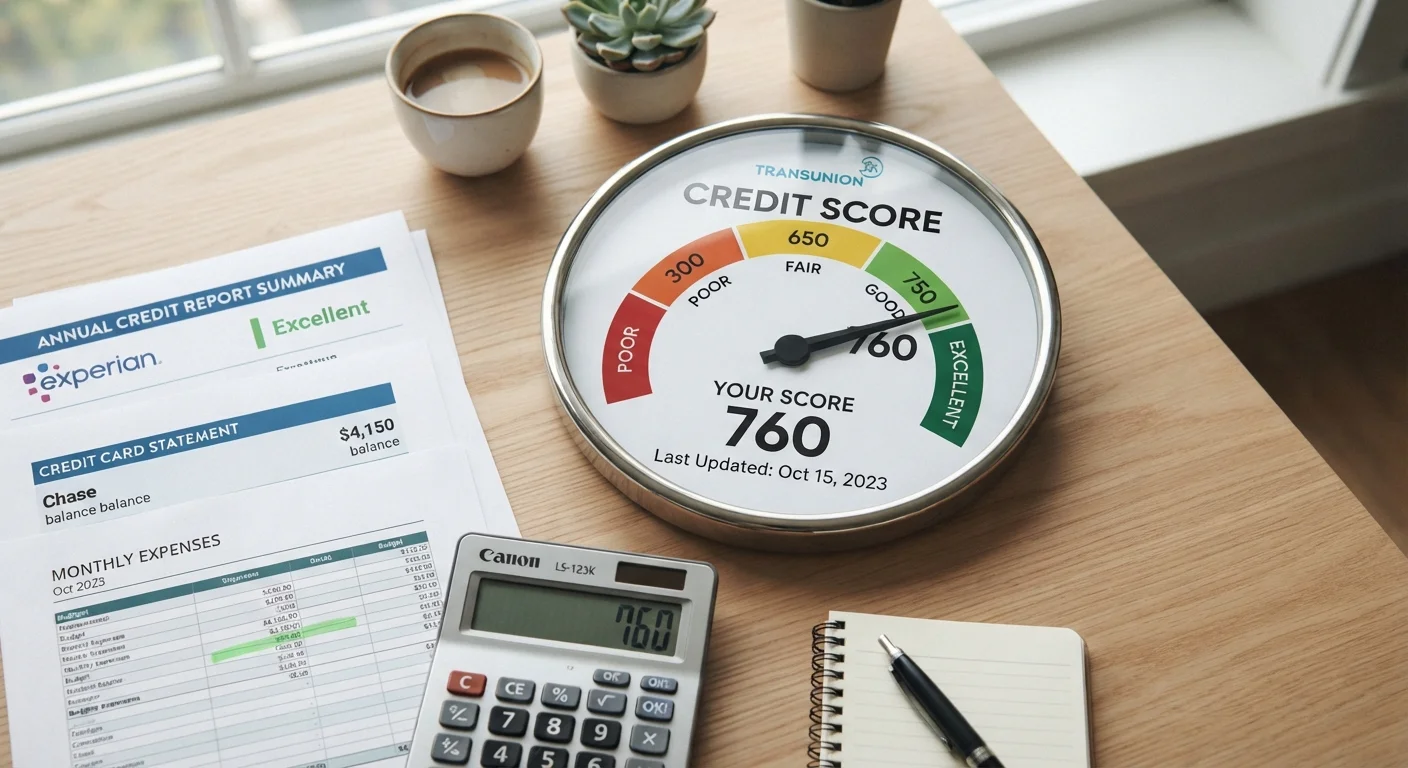
What a Credit Score Actually Is
A credit score isn't a grade given by a bank or a government agency — it's the output of a statistical model. That model takes the information in your credit report and runs it through a formula designed to predict how likely you are to miss a payment by 90 days or more in the next 24 months.
The most widely used model in the US is the FICO Score, developed by Fair Isaac Corporation. VantageScore, a competing model created jointly by the three major credit bureaus, is also used by many lenders. Both produce scores on a 300–850 scale, but the formulas differ, which is part of why your score can vary depending on which model a lender uses.
It's worth understanding that your credit score and your credit report are two different things. Your report is the raw data — account histories, balances, payment records. Your score is a number derived from that data. Credit reports and credit scores are not the same thing, and knowing the distinction helps you understand what actually drives the number.
300–850
Standard credit score range in the US
Both FICO and VantageScore use this range; higher scores indicate lower predicted credit risk.
35%
Weight of payment history in FICO scoring
According to FICO's published framework, on-time payment history is the single largest factor in a standard FICO Score.
3
Major US credit bureaus that generate separate reports
Equifax, Experian, and TransUnion each maintain independent files, which is why scores can vary between them.
What Goes Into the Calculation
Scoring models weigh several categories of credit behavior, though the exact weights differ by model and version. Under the standard FICO framework, five broad factors contribute to your score:
- Payment history — whether you've paid accounts on time — carries the most weight, roughly 35%.
- Amounts owed — particularly your credit utilization ratio, meaning how much of your available revolving credit you're using — accounts for about 30%. Credit utilization is one of the most reactive scoring factors.
- Length of credit history — how long your accounts have been open — contributes around 15%.
- Credit mix — having a variety of account types like credit cards, installment loans, and mortgages — is about 10%.
- New credit — recent applications and new accounts — makes up the remaining 10%.
For a closer look at each factor and how they interact, see The Five Factors Behind Your Credit Score.
You Can Access Your Credit Reports for Free
US consumers are entitled to a free credit report from each of the three major bureaus once every 12 months through AnnualCreditReport.com, the official site authorized by federal law. Reviewing your reports regularly helps you catch errors or unfamiliar accounts that could be dragging down your score. Disputing inaccurate information is your right under the Fair Credit Reporting Act.
Why You Have More Than One Score
Most people are surprised to learn they don't have a single credit score — they have many. The three major bureaus (Equifax, Experian, and TransUnion) each maintain separate files on you, and not every creditor reports to all three. Apply the same model to slightly different underlying data and you'll get different results.
Beyond the bureau differences, there are also multiple scoring models in active use. FICO alone has dozens of versions, including industry-specific scores for auto lenders and mortgage lenders that weigh factors differently. The score you see through a free monitoring service may be a different model version than what a specific lender pulls when you apply for credit.
Learn why your score differs between bureaus and what that means when you're preparing for a major application.
“Credit scores are a tool — they compress complex credit history into a single number that a lender can act on quickly. But they're a snapshot, not a permanent label.”
— Consumer Financial Protection Bureau, US federal agency overseeing consumer financial products and services
How Lenders Actually Use Your Score
A credit score is one input among several in a lending decision. Lenders also consider your income, employment status, existing debt load, and the type of loan you're applying for. Your debt-to-income ratio — the share of your monthly gross income that goes toward debt payments — is another key metric lenders commonly review.
Each lender sets its own minimum score requirements and risk thresholds, which means the same score can lead to different outcomes at different institutions. A score that qualifies you comfortably at one lender might land you in a higher-rate tier or result in a denial at another. This is especially relevant in auto lending — if you're preparing to finance a vehicle, understanding how credit scores affect the car-buying process can help you set realistic expectations before you walk into a dealership.
Credit Scores Don't Factor in Income
Your income, savings, and net worth do not appear in standard credit scoring models. A high earner with a history of missed payments can have a lower score than someone with a modest income who always pays on time. Credit scores measure borrowing behavior, not financial wealth.
Frequently Asked Questions
FICO scores of 670 and above are generally considered 'good,' while 740 and above are typically viewed as 'very good' or 'exceptional.' The exact thresholds vary by lender and loan type. A score in a higher range generally improves your chances of approval and more favorable loan terms.
Your score can change whenever the underlying data on your credit report is updated, which creditors typically do once a month. A single new piece of information — like a late payment or a new account — can shift your score noticeably. Some factors, like credit utilization, can move your score relatively quickly.
No. Checking your own score — through a free service, your bank, or AnnualCreditReport.com — is a 'soft inquiry' and has no effect on your score. Only 'hard inquiries,' triggered when a lender checks your credit as part of an application, can have a small, temporary impact.
Each of the three major credit bureaus — Equifax, Experian, and TransUnion — may hold slightly different data because not all lenders report to all three. The same scoring model applied to slightly different data will produce different results. This is normal and expected.
Yes. A credit score can be built from any type of credit account reported to the bureaus, including auto loans, student loans, or personal loans. You don't need a credit card specifically, but you do need at least one account with enough history for a score to be generated.
The content on this site is for informational purposes only and is not a substitute for professional advice. Always consult a qualified professional for guidance specific to your situation.