

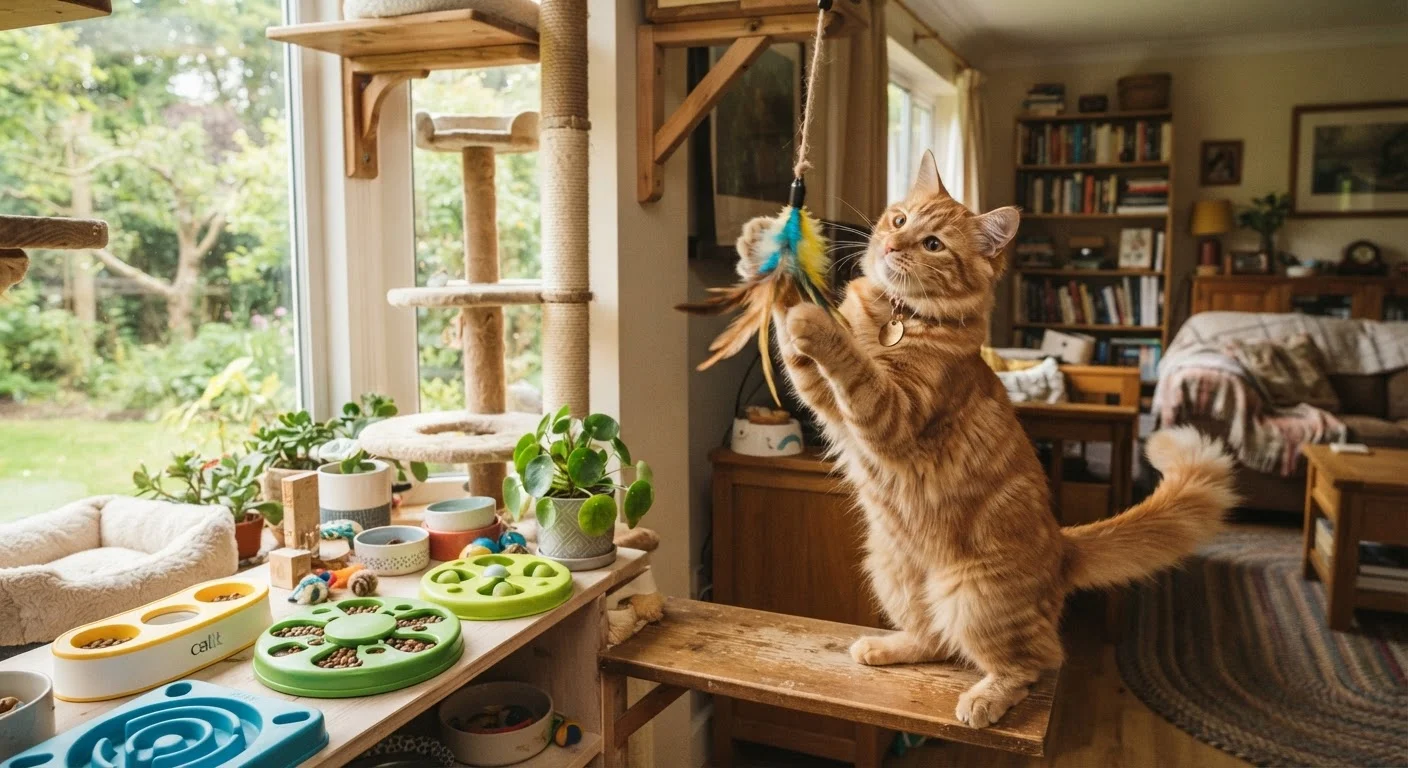
Why Enrichment Matters More Than Most Owners Realize
Indoor cats live longer, safer lives on average — but that protected environment comes with a trade-off. Without deliberate mental and physical stimulation, cats can develop chronic boredom, which veterinary behaviorists link to stress-related behaviors like over-grooming, destructive scratching, and litter box avoidance. For a deeper look at what indoor living means for feline wellbeing, see our indoor vs. outdoor cat research overview.
The good news: enrichment doesn't require a large home, a big budget, or hours of daily effort. It requires variety, rotation, and a little knowledge of how cats actually think. Cats are hardwired predators who need opportunities to stalk, pounce, sniff, and problem-solve — even domesticated ones living on the third floor of an apartment building. The enrichment ideas below are grounded in feline behavioral science and adaptable to most living situations.
Enrichment needs vary by age and health
Kittens and young adult cats typically need more stimulation and more frequent rotation than older cats. Senior cats may have joint limitations that rule out climbing or jumping activities. If your cat shows sudden disinterest in activities they previously enjoyed, a veterinary check-up is worthwhile — reduced engagement can sometimes signal pain or illness rather than boredom.
Enrichment Ideas That Actually Hold a Cat's Attention
Puzzle feeders and food-dispensing toys
Puzzle feeders replace the bowl with a problem to solve. Rather than eating in seconds, cats spend several minutes working for their food — mimicking the cognitive effort of a hunt. This is especially useful for fast eaters and cats who seem restless after meals.
Start with simple designs that release kibble when batted, then increase difficulty gradually. Even a muffin tin with kibble hidden under tennis balls counts. If your cat eats wet food, lick mats offer a similar slow-feeding benefit. Puzzle feeding pairs naturally with thinking about what goes into that food — our guide to reading cat food labels can help you evaluate what you're putting in the feeder.
Puzzle feeders turn mealtime into a mental workout that mirrors the effort of a real hunt.
Scent trails and herb exploration
Cats experience the world largely through smell — they have roughly 200 million odor receptors compared to a human's 5 million. Scent-based enrichment taps into this directly. Rub a small amount of dried catnip, silver vine, or valerian root onto a cardboard scratcher or fabric toy and observe your cat's response. Not all cats react to catnip (sensitivity is genetic, affecting roughly 50–70% of cats), but silver vine tends to elicit responses in cats who don't.
You can also place used paper bags or cardboard boxes from outside for your cat to investigate — the outdoor scents they carry are genuinely stimulating. Rotate the scents every few days to maintain novelty.
Scent enrichment costs almost nothing and engages a cat's most powerful sense directly.
Window perches and bird feeders outside
Visual stimulation from a reliable perch is one of the simplest, most consistently effective enrichment tools available. Cats are drawn to movement — birds, squirrels, passing pedestrians — and a comfortable window seat with an unobstructed view functions as what animal behaviorists sometimes call "cat TV."
To enhance the experience, place a bird feeder or shallow water dish within view of a favored window. This creates reliable, predictable activity for your cat to observe without requiring any effort from you once it's set up. A window perch with a padded surface and a suction-cup mount works in apartments where no sill space exists.
A window perch overlooking a bird feeder gives cats hours of low-effort, high-engagement stimulation.
Interactive wand toys used intentionally
Wand toys with feathers, ribbon, or fabric attachments work best when used with intention rather than waved aimlessly. Mimic realistic prey movement: drag the toy slowly, pause, let it twitch, then dart away. Cats are triggered by the full predatory sequence — stalk, chase, pounce — so allow yours to complete that cycle, including a satisfying "catch."
End sessions with a small treat or a portion of their meal, which closes the hunt sequence and prevents frustration. Interactive play also doubles as bonding time, which matters for cats who live alone and have limited social interaction during the day.
Mimicking real prey movement — pause, twitch, dart — unlocks a cat's full predatory sequence.
Vertical space and climbing structure
Cats feel safer when they can survey their environment from height. Adding vertical real estate — cat trees, wall-mounted shelves, or even sturdy bookcases arranged for climbing — reduces stress and increases a cat's overall activity level throughout the day. In multi-cat households, vertical space is especially important because it expands territory without requiring more floor area.
Arrange climbing paths so cats can travel across a room without touching the floor — this "cat highway" concept encourages spontaneous movement and keeps sedentary cats more active over time. Scratching posts integrated into vertical structures also fulfill a separate behavioral need, protecting your furniture in the process.
Vertical space expands a cat's perceived territory and encourages natural climbing behavior throughout the day.
Cardboard boxes and paper bag tunnels
Free and immediately available, cardboard boxes tap into a cat's instinct to hide, ambush, and claim territory. A single box left on the floor will often be investigated and adopted within minutes. Cut entry holes in opposite sides to create a tunnel effect, or stack boxes to build a simple multi-level structure.
Crinkled paper inside the box adds an auditory element. Paper grocery bags (with handles removed for safety) make excellent exploratory tunnels. Rotate these every week or two — once a box loses its novelty, recycle it and introduce a new one.
A cardboard box with a few cut holes costs nothing and satisfies a cat's drive to hide and ambush.
Observe before you invest
Before buying any enrichment product, watch your cat for a few days. Does she stalk and pounce, or does she prefer sniffing and batting? Is she motivated by food, movement, or texture? Matching enrichment type to your individual cat's instincts will yield far better results than following a generic shopping list.
Building a Routine That Sticks
The most common reason enrichment stops working is repetition without variation. Cats are quick to habituate — the toy that captivated them on Monday may be completely ignored by Thursday. A simple rotation system, cycling toys and activities in and out every few days, goes a long way. Keep a small "reserve" of items stored away so each reintroduction feels genuinely novel.
Pair enrichment sessions with your cat's natural activity peaks, typically dawn and dusk, when feline predatory instincts are naturally heightened. Five to ten focused minutes of interactive play during these windows can be more effective than leaving toys out passively all day. If you're still getting settled with a new cat, our guide for first-time cat owners covers how to layer in enrichment as part of an early routine.
The content on this site is for informational purposes only and is not a substitute for professional advice. Always consult a qualified professional for guidance specific to your situation.