

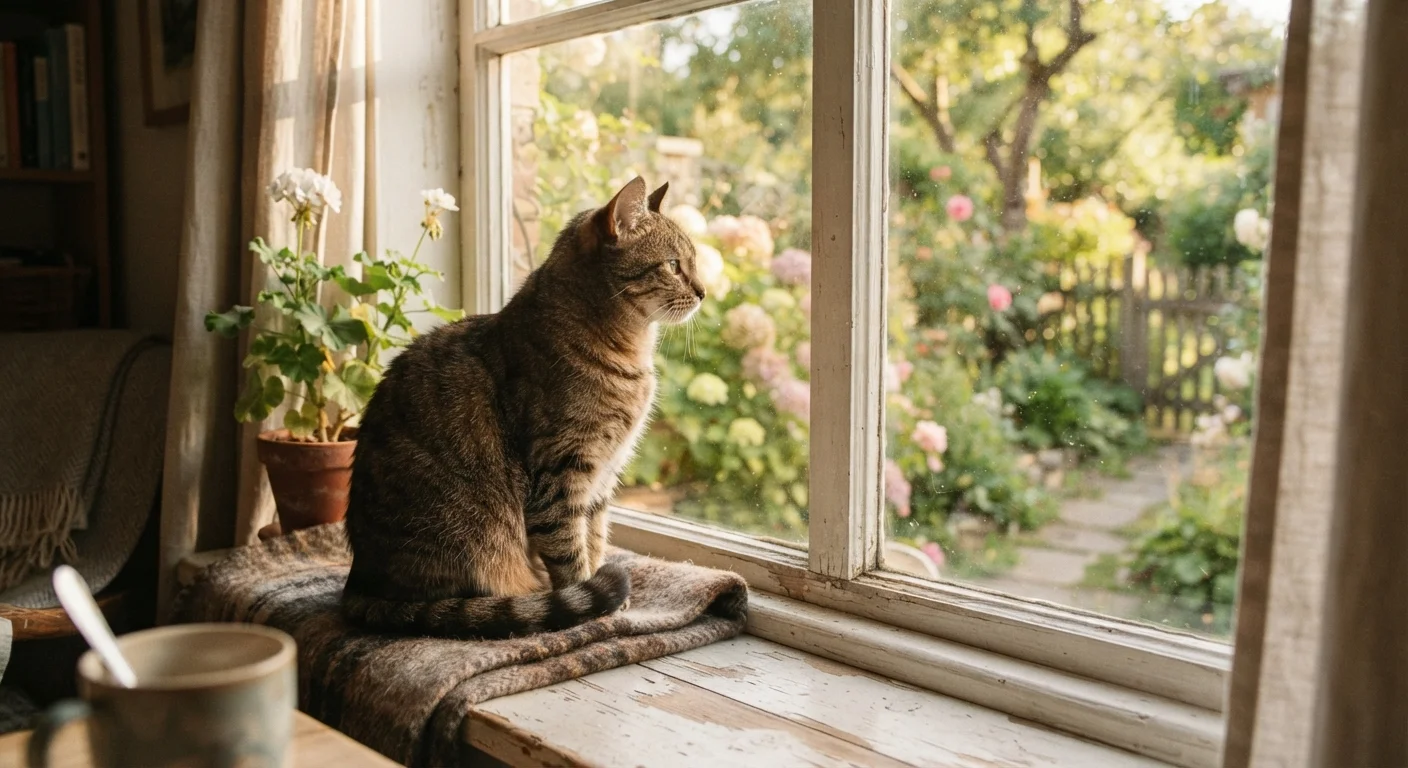
Option A
Indoor Cats
The protected, environment-controlled lifestyle.
Best for: Cats living in urban areas, high-traffic neighborhoods, or homes where owner supervision is limited.
Option B
Outdoor Cats
The free-roaming, stimulus-rich alternative.
Best for: Cats in rural or low-traffic settings where supervised or limited outdoor access can be managed safely.
What the Lifespan Data Tells Us
One of the starkest differences between indoor and outdoor cats is longevity. Veterinary and feline welfare research consistently indicates that cats kept exclusively indoors tend to live considerably longer than those with unrestricted outdoor access. Estimates vary by study, but the gap is frequently cited as significant — some sources suggest indoor cats may live roughly twice as long on average, though individual variation is wide.
The reasons aren't mysterious. Outdoor cats are exposed to a range of hazards that simply don't exist inside a home: road traffic, predators (including other cats and dogs), infectious diseases spread through contact with other animals, and environmental toxins such as pesticides or antifreeze. Feline immunodeficiency virus (FIV) and feline leukemia virus (FeLV), for example, are both transmitted primarily through cat-to-cat contact — a risk that rises sharply with outdoor roaming.
10–15 yrs
Typical indoor cat lifespan
Veterinary sources commonly cite this range for indoor-only cats, compared to lower averages for free-roaming cats.
~3×
Greater FIV exposure risk outdoors
FIV is primarily transmitted through bite wounds during cat fights — a risk that rises substantially with unsupervised outdoor access.
If you're bringing a cat home for the first time, understanding these baseline risks early can help you make an informed decision about lifestyle from the outset.
The Behavioral Case for Outdoor Access
Despite the safety advantages of indoor living, it comes with its own welfare considerations. Domestic cats retain strong predatory instincts and a natural drive to explore, patrol territory, and engage in sensory-rich environments. When these needs go unmet, the result can be boredom, frustration, and stress-related behaviors — including over-grooming, aggression, or house soiling.
Research into feline welfare emphasizes that environmental enrichment isn't optional for indoor cats — it's essential. Puzzle feeders, climbing structures, window perches, scent enrichment, and regular interactive play can meaningfully offset the stimulation an outdoor cat would find naturally. See our enrichment ideas guide for practical approaches suited to different cat personalities.
| Criterion | Indoor Cats | Outdoor Cats |
|---|---|---|
| Average lifespan | Generally longer | Generally shorter |
| Infectious disease risk | Low (FIV, FeLV, parasites) | Higher through contact with other cats |
| Injury & accident risk | Low | Higher (traffic, predators) |
| Behavioral stimulation | Requires deliberate enrichment | Naturally varied environment |
| Predatory outlet | Must be provided through play | Exercised through hunting |
| Wildlife impact | None | Can affect local bird and small animal populations |
| Owner control over diet | High | Lower (may hunt or scavenge) |
Understanding your cat's body language is also a useful tool here. A cat that paces, vocalizes excessively, or fixates on exits may be signaling unmet needs. Our feline body language guide can help you interpret these cues accurately.
The Middle Ground: Managed Outdoor Access
The indoor-outdoor debate doesn't have to be binary. Many cat owners and veterinarians advocate for supervised or contained outdoor access as a practical compromise. Options include enclosed outdoor runs (commonly called catios), harness-and-leash walking, or secured garden spaces that prevent roaming while offering genuine environmental stimulation.
This approach addresses both sides of the welfare equation: cats get exposure to fresh air, natural sights and smells, and mild unpredictability — while owners retain meaningful control over the risks. It's worth noting that not every cat will take to harness training, and some may find enclosed spaces stressful rather than enriching. Patience and gradual introduction matter.
Wildlife Impact Is Also a Factor
Free-roaming domestic cats are estimated to be one of the leading human-linked causes of wild bird and small mammal mortality in the United States, according to research published by the Smithsonian Conservation Biology Institute. This ecological dimension doesn't determine what's right for your individual cat, but it is a legitimate consideration in the broader debate. Keeping cats indoors or providing enclosed outdoor spaces eliminates this impact entirely.
Regardless of lifestyle choice, spaying and neutering significantly reduces roaming behavior in outdoor cats and lowers disease transmission risks. It's considered standard care by veterinary organizations for cats of any lifestyle.
For senior cats, the calculus often shifts further toward indoor living. Older cats are more vulnerable to injury, infection, and temperature extremes — factors worth discussing with your vet as your cat ages.
This article provides general information about feline care and is not a substitute for professional veterinary advice. Consult your veterinarian for guidance tailored to your cat's individual health needs.
The content on this site is for informational purposes only and is not a substitute for professional advice. Always consult a qualified professional for guidance specific to your situation.