

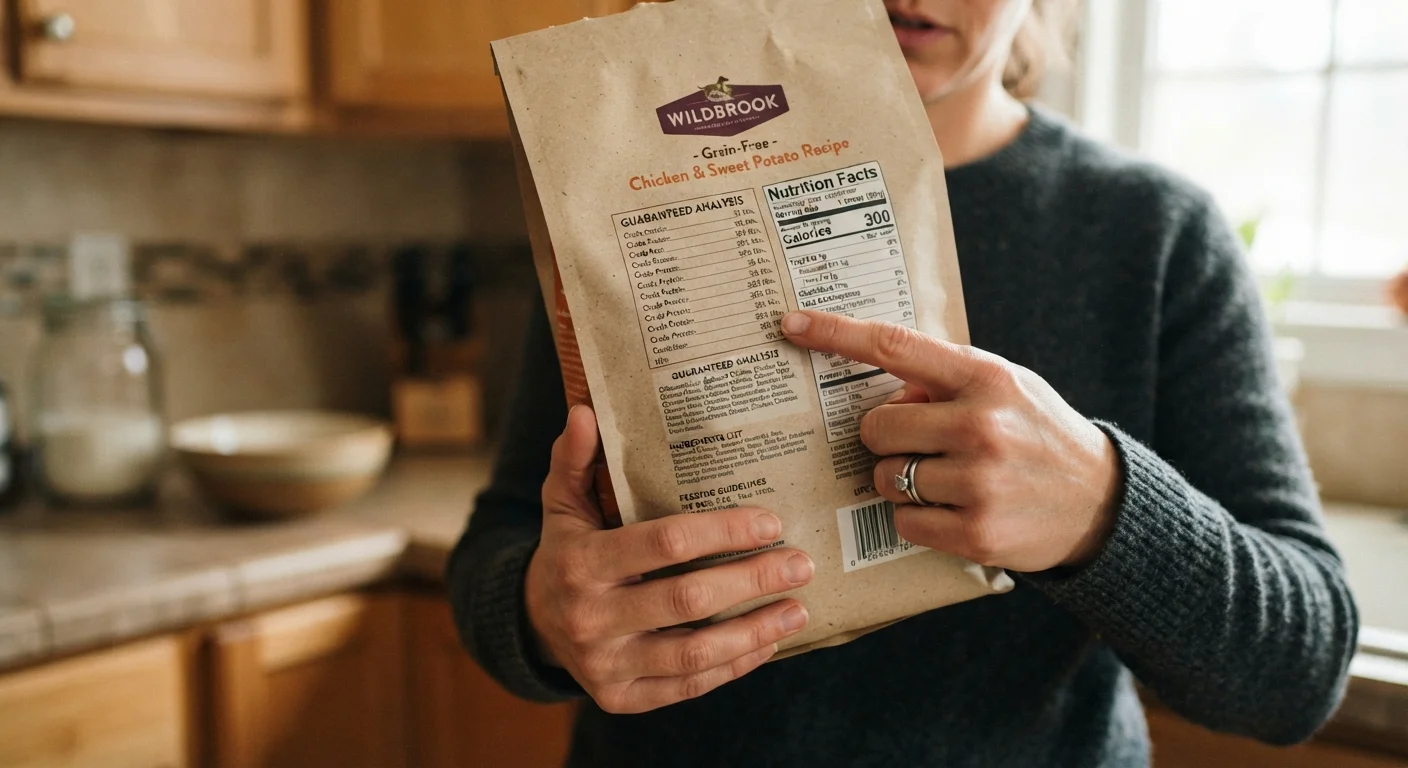
The Five Required Label Panels
Every dog food sold in the U.S. must include five core pieces of information: the product name, the net quantity, the manufacturer's name and address, the ingredient list, and the guaranteed analysis. Together, these form the factual backbone of the label — everything else, including imagery and front-panel claims, is marketing.
The product name itself is regulated. AAFCO rules govern how prominently a protein source can be named. If a food is called 'Beef Dog Food,' beef must make up at least 95% of the total ingredients (excluding water). A label saying 'with Beef' only requires 3% beef. That gap is significant and easy to miss.
AAFCO Does Not Approve Individual Products
A common misconception is that the AAFCO statement means a food has been 'approved' or 'certified' by a regulatory body. AAFCO publishes model regulations and nutrient profiles, but enforcement happens at the state level. No federal agency pre-approves pet food before it reaches store shelves, though manufacturers are responsible for accurate label claims.
The manufacturer address matters more than it might seem. If you ever need to report a quality issue or check a recall, this is where you start. Keep the packaging until the bag is finished.
Reading the Ingredient List Honestly
Ingredients are listed in descending order by weight before processing. This is where the label can mislead even careful readers. Fresh chicken, for example, is roughly 70% water. Once cooked, its actual contribution to the finished food may be smaller than a dry ingredient listed fourth or fifth on the list.
Ingredient splitting is another pattern worth knowing. A manufacturer might list 'ground corn,' 'corn gluten meal,' and 'corn flour' separately — each appears lower on the list individually, but combined they could outweigh the first ingredient. This isn't illegal, but it's worth factoring into your reading.
Preservatives, colorings, and flavor additives must also be listed. If you want to compare two foods fairly, look at the guaranteed analysis alongside the ingredient list rather than relying on either alone. For a broader comparison of how food format affects nutrition, see our guide to dry vs. wet food.
Use the Dry-Matter Basis for Fair Comparisons
When comparing foods with very different moisture levels — like kibble vs. canned — convert nutrient percentages to a dry-matter basis. Subtract the moisture percentage from 100 to get dry matter, then divide the nutrient percentage by that number. For example, a wet food with 78% moisture and 8% protein: 8 ÷ 22 = 36% protein on a dry-matter basis. This gives you a true apples-to-apples comparison.
The Guaranteed Analysis: What the Numbers Mean
The guaranteed analysis lists minimum percentages for crude protein and crude fat, and maximum percentages for crude fiber and moisture. These are not exact values — they are regulatory thresholds. Actual nutrient content may differ from what the label states.
25%
Minimum named ingredient for 'dinner' or 'formula' products
Per AAFCO model pet food regulations, a food labeled as a 'dinner,' 'platter,' or 'formula' must contain at least 25% of the named ingredient, excluding water used in processing.
95%
Minimum named ingredient for single-protein label claims
AAFCO's '95% rule' requires that a food named simply 'Beef Dog Food' contain at least 95% of that ingredient by weight, excluding water and condiments.
3%
Minimum ingredient level required to use 'with' on a label
A product claiming to be made 'with' a specific ingredient (e.g., 'with Salmon') only needs to contain 3% of that ingredient under AAFCO guidelines.
One important limitation: the guaranteed analysis uses an as-fed basis, meaning the numbers include moisture. Comparing a wet food (which may be 78% moisture) to a dry kibble (around 10% moisture) on an as-fed basis is like comparing apples to oranges. To compare accurately, you'd need to convert both to a dry-matter basis by dividing each nutrient percentage by the percentage of dry matter (100% minus moisture %).
The term 'crude' in crude protein doesn't mean low quality — it refers to the laboratory method used to measure nitrogen content, from which protein is estimated.
The AAFCO Statement: The Most Important Line on the Label
The nutritional adequacy statement — often called the AAFCO statement — is arguably the single most useful piece of information on a dog food label. It tells you three things: whether the food is complete and balanced, which life stage it's formulated for, and how that claim was established.
There are two ways a manufacturer can support this claim. Formulation means the recipe was calculated to meet AAFCO nutrient profiles on paper. Feeding trials means animals were actually fed the food and tested for nutritional outcomes. Both are legitimate, though feeding trials provide real-world evidence of digestibility and palatability that formulation alone cannot guarantee.
Life stage designations matter practically. A food labeled for 'adult maintenance' is not nutritionally adequate for a pregnant dog or a growing puppy. 'All life stages' covers every phase including growth and reproduction — and must meet the more demanding puppy nutrient profile to qualify. If your dog has specific health needs, your veterinarian is your best resource for navigating these distinctions.
“The nutritional adequacy statement is the most important thing on a pet food label. It tells you whether that food has been shown to meet your pet's nutritional needs — and for which stage of life.”
— Lisa Freeman, Board-certified veterinary nutritionist and director of the Clinical Nutrition Service at Cummings School of Veterinary Medicine, Tufts University
Marketing Claims vs. Regulated Terms
Front-panel language is designed to sell food, not inform buyers. Words like 'premium,' 'gourmet,' and 'super-premium' have no regulatory definition in pet food. A food using these terms is not required to contain higher-quality ingredients or meet any additional standard.
'Natural' has a loose AAFCO definition — it generally means no chemically synthesized ingredients — but it does not mean organic, minimally processed, or nutritionally superior. 'Grain-free' is a formulation choice, not a health claim; current research is still examining a potential link between grain-free diets and certain heart conditions in dogs, and the FDA has noted this as an ongoing area of investigation. Talk to your vet before making dietary changes based on ingredient trends.
For more context on ingredients that may affect your dog's health, our article on foods and substances toxic to dogs is worth reviewing. And if you're weighing the broader cost of feeding choices, our breakdown of real dog ownership costs puts food expenses in context.
This article is for general informational purposes only and is not veterinary or nutritional advice. Consult a licensed veterinarian for guidance specific to your dog's health and dietary needs.
Frequently Asked Questions
'Complete and balanced' means the food meets AAFCO's published nutrient profiles for a stated life stage, either through formulation or feeding trials. It signals the food can serve as your dog's sole diet without requiring supplementation. Foods labeled 'for supplemental or intermittent feeding only' are not intended as a primary diet.
Some dry food formulas include water during processing, which must be disclosed in the ingredient list. Even if water appears high on the list during manufacturing, the final kibble contains very little moisture. This is different from wet or canned foods, where water or broth is a major component by design.
Not necessarily. Ingredients are listed by pre-cooking weight, and fresh meats contain a lot of water. After processing, a fresh meat ingredient's actual contribution by weight may be smaller than a dry ingredient listed further down. Look at the guaranteed analysis protein percentage alongside the ingredient list for a fuller picture.
'Chicken' refers to the whole, unprocessed muscle meat weighed before cooking. 'Chicken meal' is rendered, meaning moisture has already been removed — so it is a more concentrated source of protein by weight. Neither is inherently superior; both can contribute meaningfully to a food's protein content.
Approved preservatives used within regulated limits are considered safe by current regulatory standards. Some owners prefer foods preserved with natural alternatives like mixed tocopherols (vitamin E) or rosemary extract. Whether artificial or natural, discuss any specific concerns about your dog's diet with your veterinarian.
Check the AAFCO nutritional adequacy statement for the stated life stage — look for 'growth,' 'all life stages,' or 'adult maintenance.' Puppies have higher needs for protein, fat, calcium, and phosphorus than adult dogs. Large-breed puppies in particular have specific calcium-to-phosphorus ratio needs, so consult your vet when selecting puppy food.
The content on this site is for informational purposes only and is not a substitute for professional advice. Always consult a qualified professional for guidance specific to your situation.