

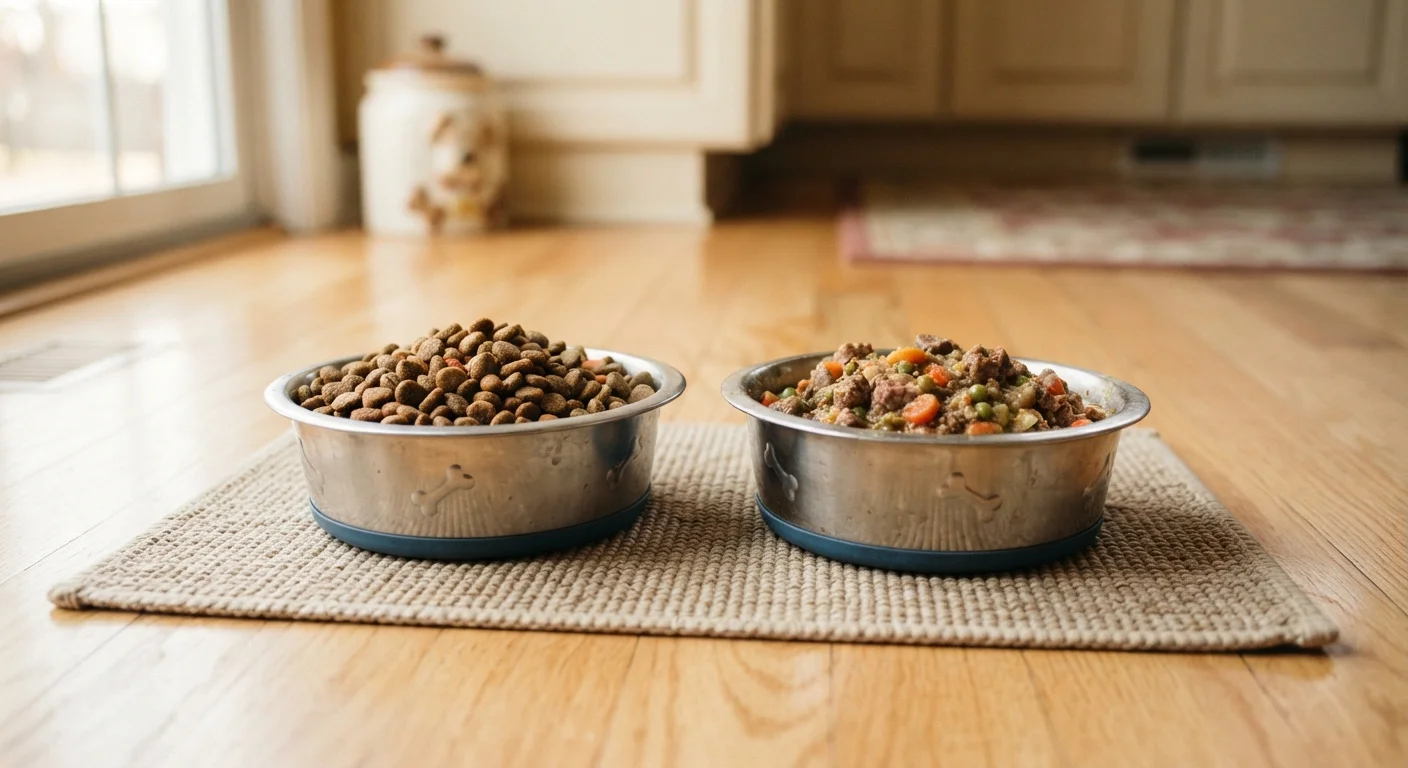
Option A
Dry Food (Kibble)
The convenient, cost-effective everyday staple.
Best for: Dogs who need an affordable, easy-to-portion, shelf-stable daily diet with dental-scrubbing texture.
Option B
Wet Food (Canned/Pouched)
The palatable, moisture-rich alternative.
Best for: Dogs who need extra hydration, have dental problems, are picky eaters, or require higher palatability due to illness or age.
What Actually Differs Between the Two Formats
Dry food (kibble) and wet food (canned or pouched) are both legitimate ways to feed a dog a complete diet — but the differences in how they're made and what they contain matter in practice.
The most significant difference is moisture content. Wet food typically contains 70–80% water, while dry kibble contains around 10%. That gap affects everything from calorie density to how much you feed per meal. Because wet food delivers far more water per gram, dogs eating it consume fewer dry-matter calories per can — which means you need to compare the two formats on a dry-matter basis to judge their nutritional content fairly, not just from the label percentages.
Kibble is produced through extrusion — ingredients are cooked under high heat and pressure, then dried into shelf-stable pellets. Wet food is cooked inside sealed cans or pouches, which preserves moisture and often results in a stronger aroma and more palatable texture. Both formats can be nutritionally complete, provided they carry an AAFCO nutritional adequacy statement. See our guide to reading dog food labels for help decoding what that statement actually means.
| Criterion | Dry Food (Kibble) | Wet Food (Canned/Pouched) |
|---|---|---|
| Moisture content | ~10% | ~70–80% |
| Cost per day (avg. medium dog) | Lower | Significantly higher |
| Shelf life (unopened) | Months at room temp | Years (canned); months (pouched) |
| Shelf life (opened) | Weeks in sealed container | 1–2 days refrigerated |
| Palatability | Moderate | Generally higher |
| Dental abrasion benefit | Minor, modest evidence | Minimal |
| Ease of portion control | Easy (measuring cup) | Requires weighing or counting cans |
| Calorie density (per gram) | Higher | Lower (due to moisture) |
| Good for picky or ill dogs | Sometimes | Often preferred |
Hydration, Dental Health, and Digestibility
For dogs prone to urinary tract issues, kidney disease, or chronic dehydration, the moisture advantage of wet food can be clinically meaningful. Veterinary nutritionists often note that dogs on wet diets tend to produce more dilute urine, which may reduce the risk of certain urinary crystals forming. That said, wet food is not a treatment for any condition — consult your vet if your dog has a diagnosed urinary or kidney problem.
Dry food is sometimes credited with promoting better dental health because the mechanical action of chewing hard kibble may help reduce plaque buildup. In reality, the evidence here is modest. Some studies suggest kibble offers a minor benefit over wet food for tartar, but it is not a substitute for brushing or professional dental cleanings. Dogs can develop significant dental disease on kibble alone.
~70–80%
Moisture content in wet dog food
Compared to roughly 10% in dry kibble, wet food provides substantially more water per gram of food consumed.
2–4×
Estimated daily cost increase with wet food
Feeding a medium dog exclusively on wet food typically costs two to four times more per day than an equivalent dry food diet.
~25%
US dogs with dental disease by age 3
The American Veterinary Medical Association notes that dental disease is among the most common conditions seen in adult dogs, regardless of diet format.
Digestibility varies by formula more than by format. A high-quality wet food and a high-quality dry food can both be highly digestible. Cheaper formulas in either format may use lower-quality protein sources that are harder for dogs to process efficiently.
Cost, Storage, and Day-to-Day Practicality
On a per-calorie basis, dry food is almost always less expensive than wet food. For a medium or large dog, feeding wet food exclusively can cost two to four times more per day than feeding kibble. This is a real consideration, especially over a dog's lifetime. Our article on the real costs of owning a dog puts food costs in the context of your full annual budget.
Storage is another practical advantage for dry food. An unopened bag of kibble keeps for months at room temperature (away from heat and humidity). Opened wet food cans must be refrigerated and used within a day or two. This matters if you travel with your dog, manage multiple pets, or simply value predictable pantry logistics.
Portion control is more straightforward with kibble — a measuring cup gives consistent results. With wet food, portions are typically calculated by weight or by the number of cans per day, which varies by product and dog size, so reading the feeding guide carefully matters.
Transitioning Between Food Types
If you decide to switch from dry to wet food or vice versa, do so gradually over 7–10 days by mixing increasing amounts of the new food with decreasing amounts of the old. Abrupt changes can cause digestive upset — loose stools, gas, or vomiting — even when the new food is nutritionally sound. Go slowly, and check in with your vet if symptoms persist.
A mixed-feeding approach — kibble as the main meal with a small amount of wet food added — is widely practiced and can address palatability issues without dramatically increasing cost. Just be sure to account for the combined calorie contribution from both sources to avoid overfeeding.
This article is for general informational purposes only and is not a substitute for personalized veterinary advice. Consult your veterinarian before making significant changes to your dog's diet, especially if your dog has a health condition.
The content on this site is for informational purposes only and is not a substitute for professional advice. Always consult a qualified professional for guidance specific to your situation.