

Start here
Choosing the Right Tank Size
Next
Essential Equipment You Actually Need
Critical step
The Nitrogen Cycle: Why It Can't Be Skipped
Then
Choosing Fish That Will Actually Thrive
Keep it going
Ongoing Care: What Daily and Weekly Maintenance Looks Like
Choosing the Right Tank Size
Counterintuitively, a larger tank is easier to manage than a small one for beginners. More water volume means chemical changes happen more slowly, giving you time to catch and correct problems. A 20-gallon tank offers far more stability than a 5-gallon bowl.
As a practical starting point, a 20- to 30-gallon tank gives you enough room to keep a small community of fish while keeping water chemistry manageable. Nano tanks under 10 gallons require very precise feeding and water changes and are generally better suited to experienced keepers.
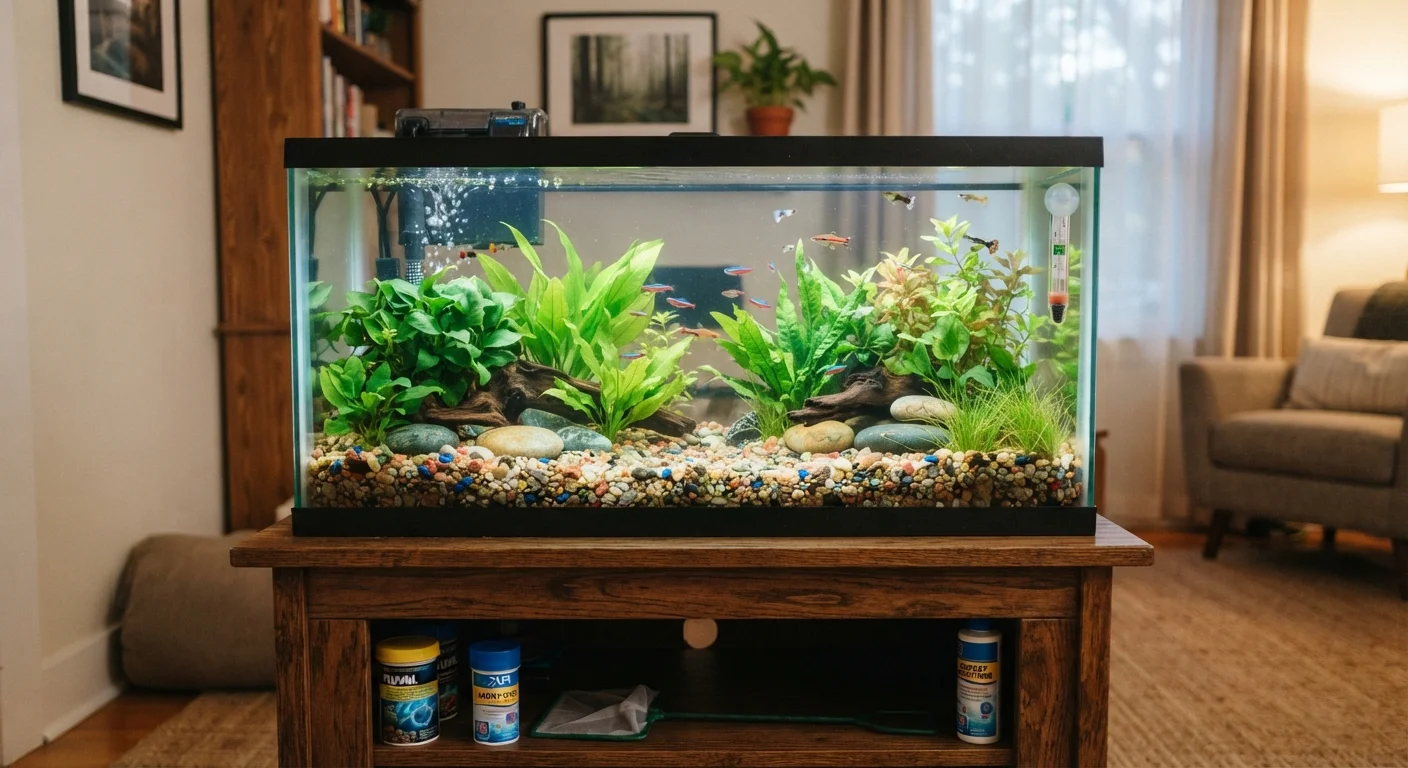
Consider placement before you buy: a full 20-gallon tank weighs roughly 225 pounds. Choose a dedicated aquarium stand or solid furniture rated for that load, away from direct sunlight (which encourages algae) and drafts (which cause temperature swings).
Nitrogen cycle
The biological process by which beneficial bacteria in your tank convert toxic fish waste (ammonia) into less harmful compounds. A tank must complete this cycle before fish can safely live in it.
Cycling
The act of establishing the nitrogen cycle in a new aquarium. It involves building up colonies of beneficial bacteria before any fish are added, typically taking 4–8 weeks.
Ammonia
A toxic chemical produced by fish waste, uneaten food, and decomposing matter. Even low concentrations can harm or kill fish, making it the key parameter to watch in a new tank.
Nitrate
The final, relatively harmless byproduct of the nitrogen cycle. Nitrate accumulates over time and is managed through regular partial water changes.
Dechlorinator
A liquid water conditioner that neutralizes chlorine and chloramine in tap water, making it safe for fish. It is added every time you prepare water for a water change or top-off.
Overstocking
Adding more fish than a tank's water volume and filtration can support. Overstocking causes waste to accumulate faster than bacteria can process it, leading to dangerous water chemistry.
Essential Equipment You Actually Need
Aquarium marketing can make the equipment list feel overwhelming. In practice, three items are truly non-negotiable:
- Filter: Removes waste and, critically, houses the beneficial bacteria that process toxic ammonia. Size your filter for the tank volume listed on the packaging.
- Heater and thermometer: Most tropical freshwater fish require a stable temperature between 74–80°F. A heater maintains that range; a thermometer confirms it's working.
- Water test kit: A liquid-reagent test kit (not test strips, which are less reliable) lets you measure ammonia, nitrite, nitrate, and pH — the four readings that tell you whether your tank is safe for fish.
A lid is also strongly recommended to prevent jumping, reduce evaporation, and support any hood lighting. Substrate (gravel or sand) and décor provide enrichment and hiding spots, but their type matters less than the equipment above.
Test Before You Trust Your Equipment
Even a brand-new heater can malfunction. After setting up your tank, use a separate thermometer to verify the water temperature is actually in the target range — don't rely solely on the heater's dial. Check readings for the first few days to confirm stability before cycling begins.
The Nitrogen Cycle: Why It Can't Be Skipped
The single most common reason new fish die is being added to an uncycled tank. Fish produce ammonia through waste and respiration. In an established tank, two types of beneficial bacteria convert that ammonia first into nitrite (also toxic) and then into nitrate (relatively harmless at low levels). This process is called the nitrogen cycle.
It takes 4–8 weeks to complete in a new tank. During this time, ammonia and nitrite levels spike and then fall as bacteria colonies grow. Adding fish before the cycle is complete exposes them to toxic conditions — a phenomenon sometimes called "new tank syndrome."
You can cycle a tank fishlessly by adding a small amount of pure ammonia to feed the developing bacteria. Test the water every few days. The cycle is complete when ammonia and nitrite both read zero and nitrate is detectable.
For a deeper look at the process, see our full guide to the nitrogen cycle.
Never Add Fish to an Uncycled Tank
Adding fish before ammonia and nitrite levels have dropped to zero is the leading cause of preventable fish death for beginners. Resist the urge to shorten the cycle — there are no safe shortcuts. Use the waiting period to research compatible fish species instead.
Choosing Fish That Will Actually Thrive
Before you buy any fish, research their adult size, preferred water parameters, and social behavior. Many popular fish sold as small juveniles grow significantly larger, and some labeled as "community" fish are actually aggressive toward specific species.
A few principles that prevent common stocking mistakes:
- Match water chemistry. Different species thrive at different pH levels and hardness. Group fish with compatible requirements.
- Avoid overstocking. The rough guideline of one inch of adult fish per gallon is a ceiling, not a target. More fish means more waste, more filter strain, and faster water quality decline.
- Introduce fish gradually. Add a few fish at a time rather than all at once to avoid overwhelming your filter's biological capacity.
- Quarantine new arrivals. A separate small tank used to observe new fish for 2–4 weeks can prevent disease from spreading to your main tank.
If you're building confidence across other first-time pet experiences, our guide to bringing a cat home covers similar themes of preparation and gradual adjustment.
Ongoing Care: What Daily and Weekly Maintenance Looks Like
Fish keeping isn't passive, but the routine is simple once established. Here's what sustainable maintenance looks like:
- Daily
- Feed small amounts once or twice a day — only what fish consume within 2–3 minutes. Check that equipment is running and fish are behaving normally.
- Weekly
- Perform a 25–30% partial water change using dechlorinated water matched to tank temperature. Vacuum the substrate to remove settled waste. Wipe algae from glass as needed.
- Monthly
- Rinse filter media in tank water (never tap water, which kills beneficial bacteria). Test water parameters and adjust as needed.
Overfeeding is one of the fastest routes to poor water quality — uneaten food decomposes and fuels ammonia spikes. If you ever notice unexplained fish losses, our troubleshooting guide for fish health walks through the most common causes and solutions.
This article is for general informational purposes. For advice specific to a particular fish species or health concern, consult an aquatic veterinarian or a knowledgeable aquatic specialist.
Frequently Asked Questions
You need to complete the nitrogen cycle first, which typically takes 4–8 weeks. Adding fish too early exposes them to toxic ammonia and nitrite spikes. Testing your water with a liquid test kit will tell you when conditions are safe.
Hardy species like zebra danios, platies, and guppies are commonly recommended for beginners because they tolerate a range of water conditions. Always research the specific needs of any species before purchasing, including water temperature, pH, and tank size requirements.
Most freshwater tanks benefit from a 25–30% partial water change each week. This removes accumulated nitrates without disrupting the beneficial bacteria colony in your filter. Avoid full water changes, which can crash your cycle.
Yes, but tap water must be treated with a dechlorinator (also called a water conditioner) before use. Chlorine and chloramine in municipal water are toxic to fish. Dechlorinators work quickly and are inexpensive.
A general guideline is one inch of adult fish per gallon of water, though this is a rough starting point rather than a precise rule. The actual capacity depends on filtration, species behavior, and waste output. When in doubt, stock fewer fish than you think you can.
Live plants are beneficial — they absorb some ammonia and nitrates, provide cover for fish, and improve water quality — but they aren't required. Artificial plants or bare tanks can work, especially for beginners still learning water chemistry.
The content on this site is for informational purposes only and is not a substitute for professional advice. Always consult a qualified professional for guidance specific to your situation.