

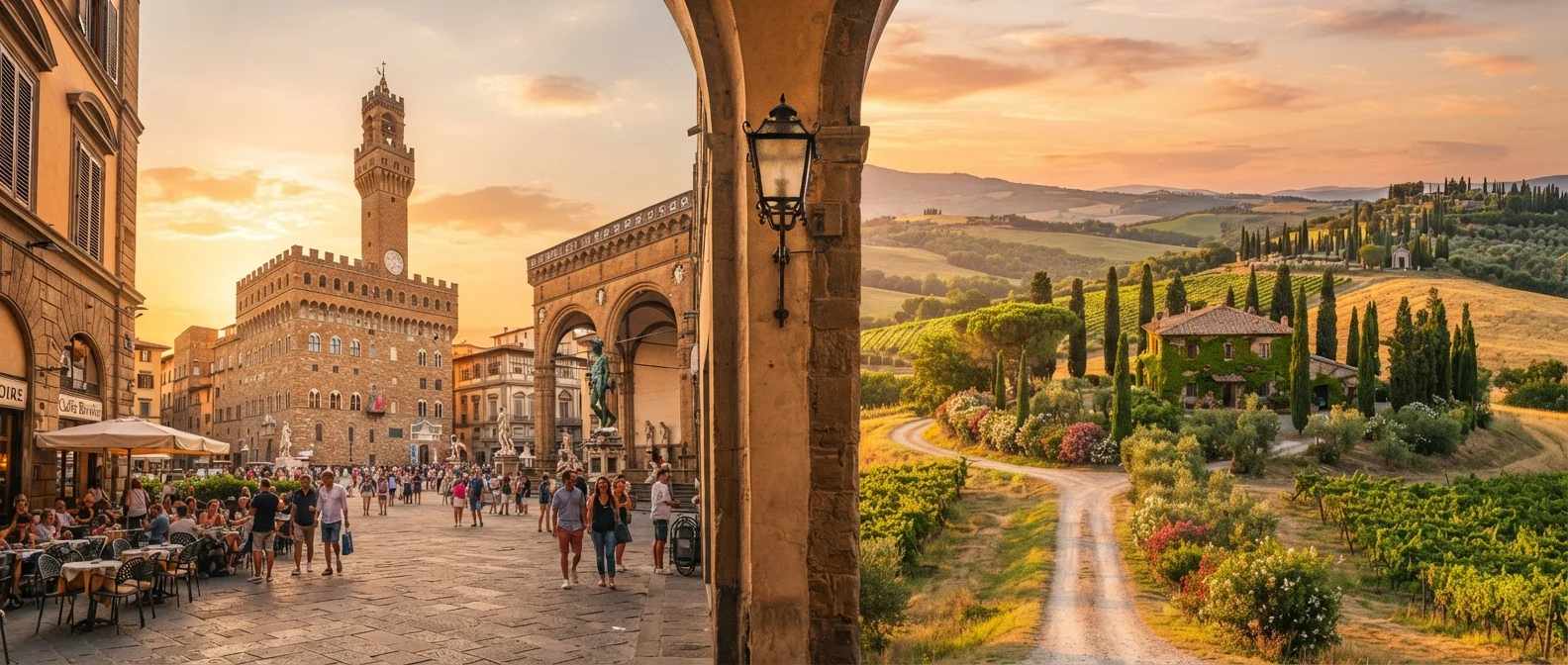
Our Verdict
Italy's cities and countryside are two distinct travel experiences that happen to share one extraordinary country. Cities reward those hungry for art, history, and urban energy, while the countryside offers something rarer: stillness, seasonal food, and the Italy that most postcards only hint at. Neither is objectively better — the right base is the one that matches how you actually want to spend your days.
| Best for | Recommended |
|---|---|
| First-time visitors wanting maximum sightseeing | City base |
| Travelers seeking slow travel, food, and wine immersion | Countryside base |
| Families or groups with mixed interests | Split stay (city + countryside) |
| Those with limited time but broad curiosity | City base with countryside day trips |
What a City Base Actually Gets You
Basing yourself in Rome, Florence, Milan, or Bologna means you're rarely more than a short walk from something extraordinary. World-class museums, centuries-old churches, vibrant markets, and some of the planet's most celebrated restaurants are all woven into the fabric of daily city life. Public transportation — trains, metro lines, and regional rail connections — makes it easy to explore without renting a car.
Cities also tend to offer more flexible accommodation options at varying price points, along with stronger infrastructure for solo travelers, families, and those with accessibility needs. Evening culture is another draw: aperitivo hour, late-night trattorias, and live music scenes are distinctly urban experiences.
The trade-off is density. Popular Italian cities can feel crowded, particularly during summer, and the constant stimulation can be exhausting. If you're hoping to absorb the quieter, agrarian soul of Italy, a city-only trip may leave you feeling like you've seen the highlight reel but missed the film. See our guide to exploring cities beyond the tourist trail for strategies to find more local rhythm even in a busy urban setting.
What the Countryside Offers That Cities Simply Can't
Italy's rural landscapes — Tuscany, Umbria, the Langhe in Piedmont, Puglia's trulli-dotted Valle d'Itria — operate at an entirely different pace. Staying at an agriturismo (a working farm offering lodging and meals) puts you inside the production of the food and wine that define Italian cuisine: olive oil pressed on-site, cheese aged in stone cellars, wines poured from the vineyard just outside your window.
The sensory experience is distinct. Early morning mist over vineyards, the smell of woodsmoke and fresh bread, afternoons with no agenda — these aren't things a city hotel can replicate. For travelers who feel genuinely restored by natural landscapes and unhurried days, a countryside base can be transformative rather than merely scenic.
That said, rural Italy comes with real logistical considerations. A car is almost always necessary. English is less commonly spoken in small villages. Some restaurants and shops keep limited hours or close entirely outside high season. If you're drawn to the kind of quiet rural immersion that many travelers overlook — similar to what Portugal's Alentejo offers — check out our piece on Portugal's rural interior for a sense of what slow-travel Europe can feel like.
Seasonal Closures Can Catch You Off Guard
Many rural agriturismos, small trattorias, and village shops close entirely between November and March. If you're planning an off-season trip to the Italian countryside, confirm your accommodation and key dining options are actually open before booking non-refundable travel. The landscapes can be stunningly quiet in winter — but only if you've planned ahead.
Comparing City and Countryside Stays Side by Side
The choice often comes down to a handful of practical factors: how you're getting around, how long you're staying, and what kind of days feel like a vacation to you. The table below breaks down the key differences.
| City Base | Countryside Base | |
|---|---|---|
| Transportation | Public transit widely available | Car rental usually essential |
| Accommodation style | Hotels, B&Bs, apartment rentals | Agriturismos, villas, small inns |
| Food & dining access | Restaurants open late, many options | Fewer options; often farm-to-table meals included |
| Pace of travel | Fast, activity-dense | Slow, experience-focused |
| Crowd levels | Higher, especially peak season | Generally quieter year-round |
| Sightseeing access | Excellent — museums, monuments nearby | Requires driving or day trips |
| Language considerations | English spoken widely in tourist areas | Less English; Italian basics helpful |
| Best for | First-timers, short trips, solo travelers | Returning visitors, couples, slow travelers |
The Hybrid Approach: Split Stays and Day Trips
Many travelers find the most satisfying answer is to combine both. A common structure is to anchor in a city for the first few days — arriving, orienting, hitting major sights — then move to a rural area for a slower second half of the trip. Alternatively, some countryside accommodations are close enough to cities (Siena to Florence, Orvieto to Rome) to use as a quieter base for day trips into urban centers.
If you're planning a multi-city itinerary that also incorporates rural stops, sequencing matters. Organizing a multi-city trip thoughtfully can mean the difference between a smooth journey and an exhausting one. And if you haven't mapped out your days at all yet, starting with building an itinerary from scratch will help you structure everything before you book.
Try a 60/40 Split for First-Timers
If this is your first trip to Italy and you're torn between city and countryside, consider spending roughly 60% of your nights in a city and 40% in a rural area. This gives you a solid foundation of sightseeing and orientation before transitioning to the slower, more immersive countryside experience. Starting in the city also means arriving jetlagged into a place with easy food and transit access — a practical advantage that shouldn't be underestimated.
How structured your days need to be is worth thinking through early. Weighing flexible vs. fixed itineraries is especially relevant if you're splitting your trip between fast-paced cities and slower rural areas, where spontaneity is often the whole point.
The content on this site is for informational purposes only and is not a substitute for professional advice. Always consult a qualified professional for guidance specific to your situation.