

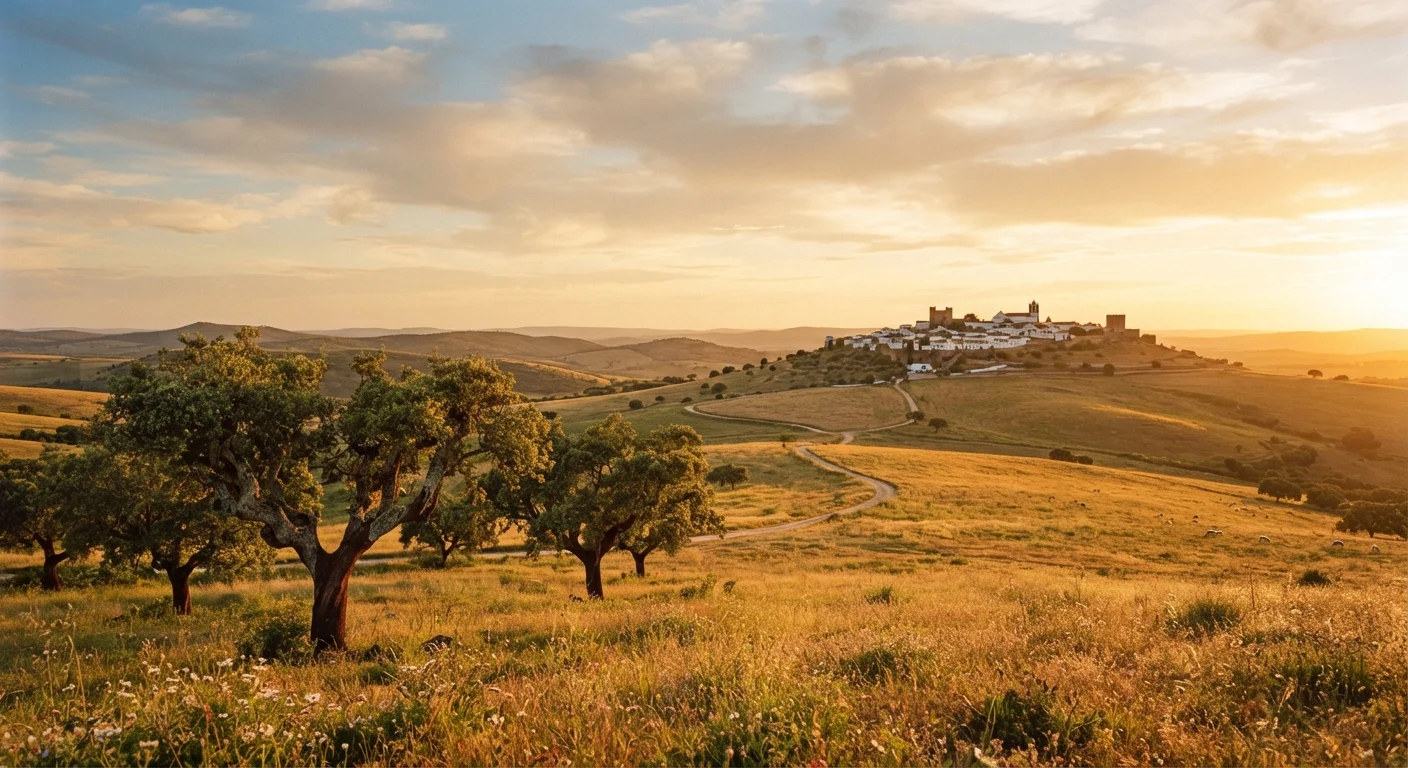
A Region That Belongs to Another Time
Most travelers touch down in Lisbon or Porto, maybe catch the train to Sintra, and consider Portugal ticked off the list. But head east from Lisbon for 90 minutes and the motorway dissolves into two-lane roads threading through wheat fields, olive groves, and forests of cork oak. This is Alentejo — and it operates at an entirely different rhythm.
Villages here look much as they did five centuries ago: whitewashed walls trimmed in cobalt blue, narrow stone streets, and fortified hilltops that once watched for Moorish and Spanish invasions. Évora, the regional capital, holds a UNESCO World Heritage designation for its extraordinarily intact Roman, medieval, and Renaissance layers — and on a weekday morning you can walk its streets nearly alone. Compare that to the shuffling queues of Sintra or the selfie-stick traffic of Lisbon's Alfama, and the appeal becomes obvious.
Alentejo's Summer Heat Is Real
Alentejo regularly records some of the highest summer temperatures in continental Europe, with July and August daytime highs frequently topping 40°C (104°F). If you travel in summer, plan outdoor sightseeing for early mornings and late afternoons, and ensure your accommodation has reliable air conditioning. This is not a region where summer heat can be ignored.
Cork, Wine, and the Landscape That Produces Them
Alentejo produces roughly half of the world's cork — a fact that explains both the look of the land and its economy. Cork oaks (sobreiros) are stripped of their bark every nine years in a harvest that has been practiced for centuries. The exposed trunks glow rust-red and burnt orange after each harvest, creating a landscape that is genuinely unlike anything in the rest of Europe.
~50%
Share of global cork produced in Alentejo
Portugal is the world's leading cork producer, and Alentejo's montado (cork oak woodland) ecosystem accounts for the largest portion of that output.
~33%
Share of Portugal's landmass covered by Alentejo
Despite its enormous size, Alentejo is one of the least densely populated regions in Western Europe, contributing to its exceptionally quiet, open landscapes.
UNESCO
World Heritage status held by Évora
Évora's historic center was designated a UNESCO World Heritage Site in 1986 for its outstanding Roman, medieval, and Renaissance monuments.
Underneath that cork canopy, Alentejo's wine industry thrives. The region accounts for a significant share of Portugal's total wine exports, with producers crafting powerful reds from indigenous grape varieties like Aragonez, Trincadeira, and Alicante Bouschet. Many estates — called herdades — offer tasting rooms and vineyard walks, some with outstanding rural accommodation built into historic farm buildings. Wine tourism here feels personal rather than performative, without the tour-bus volume of more famous European wine regions. If you've explored Italy's Tuscany and wondered whether there's a quieter alternative, understanding how rural and urban bases compare can help frame what Alentejo's countryside offers by contrast.
Villages Worth Slowing Down For
Beyond Évora, a loose circuit of villages rewards anyone willing to leave the main roads. Monsaraz, perched on a ridge above the Alqueva reservoir, is Portugal's largest man-made lake and the darkest skied area in Western Europe — a certified Dark Sky destination where stargazing is exceptional. The village itself has fewer than 200 permanent residents and a castle you can walk around in twenty minutes, but its atmosphere lingers far longer.
Marvão, tucked against the Spanish border in Alto Alentejo, sits at nearly 900 meters altitude and feels genuinely remote. Its castle walls frame panoramic views over two countries. Estremoz is known for its Saturday marble market and its ceramics tradition — particularly the painted clay figures called bonecos de Estremoz.
Time Your Village Visits Wisely
Many of Alentejo's smaller villages operate on a true local schedule — restaurants may close between lunch and dinner, and some attractions keep limited hours outside of peak months. Arriving mid-morning and building in a long lunch break aligns naturally with local rhythms and avoids frustration. Calling ahead to wine estates before visiting is also strongly recommended.
Travelers accustomed to destination-hopping between coastal towns may find useful context in how Morocco's interior cities contrast with its Atlantic coast — the principle of choosing between a buzzing hub and a quieter, slower-paced setting applies equally here.
What to Eat and How to Travel
Alentejo's cuisine is rooted in peasant ingenuity: making deeply satisfying meals from what the land provides. Açorda is a bread-thickened soup fragrant with garlic, cilantro, and olive oil — simple, warming, and utterly regional. Carne de porco à alentejana combines marinated pork with clams in a combination that sounds improbable and tastes extraordinary. Sheep's milk cheeses from Serpa and Nisa, cured meats, and local honey appear on nearly every table.
For logistics: a rental car is the honest answer. Buses link the larger towns, but the most rewarding parts of Alentejo — a farmhouse winery off an unmarked road, a prehistoric dolmen hidden in a cork forest, a village festival in a square with twenty attendees — are not on any bus route. Roads are generally quiet and well-maintained, making self-driving pleasant rather than stressful. Plan loosely, leave afternoons open, and resist the urge to over-schedule. Alentejo's greatest offering is the feeling of time stretching out ahead of you.
Travel conditions, entry requirements, and local access can change; always verify current information with official Portuguese tourism authorities and your government's travel advisory before your trip.
Frequently Asked Questions
The city of Évora, Alentejo's most visited hub, is about 130 kilometers (roughly 80 miles) east of Lisbon. By car that journey takes around 90 minutes. Train connections also exist, though the region's villages generally require a rental car to reach comfortably.
Spring (March through May) and autumn (September through November) offer the most comfortable temperatures and beautiful landscapes. Summers are famously hot — daytime temperatures regularly exceed 40°C (104°F) — which deters some travelers but also ensures uncrowded sights. Winters are mild and peaceful, ideal for slow travel.
Absolutely. Alentejo is one of Portugal's most celebrated wine regions, producing robust reds from Aragonez and Trincadeira grapes. Many estates (called 'herdades') welcome visitors for tastings and tours, and wine tourism infrastructure has improved considerably in recent years.
For anything beyond Évora, a rental car is strongly recommended. Buses connect major towns but run infrequently, and the appeal of Alentejo is often found in small villages and rural estates that are impossible to reach by public transport.
Alentejo is considered one of Portugal's safest and most welcoming regions. Crime rates are low, locals are generally hospitable to visitors, and the region sees far less petty theft than Portugal's busiest coastal cities.
The Algarve is coastal, summer-packed, and internationally resort-oriented. Alentejo is inland, agricultural, and quiet year-round. Travelers seeking beaches and sun-loungers will prefer the Algarve; those after landscapes, wine, history, and solitude will find Alentejo far more rewarding.
The content on this site is for informational purposes only and is not a substitute for professional advice. Always consult a qualified professional for guidance specific to your situation.