

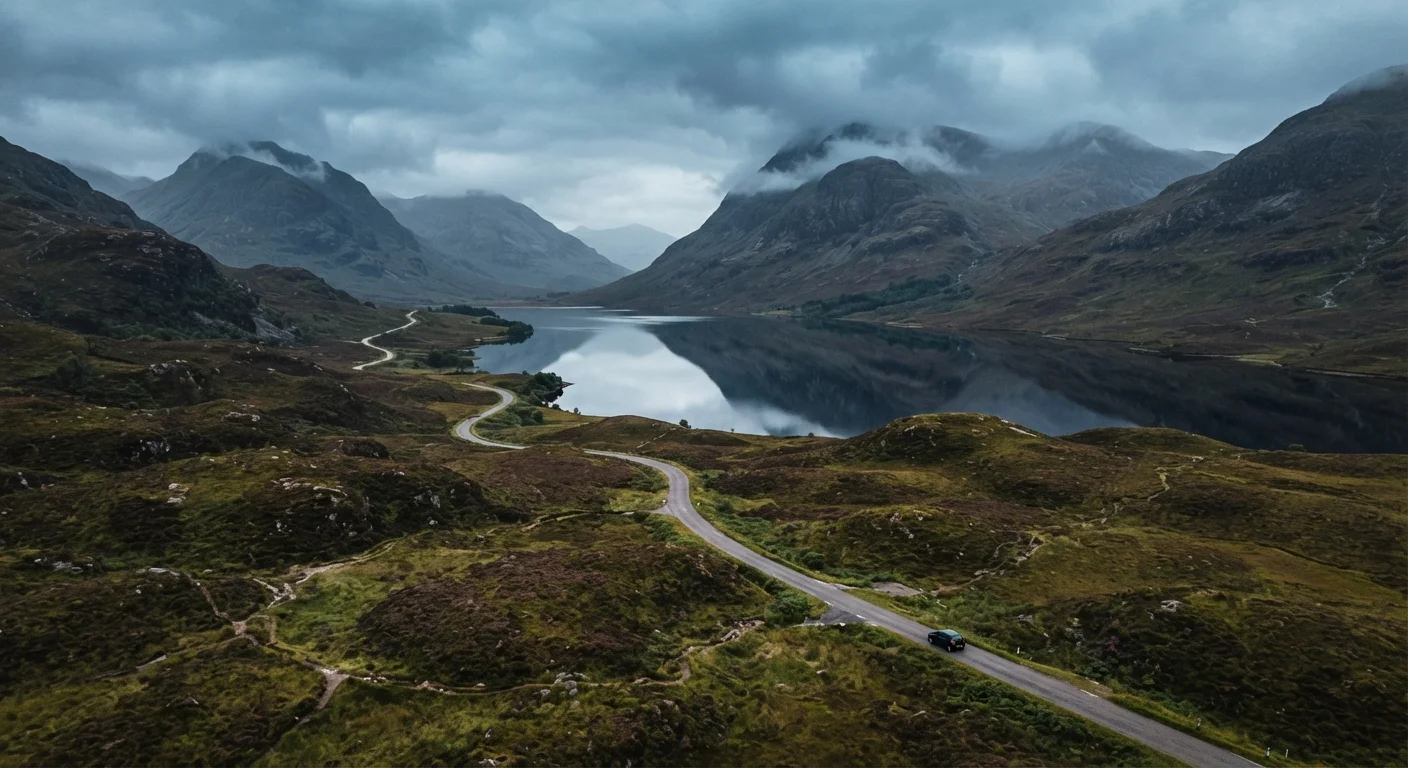
What and Where Is the Scottish Highlands?
The Scottish Highlands is a vast geographic and cultural region occupying the northern and northwestern portion of Scotland. It is loosely defined as the land north and west of the Highland Boundary Fault — a geological divide that runs roughly from Helensburgh on the west coast to Stonehaven on the east. This fault separates the rugged uplands of the north from the relatively lower-lying Central Belt where Edinburgh and Glasgow sit.
Administratively, the Highland council area is the largest local government region in the United Kingdom by land area. But when travelers and locals speak of the Highlands, they often mean a broader cultural zone that includes Argyll and Bute, parts of Stirlingshire, and the island chains of the Inner and Outer Hebrides. In practice, the term captures a spirit as much as a boundary — one defined by mountains, Gaelic heritage, and a particular kind of open, unhurried space.
~30%
Share of Scotland's land area covered by the Highlands
Despite this vast size, the Highland council area is home to fewer than 250,000 residents, making it one of Europe's most sparsely populated regions.
31,000+
Freshwater lochs across Scotland
Scotland's lochs collectively hold more fresh water than all lakes in England and Wales combined, with the Highlands accounting for the majority.
~3 billion
Age in years of Lewisian Gneiss rock
Found in the far northwest Highlands and the Outer Hebrides, Lewisian Gneiss is among the oldest exposed rock formations on the planet.
The Landscape: Geology, Lochs, and Wild Terrain
The Highlands sit atop some of the oldest exposed rock on Earth. The Lewisian Gneiss of the far northwest is estimated to be around three billion years old, predating complex life. Glaciers that retreated around 10,000 years ago carved the region's most recognizable features: deep U-shaped glens, ribbon lochs (freshwater lakes), and sea lochs that finger into the coastline from the Atlantic.
Loch Ness — famous worldwide — is one of nearly 31,000 freshwater lochs across Scotland, but its sheer depth (around 230 meters at its deepest) means it holds more fresh water than all lakes in England and Wales combined. The Cairngorms form the largest area of high ground in the British Isles, home to rare subarctic plant communities and birds like the capercaillie and osprey. Along the northwest coast, the landscape becomes increasingly raw, with stacked sandstone ridges rising out of blanket bog in a scene that looks almost Martian.
Don't confine your loch visits to Loch Ness. Loch Torridon, Loch Maree, and Loch Assynt in the northwest offer comparable drama with a fraction of the foot traffic.
Popular sites concentrate visitors and reduce the sense of solitude that many travelers seek in the Highlands; lesser-known lochs offer equivalent scenery with a more immersive atmosphere.
Download offline maps before heading into remote glens — mobile coverage drops to zero quickly once you leave major roads, and paper OS (Ordnance Survey) maps remain the reliable backup for serious hill walking.
Connectivity is genuinely unreliable across large swaths of the Highlands, and disorientation in mountain terrain can escalate to a safety issue without preparation.
Clan Heritage and Highland History
The clan system — networks of extended family groups bound by loyalty to a common chief — organized Highland society for centuries before being effectively dismantled following the Jacobite Rising of 1745. After the Jacobite defeat at the Battle of Culloden in April 1746, the British government enacted a series of measures designed to break Highland culture: banning tartan, restricting the carrying of arms, and abolishing traditional clan structures.
The Highland Clearances of the late 18th and 19th centuries compounded this rupture. Landlords evicted tens of thousands of tenant farmers to convert the land to sheep farming and, later, deer stalking estates. Many cleared communities emigrated to Canada, Australia, and the United States — which is why Highland heritage resonates so strongly across the Scottish diaspora today.
Visitors encounter this history in landscape as much as museum: ruined blackhouses (traditional stone-and-turf dwellings), overgrown lazy beds where crops once grew, and abandoned villages are scattered throughout the glens. Culloden Battlefield near Inverness is one of the most visited historic sites in Scotland, and it carries an atmosphere of genuine solemnity.
Culloden: Approach with Respect
Culloden Battlefield is a site of genuine historical trauma — around 1,500 Jacobite soldiers died there in under an hour. Treat it as you would any memorial site: speak quietly, stay on designated paths, and read the interpretive materials before forming impressions. The National Trust for Scotland manages the site and offers excellent visitor resources.
Weather, Seasons, and When to Visit
The Highlands have a reputation for rain that is, frankly, well earned — but the picture is more nuanced than constant drizzle. The west coast, exposed to prevailing Atlantic weather systems, receives considerably more rainfall than the east. Fort William, near Ben Nevis, averages around 2,000mm of rain annually; Inverness on the east side averages closer to 650mm, comparable to London.
Summer (June–August) brings long days — at Midsummer, the far north experiences near-continuous twilight known as the simmer dim — and the highest visitor numbers. Late spring and early autumn offer a compelling balance: fewer crowds, spectacular light, and the famous purple heather bloom in August and September. Winter brings snow to the higher peaks, dramatic storms, and a real possibility of seeing the Fir Chlis — the Northern Lights — on clear nights at higher latitudes.
Highland Weather Can Change Fast
Conditions in the mountains can shift from sunshine to wind-driven rain within minutes at any time of year. Always carry waterproof layers, extra warm clothing, and adequate food and water when venturing beyond roadside viewpoints. If you plan to walk in the high hills, check Mountain Weather Information Service (MWIS) forecasts — not just a general weather app — before setting out.
Getting Around the Highlands
Self-driving is the most flexible way to explore the Highlands, and for remote areas it is often the only practical option. Many routes are single-track roads with passing places — pull-offs where vehicles yield to let oncoming traffic through. This system requires patience and courtesy; rushing is neither safe nor in keeping with Highland culture.
The North Coast 500 (NC500), a roughly 516-mile driving route that loops around the northern coastline from Inverness, has become a major draw since its launch in 2015. It showcases spectacular coastal and mountain scenery but can be crowded in peak summer; planning stops at smaller side roads and lesser-known communities enriches the journey.
Rail connects Inverness to the south, and two iconic scenic routes — the West Highland Line and the Far North Line — offer memorable journeys in themselves. Bus services operate between major towns but are infrequent in rural areas. For island hopping in the Hebrides, CalMac ferries are the lifeline, though schedules and availability vary significantly by season; checking ahead with official ferry operator resources is strongly advised.
If your wider Scotland trip includes a maritime component, it's worth exploring how regional geography shapes seaborne routes — much as it does for other destinations covered in our guide to how different regions shape the cruising experience.
Book Ferries and Accommodation Early
In peak season (July–August), CalMac ferry crossings to popular islands like Skye's smaller neighbors and the Outer Hebrides can fill weeks in advance. The same applies to accommodation in small villages with limited options. Booking ahead removes significant stress and gives you more flexibility to linger where you feel moved to stay longer.
What Shapes the Highland Experience
Several forces combine to make the Highlands genuinely unlike anywhere else in the British Isles. First, scale: the sense of space here is rare in densely populated Europe. Second, layered time: Neolithic standing stones, medieval castle ruins, 18th-century clearance villages, and 21st-century rewilding projects exist within the same view. Third, light: the low sun angle, fast-moving cloud, and reflective water create conditions that photographers and painters have chased for centuries.
Gaelic culture — language, music, and storytelling — is not merely decorative. Communities in the Western Isles have maintained Gaelic as a living first language, and local festivals (known as mods) celebrate this tradition vigorously. Wildlife encounters — red deer, golden eagles, red squirrels, and bottlenose dolphins off the Black Isle — add an unpredictable natural element that no itinerary can fully guarantee but that rewards slow travel.
Ultimately, the Highlands reward travelers who arrive with flexibility and curiosity rather than a rigid checklist. The best moments — a sudden break in cloud revealing a sunlit glen, a red deer silhouetted on a ridge, a conversation with a crofter in a village pub — are rarely the ones you planned for.
VisitScotland — Highlands & Islands
Scotland's official tourism body provides destination guides, itinerary ideas, and practical travel information for the Highlands and Islands, verified for accuracy.
Mountain Weather Information Service (MWIS)
Specialist mountain-area forecasts for the Scottish hills, far more granular than general weather apps. Essential for any hillwalking or outdoor activity planning.
Ordnance Survey Maps (OS Explorer/Landranger)
The gold standard for navigating Highland terrain on foot. The 1:25,000 Explorer series is recommended for walkers; 1:50,000 Landranger suits road-level trip planning.
Gaelic Arts Agency (Proiseact nan Ealan)
Promotes Gaelic language and arts across the Highlands and Islands. A useful resource for understanding the living cultural context behind the heritage visitors encounter.
The content on this site is for informational purposes only and is not a substitute for professional advice. Always consult a qualified professional for guidance specific to your situation.