
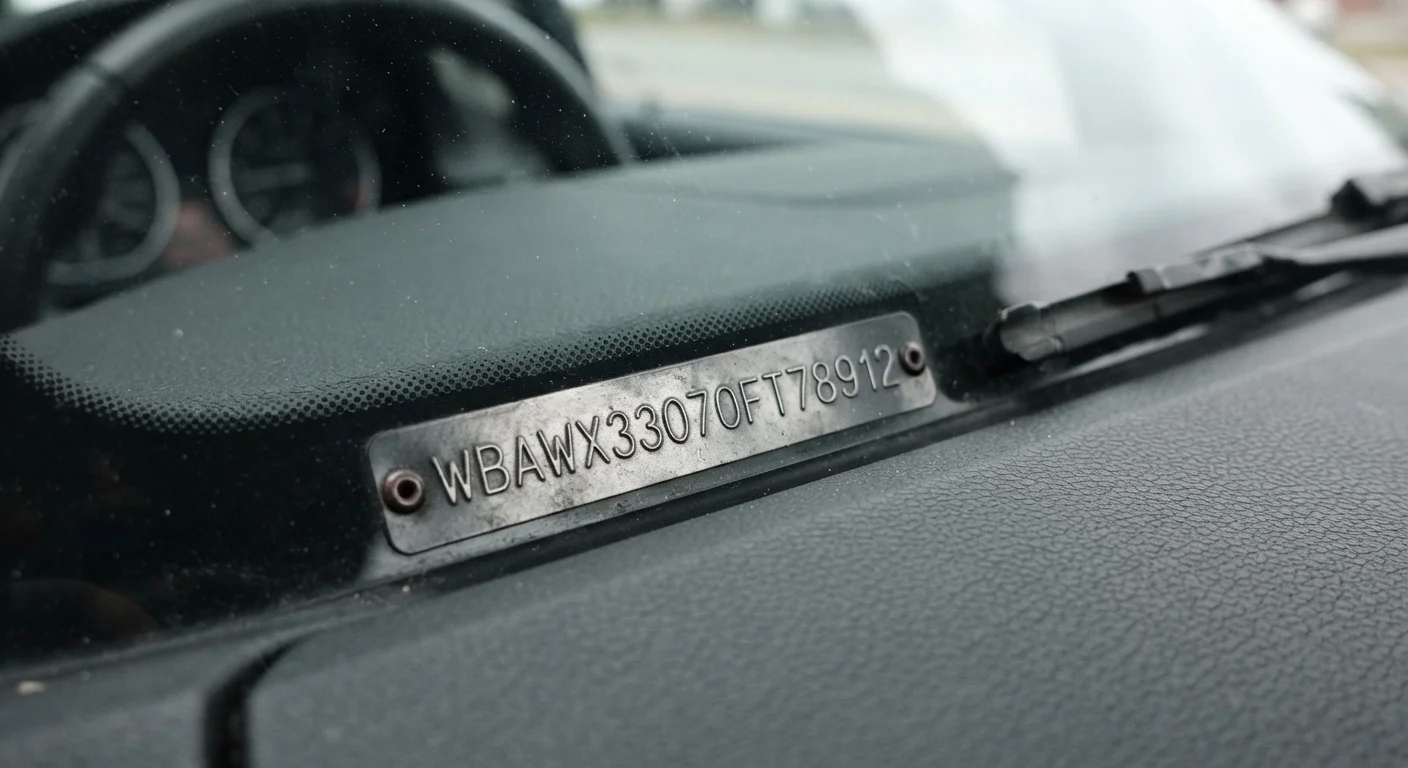
What Is a VIN?
A Vehicle Identification Number (VIN) is a unique 17-character code assigned to every motor vehicle manufactured or sold in the United States since 1981. Think of it as a car's fingerprint - no two vehicles share the same VIN. You can find it stamped on a plate visible through the driver's side of the windshield at the base, on the driver's door jamb sticker, and in key documents like the title and registration.
Knowing how to read a VIN is genuinely useful. It lets you independently verify a used car's make, model, and origin before you buy, and it's the key input for running a vehicle history report that can flag accidents, title issues, or odometer discrepancies.
| VIN length | 17 characters (NHTSA standard, adopted 1981) |
| Characters never used | I, O, Q, U, Z (Excluded to avoid confusion with 0 and 1) |
| Where to find it | Driver's side windshield base, door jamb sticker, title/registration |
| Check digit position | Position 9 (Used to verify VIN authenticity) |
| Free recall lookup | nhtsa.gov VIN search tool (National Highway Traffic Safety Administration) |
Breaking Down the 17 Characters
The National Highway Traffic Safety Administration (NHTSA) standardizes the VIN format in the U.S. Each position - or group of positions - carries a specific meaning.
Positions 1-3: World Manufacturer Identifier (WMI)
The first three characters identify who built the vehicle and where. Position 1 is the country of manufacture (for example, 1, 4, or 5 indicates the U.S.; J indicates Japan; W indicates Germany). Positions 2 and 3 narrow it down to the specific manufacturer and vehicle type. Together, these three characters form the World Manufacturer Identifier.
Positions 4-8: Vehicle Descriptor Section (VDS)
The next five characters describe the vehicle itself. Depending on the manufacturer, this section encodes attributes such as body style, engine type, restraint systems, and model line. Each automaker uses this section slightly differently, so the exact meaning of each character varies by brand - a practice that reflects the logic automakers use to name and classify their models.
Position 9: Check Digit
The ninth character is a mathematically calculated check digit used to verify the VIN's authenticity. The formula uses the other characters to produce a single number or the letter X. A mismatch here is a red flag for a fraudulent or tampered VIN.
Position 10: Model Year
A single letter or number encodes the model year. For instance, K = 2019, L = 2020, M = 2021, N = 2022, P = 2023, and R = 2024. Note that the letters I, O, Q, U, and Z are never used to avoid confusion with numbers.
Position 11: Assembly Plant
This character identifies the specific factory where the vehicle was assembled. The meaning is defined by each manufacturer, so the same letter can refer to different plants depending on the brand.
Positions 12-17: Vehicle Serial Number
The final six characters are the production sequence number - essentially the order in which that specific vehicle rolled off the assembly line at that plant for that model year. This makes the full VIN unique.
World Manufacturer Identifier (WMI)
The first three characters of a VIN that identify the country of manufacture and the specific automaker. Standardized internationally so any decoder can read any VIN.
Vehicle Descriptor Section (VDS)
Characters 4 through 8 of the VIN, describing vehicle attributes such as body style, engine type, and model line. The exact meaning of each character varies by manufacturer.
Check Digit
The ninth VIN character, calculated mathematically from the other 16 characters. It allows verification that the VIN has not been altered or fabricated.
Vehicle Serial Number
The last six characters (positions 12-17) that form a unique production sequence number for that specific vehicle, making every VIN globally unique.
Practical Ways to Use a VIN
Once you know how a VIN is structured, it becomes a practical tool in several real-world situations:
- Verifying a used car listing: Cross-reference the VIN on the vehicle against the title, registration, and any listing documents to confirm they match. Discrepancies are worth investigating before any purchase.
- Checking for recalls: The NHTSA maintains a free public recall database at nhtsa.gov where you can enter any VIN to see open safety recalls.
- Running a history report: VIN-based history services can surface prior ownership, reported accidents, and title status - information worth reviewing when researching any car model for the first time.
- Ordering the right parts: Mechanics and parts suppliers use the VIN to confirm engine type and trim level, reducing the risk of ordering components that don't fit.
VIN Decoding Tools Are Widely Available
NHTSA offers a free VIN decoder at nhtsa.gov that breaks down each section for any U.S.-registered vehicle. Many state DMV websites and third-party automotive databases offer similar tools. These are useful for a quick sanity check, but for full history details - including reported accidents or title brands - a dedicated vehicle history report provides considerably more depth.
Understanding a VIN complements other forms of vehicle literacy - just as tyre sidewall markings tell you about fitment and load capacity, a VIN tells you about the vehicle itself at the factory level.
The content on this site is for informational purposes only and is not a substitute for professional advice. Always consult a qualified professional for guidance specific to your situation.