

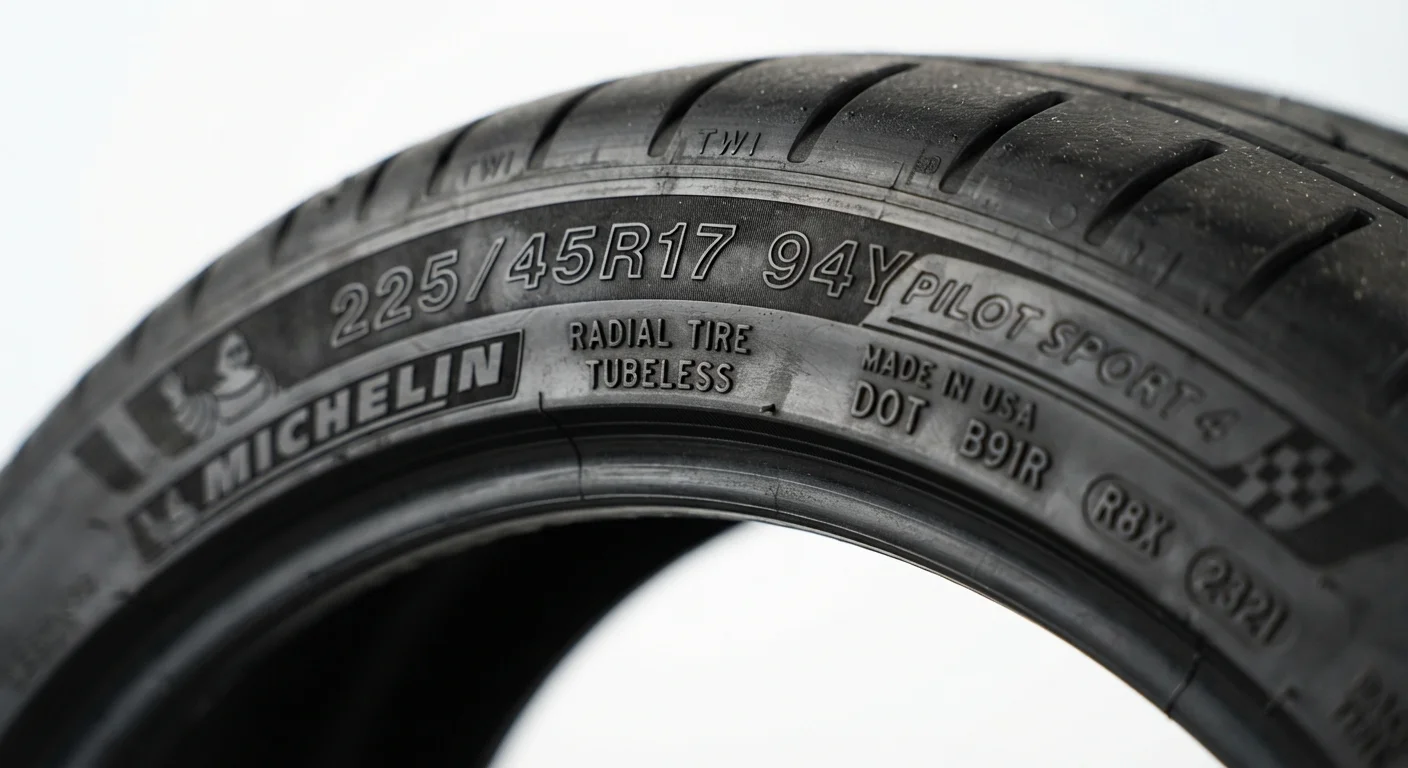
Breaking Down the Size Code
Look at the sidewall of any passenger tyre and you will find a sequence like 205/55R16. Each part of that string carries a precise, standardised meaning.
- 205 - Section width in millimeters. This is the tyre's widest point from sidewall to sidewall when correctly mounted and inflated.
- 55 - Aspect ratio. The sidewall height equals 55% of the section width. Lower numbers (e.g., 40) indicate a sportier, lower-profile tyre; higher numbers (e.g., 70) indicate a taller sidewall often found on trucks and SUVs.
- R - Construction type. "R" stands for radial, which is the standard for virtually all modern passenger and light-truck tyres. Radial construction means the internal cord plies run perpendicular to the direction of travel.
- 16 - Rim diameter in inches. The tyre must match this to your wheel exactly.
Together, these three numbers and one letter define the tyre's physical dimensions. Changing any of them means the tyre may not fit your vehicle safely or correctly. Your owner's manual and the placard on the driver's door jamb both list the approved sizes for your specific vehicle.
| Tyre width unit | Millimeters (e.g., 205 mm) |
| Aspect ratio range (common passenger tyres) | 35 to 80 |
| Rim diameter unit | Inches (e.g., 16") |
| DOT date code format | 4 digits: week + year (e.g., 2319 = 23rd week of 2019) (U.S. Department of Transportation) |
| Common speed rating for family sedans | H (up to 130 mph / 210 km/h) |
| Recommended max tyre age | 6-10 years from manufacture date (Generally advised by tyre manufacturers and safety bodies) |
Load Index and Speed Rating
Immediately after the size code, you will typically find two more values - for example, 91H.
91 is the load index. It corresponds to a maximum weight capacity per tyre on a standardised chart (in this case, approximately 1,356 lb / 615 kg). The index scale runs from around 0 to 279+, and the actual weight value must be looked up on the published load index table, since the numbers are not linear.
The letter H is the speed rating. It signals the maximum sustained speed the tyre is engineered to handle under its rated load. Common ratings you will encounter:
| Symbol | Max speed | Typical use |
|---|---|---|
| S | 112 mph (180 km/h) | Family sedans, minivans |
| T | 118 mph (190 km/h) | Sedans, light trucks |
| H | 130 mph (210 km/h) | Sport sedans, coupes |
| V | 149 mph (240 km/h) | Performance cars |
| W | 168 mph (270 km/h) | High-performance vehicles |
Never Downgrade Your Speed Rating
When replacing tyres, always match or exceed the speed rating specified in your vehicle's owner's manual or the tyre placard in the door jamb. Fitting a tyre with a lower speed rating than recommended can compromise handling and is considered unsafe, even if it fits the rim. If you are unsure which rating is correct for your vehicle, consult a qualified tyre technician.
For more on reading codes stamped on your vehicle, see how a VIN breaks down into equally meaningful segments.
The DOT Code and Manufacture Date
Elsewhere on the sidewall - often on the inboard face - you will find a sequence beginning with DOT. This is a U.S. Department of Transportation compliance identifier. The most useful part for everyday drivers is the final four digits, known as the date code.
Aspect Ratio
The ratio of a tyre's sidewall height to its section width, expressed as a percentage. A lower number means a shorter, stiffer sidewall.
Load Index
A numerical code that indicates the maximum weight a tyre can safely support when properly inflated. Higher numbers mean greater load capacity.
Speed Rating
A letter code indicating the maximum sustained speed a tyre is designed to handle safely under its rated load.
DOT Code
A Department of Transportation compliance code molded into the sidewall, which includes the tyre's manufacturing date in its last four digits.
Section Width
The measurement in millimeters from one sidewall to the other at a tyre's widest point, measured on a correctly mounted and inflated tyre.
Rim Diameter
The diameter of the wheel (in inches) that the tyre is designed to fit. Matching this to your wheel size is essential for safe fitment.
Example: DOT ... 2319 means the tyre was manufactured in the 23rd week of 2019. Tyres age even when they are stored or barely used. Rubber degrades over time due to oxidation and exposure to heat. Most tyre manufacturers and safety organisations generally advise that tyres older than six to ten years from the manufacture date be inspected carefully and considered for replacement, regardless of tread depth - though you should consult a qualified tyre technician for guidance specific to your situation.
Checking this date is especially important when buying used tyres or a used vehicle. A tyre that looks fine on the surface may still be past a reasonable service life. Keep tabs on tyre health alongside other maintenance checks, and if your dashboard ever shows a tyre pressure warning, consult our guide to dashboard warning lights for context. For ongoing care routines, tyre care fundamentals covers what regular maintenance actually involves.
The content on this site is for informational purposes only and is not a substitute for professional advice. Always consult a qualified professional for guidance specific to your situation.