
Why Body Style Is the Right Starting Point
Before you dig into engine specs, trim levels, or fuel economy figures, body style shapes almost every practical aspect of a vehicle: how much cargo it can swallow, how easy it is to park, how passengers sit, and how it handles in different conditions. Getting this baseline right makes every subsequent comparison easier.
Automakers now produce dozens of variants, but most passenger vehicles fall into four core categories - sedan, SUV, hatchback, and crossover. The lines between them have blurred over time, which is exactly why a clear definition of each matters. If you're just starting to narrow down your options, see our guidance on buying a car for a broader framework.
| Most popular U.S. vehicle segment | Crossover / CUV (Based on consistent U.S. sales data from major market tracking firms) |
| Sedan frame type | Unibody |
| Traditional SUV frame type | Ladder frame (truck-based) |
| Maximum typical SUV seating | 8 passengers |
| Hatchback cargo advantage | Flat load floor when rear seats fold |
| AWD most commonly offered on | Crossovers and SUVs |
The Four Main Body Styles Defined
Body style
The overall exterior shape and structural configuration of a vehicle, which determines how interior space is divided, how cargo is accessed, and how the car handles.
Unibody construction
A vehicle design where the frame and body are built as a single integrated structure. Common in cars, hatchbacks, and crossovers; generally lighter and more fuel-efficient than a separate ladder frame.
Ladder frame
A traditional truck-style chassis where the vehicle body sits on top of a separate frame. Provides high towing capacity and durability for off-road use, but adds weight and a stiffer ride.
All-wheel drive (AWD)
A drivetrain system that automatically sends power to all four wheels as needed. Improves traction on wet or slippery roads; differs from four-wheel drive (4WD), which is typically a manually engaged system designed for more demanding off-road conditions.
Liftgate
A large rear door on SUVs and crossovers that opens upward, providing access to the cargo area. Unlike a traditional trunk lid, the liftgate incorporates the rear window.
Ground clearance
The distance between the lowest point of the vehicle's undercarriage and the road surface. Higher clearance makes it easier to drive over obstacles, unpaved terrain, or deep snow without damaging the vehicle.
Sedan
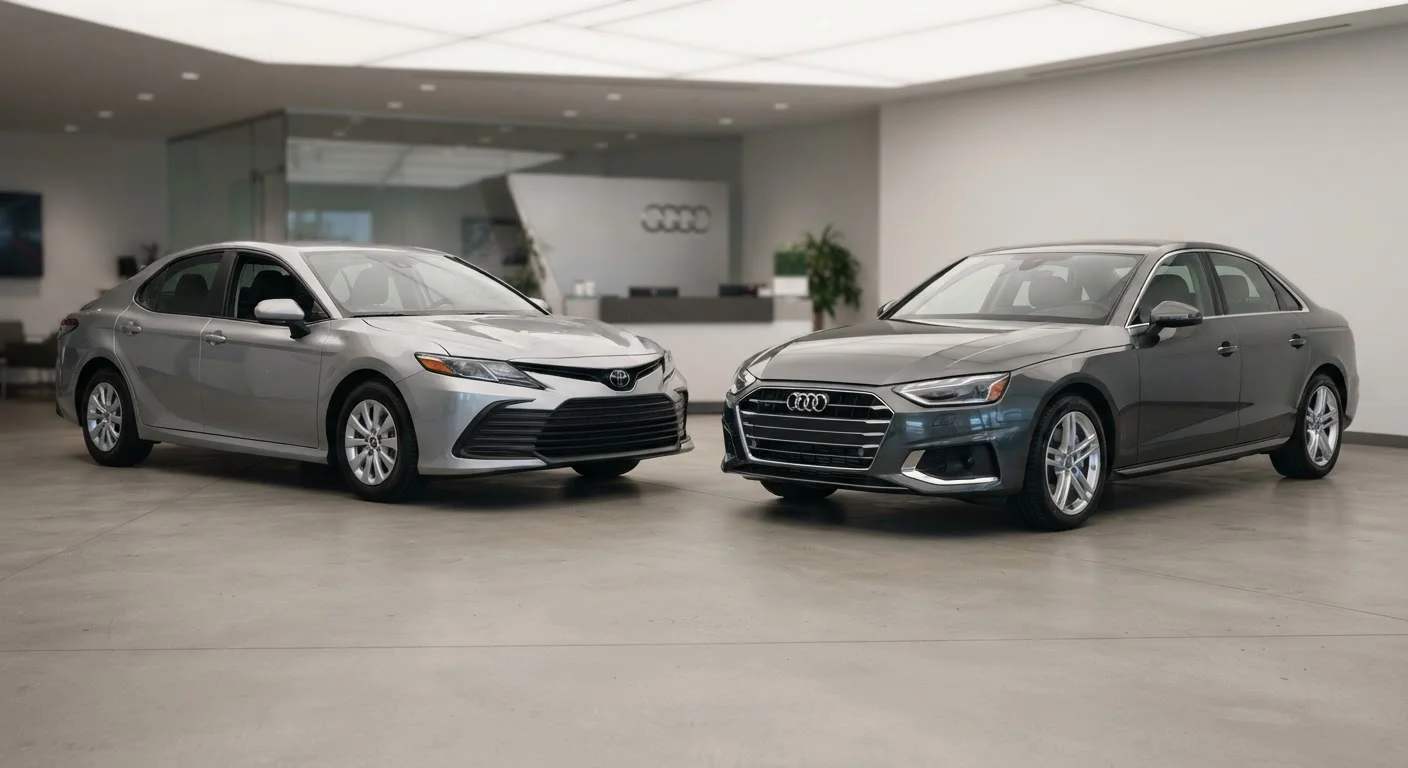
A sedan is a closed three-box design: engine compartment, passenger cabin, and a separate enclosed trunk. The trunk lid opens independently of the rear window, keeping cargo and passenger areas distinct. Sedans typically sit lower to the ground, which contributes to a smoother, more car-like ride and easier highway handling. The trade-off is a lower cargo ceiling and a fixed trunk opening that can make loading bulky items awkward.
Typical fit: Commuters, highway drivers, and anyone who prioritizes a comfortable ride and fuel efficiency over maximum cargo space.
SUV (Sport Utility Vehicle)
A traditional SUV is built on a truck-style ladder frame. That construction delivers genuine towing capacity, higher ground clearance, and available four-wheel drive suited to off-road or severe-weather use. The interior is tall and upright, and cargo space is accessed through a liftgate rather than a trunk lid. Full-size and mid-size SUVs can seat seven or eight passengers.
Typical fit: Families with large cargo needs, drivers who tow trailers or boats, and those who regularly drive on unpaved roads.
Hatchback
A hatchback uses a two-box design: one uninterrupted space combines the passenger cabin and cargo area, all accessed through a rear hatch that lifts with the window as one unit. This makes a hatchback more versatile than a sedan of similar length - fold the rear seats and you gain a genuinely useful flat cargo floor. Hatchbacks are generally compact, easy to park, and fuel efficient.
Typical fit: City dwellers, people who need flexible cargo capacity without a large vehicle, and those who do occasional weekend gear hauling.
Crossover (CUV)
A crossover blends SUV aesthetics with car-based construction. Rather than a truck frame, a crossover uses a unibody design - the same platform approach found in sedans and hatchbacks. The result is a raised ride height and an SUV-like interior volume without the stiff, truck-like driving feel. Most crossovers offer all-wheel drive as an option rather than a true four-wheel-drive system. They are currently the most popular vehicle segment in the U.S. market.
Typical fit: Drivers who want SUV practicality and visibility with a more car-like ride, better fuel economy, and easier urban maneuverability.
~50%
Share of U.S. new vehicle sales that are crossovers or SUVs
Crossovers and SUVs together have consistently accounted for roughly half or more of new passenger vehicle sales in the United States in recent model years, according to industry sales tracking data.
3
Distinct structural boxes in a traditional sedan design
A sedan's three-box shape - engine bay, passenger cabin, and separate trunk - is the defining architectural difference from hatchbacks and SUVs.
Key Differences at a Glance
Comparing body styles across a few practical dimensions cuts through marketing language quickly. Cargo flexibility, ground clearance, seating capacity, and driving feel tend to be where real differences show up day to day.
| Factor | Sedan | SUV | Hatchback | Crossover |
|---|---|---|---|---|
| Cargo access | Separate trunk | Rear liftgate | Integrated hatch | Rear liftgate |
| Ground clearance | Low | High | Low-moderate | Moderate |
| Max seating | 5 | Up to 8 | 5 | 5-7 |
| Frame type | Unibody | Ladder frame | Unibody | Unibody |
| Typical AWD availability | Limited | Standard/4WD | Rare | Common |
Once you understand body style, it becomes easier to interpret how automakers name and position their vehicles. Our overview of how automakers name their models explains the naming logic behind the lineup. For a deeper look at how a single model can change its character over time - including shifts in body style - see why the same model can feel like a different car across generations.
When you're ready to research specific models, questions worth asking when researching a car model for the first time offers a practical framework for cutting through the noise.
The Crossover vs. SUV Label Can Be Inconsistent
Automakers and dealerships sometimes use "SUV" to describe vehicles that are technically crossovers - because the term carries broader consumer appeal. When researching a specific model, check whether it uses a unibody or ladder-frame construction to understand its true capabilities. If a vehicle is listed as a "compact SUV" and shares a platform with a sedan, it is almost certainly a crossover in engineering terms. This distinction matters most if you plan to tow heavy loads or drive regularly on rough terrain.
The content on this site is for informational purposes only and is not a substitute for professional advice. Always consult a qualified professional for guidance specific to your situation.