

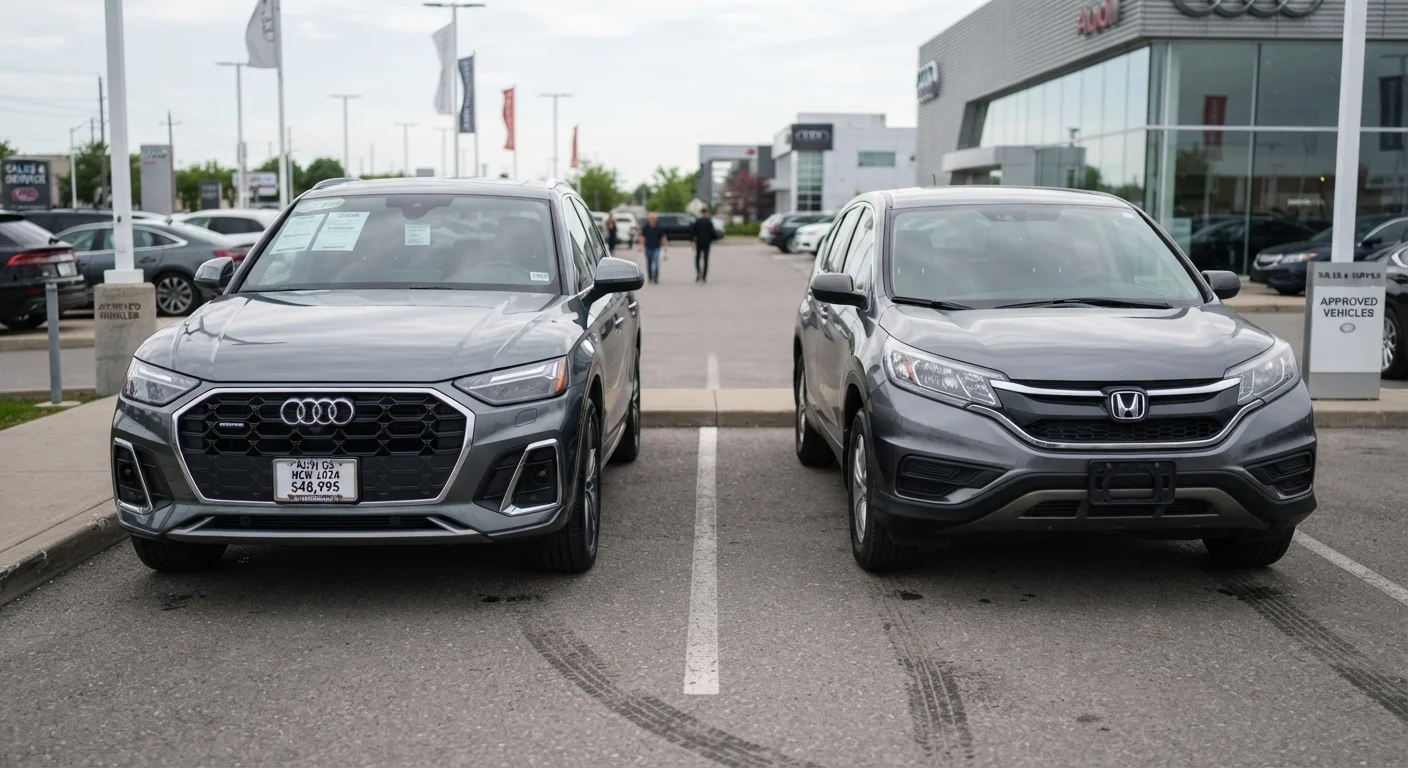
Option A
New Car
The latest features and full peace of mind - at a premium.
Best for: Buyers who want factory warranty coverage, modern safety technology, and predictable long-term reliability.
Option B
Used Car
Immediate value and lower upfront cost - with some unknowns.
Best for: Budget-conscious buyers willing to research a vehicle's history in exchange for avoiding steep early depreciation.
Depreciation: Where the Real Money Is Lost
Depreciation is the single largest cost most car owners never see as a line item - and it hits new vehicles hardest. A new car typically loses between 15% and 25% of its value in the first year, and up to 50% or more within five years, depending on the model and market conditions. That drop happens the moment the vehicle leaves the dealership lot.
For used-car buyers, this works in their favor. Purchasing a vehicle that is two to four years old means someone else absorbed that initial value loss. The vehicle depreciates more slowly from that point forward. For new-car buyers, the equation only makes financial sense if you plan to keep the car long enough to spread that cost over many years of use - and if the warranty and reliability benefits justify the premium.
Understanding the full picture of what a vehicle costs over time goes well beyond the purchase price. Our guide on the real cost of owning a car breaks down depreciation alongside insurance, fuel, and maintenance.
| Criterion | New Car | Used Car |
|---|---|---|
| Depreciation | Steepest in first 1-2 years | Initial drop already absorbed |
| Purchase Price | Higher sticker price | Lower upfront cost |
| Warranty Coverage | Full manufacturer warranty included | Limited or none; CPO adds some |
| Financing Rate | Often lower APR | Often higher APR |
| Insurance Cost | Generally higher premiums | Generally lower premiums |
| Technology & Safety Features | Latest available standards | Varies by model year |
| Reliability Risk | Lower near-term risk | Depends on maintenance history |
| Vehicle History Uncertainty | None - provenance is known | Requires research and inspection |
Warranty, Reliability, and Hidden Repair Costs
New cars come with a manufacturer's warranty - typically a bumper-to-bumper coverage period of three years and a powertrain warranty of five years or more, depending on the brand. That coverage means most mechanical failures during that window won't cost you out of pocket. It also provides a degree of predictability that used vehicles cannot always match.
Used cars carry more uncertainty. A vehicle with 60,000 miles may be well past its original warranty, meaning any significant repair - a transmission issue, a failed water pump - becomes the buyer's expense. The risk varies enormously by make, model, and how the previous owner maintained it. A thorough pre-purchase inspection by an independent mechanic and a complete vehicle history report are essential steps, not optional ones.
One middle path worth exploring is a certified pre-owned (CPO) vehicle. These are used cars that have passed a manufacturer-defined inspection and typically come with an extended limited warranty. Our CPO vs. regular used guide explains what certification actually covers and when the added cost makes sense.
~20%
Average first-year new car depreciation
Industry estimates commonly place new vehicle depreciation at 15-25% in the first year, with variation by brand and market demand.
3-5 yrs
Typical new car bumper-to-bumper warranty
Most major manufacturers offer at least a 3-year bumper-to-bumper warranty, with powertrain coverage extending to 5 years or beyond on many models.
Up to 50%
Value loss within five years (new vehicles)
Automotive valuation analysts generally estimate new vehicles lose between 40-60% of their original value over the first five years of ownership.
Financing Rates, Insurance, and the Total Monthly Picture
Interest rates on auto loans are not uniform across new and used vehicles. Lenders - including banks, credit unions, and dealerships - frequently offer lower annual percentage rates (APRs) on new car loans than on used ones, partly because a new vehicle represents more predictable collateral. However, the higher sticker price of a new vehicle often results in a larger loan balance, which can mean higher monthly payments even with a lower rate.
Used cars typically carry higher loan rates but smaller principal amounts. The monthly payment on a used vehicle is often lower in practice, though buyers with less-than-strong credit histories may see that rate gap widen significantly. It's worth comparing lender options carefully. Our article on dealer financing vs. outside lenders offers a balanced breakdown of both channels.
Insurance costs also differ. New vehicles cost more to insure, in part because their replacement value is higher and because comprehensive and collision coverage - typically required by lenders - costs more on a vehicle worth more. A used car in the same category will generally carry a lower insurance premium, though this varies by model, location, driver history, and insurer. Always request insurance quotes for any specific vehicle before finalizing a purchase decision.
Loan Terms Affect the True Cost Significantly
Stretching a loan to 72 or 84 months lowers monthly payments but increases total interest paid - and can leave you owing more than the car is worth (known as being "underwater" on the loan). Whether buying new or used, shorter loan terms typically reduce overall cost even if monthly payments are higher. Compare total loan cost, not just the monthly figure, before committing.
Making the Call: What Fits Your Situation
There is no universally correct answer between new and used. The right choice depends on how long you plan to own the vehicle, how much financial risk you can absorb in repairs, how important the latest technology and safety features are to you, and what your monthly budget can support without strain.
If reliability and low-risk ownership are your priorities and you have the financial flexibility, a new car's warranty coverage provides real value - especially if you intend to drive it for a decade. If you are focused on minimizing monthly costs and comfortable doing homework on a vehicle's history, a well-maintained used car bought at the right price is a financially sound decision for most drivers.
Before finalizing anything, review what you actually know - and don't know - about where the vehicle is coming from. Our guide comparing private sellers vs. dealerships outlines how the buying channel affects your protections, price, and process.
The content on this site is for informational purposes only and is not a substitute for professional advice. Always consult a qualified professional for guidance specific to your situation.