

Start here
Why Tyre Maintenance Matters
Core skill
Checking Tyre Pressure
Next step
Reading Tread Depth
Go further
Tyre Rotation and Alignment
Stay alert
Spotting Damage Early
Why Tyre Maintenance Matters
Your tyres are the only part of your car that contacts the road. Everything else - steering, braking, acceleration - depends on four palm-sized contact patches working reliably at any given moment. That makes tyre condition one of the most direct influences on your safety and your vehicle's performance.
Neglected tyres don't just wear out faster; they reduce braking effectiveness, increase the risk of a blowout, and quietly drain fuel economy. The good news is that routine tyre care requires no specialist tools and very little time. Understanding a handful of fundamentals puts you firmly in control. For context on how driving habits feed into tyre wear, see everyday habits that accelerate wear.
Checking Tyre Pressure
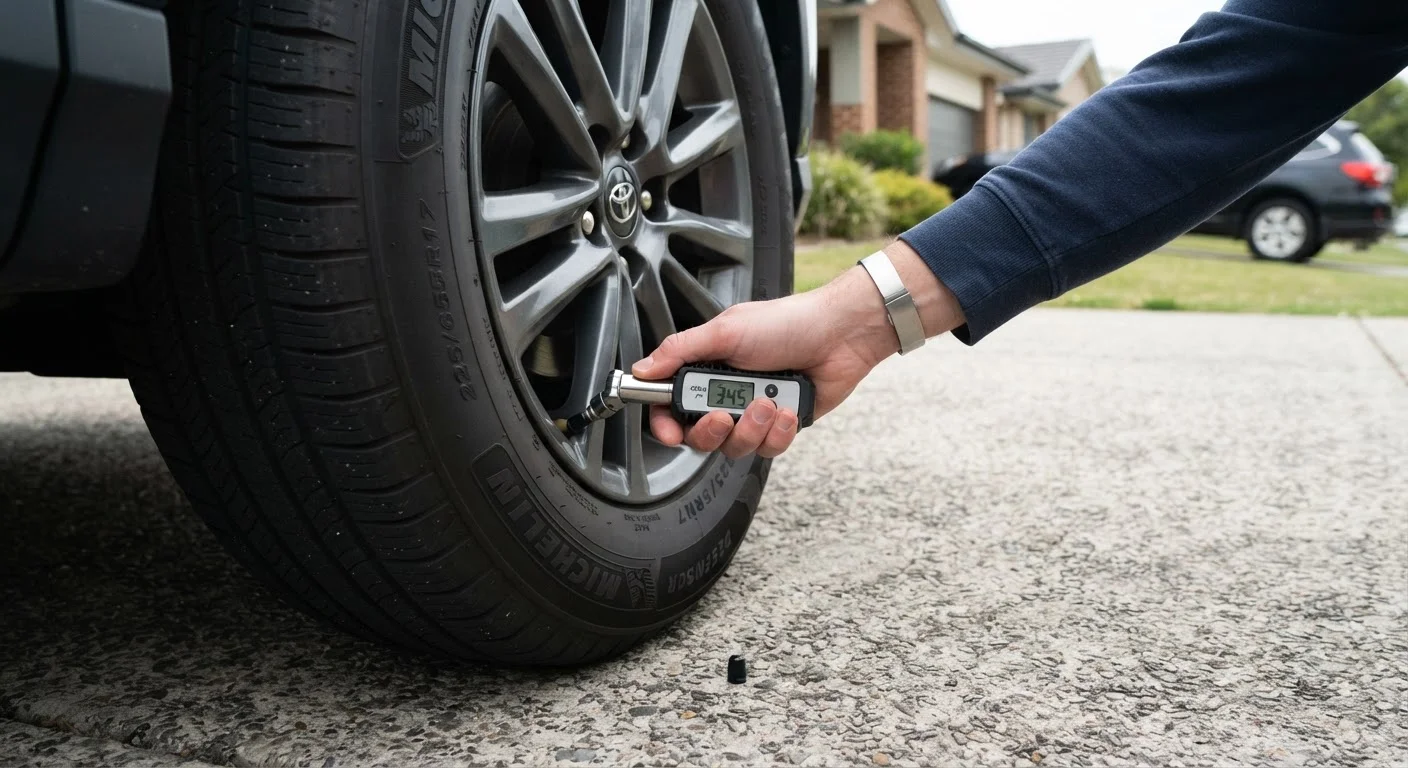
Tyre pressure is measured in PSI. The correct figure for your vehicle is printed on a sticker inside the driver's door jamb or in your owner's manual. Do not rely on the number molded into the tyre sidewall - that is the maximum the tyre can safely hold, not the recommended operating pressure.
To get an accurate reading, check pressure when tyres are cold (the car undriven for at least three hours). Use a quality dial or digital gauge, remove the valve cap, press the gauge firmly onto the valve stem, and read the display. If pressure is low, add air using a service station pump or a portable compressor. Recheck after adding air to avoid over-inflation.
Don't Rely Solely on Your Dashboard Warning
Most modern vehicles include a Tyre Pressure Monitoring System (TPMS) that triggers a dashboard warning when pressure drops significantly. However, the warning typically activates only after pressure is already 25% below the recommended level - well into unsafe territory. Manual checks catch problems before the light comes on.
Most modern vehicles include a Tyre Pressure Monitoring System (TPMS) that triggers a dashboard warning when pressure drops significantly. However, the warning typically activates only after pressure is already 25% below the recommended level - well into unsafe territory. Manual checks catch problems before the light comes on.
Reading Tread Depth
Tread depth
The measurement from the top of a tyre's rubber surface down into its grooves. Deeper tread channels water away from the road contact area more effectively.
Tyre pressure (PSI)
The amount of air inside a tyre, measured in pounds per square inch. Too little or too much pressure both reduce tyre performance and safety.
Tyre rotation
Moving each tyre to a different position on the vehicle so that all four tyres wear at a similar rate over time.
Wheel alignment
The adjustment of the angles at which your tyres sit relative to the road and to each other, ensuring even contact and straight tracking.
TPMS
Tyre Pressure Monitoring System - a sensor built into most modern vehicles that alerts the driver when tyre pressure drops significantly below the recommended level.
Sidewall
The vertical side of a tyre between the tread and the wheel rim. It carries size and specification markings and protects the tyre's internal structure.
Tread depth is what allows tyres to channel water away from the contact patch and maintain grip on wet roads. As tread wears down, that ability diminishes. In the US, tyres are legally required to have at least 2/32 of an inch of tread depth remaining. Many safety professionals recommend replacing tyres at 4/32 of an inch, particularly for driving in rain or snow.
A quick field test: insert a quarter upside-down (Washington's head facing down) into a tread groove. If the top of the head is visible, you're approaching 4/32 of an inch. A penny used the same way indicates approximately 2/32 of an inch - the legal minimum. Inexpensive tread depth gauges are also widely available and give more precise readings.
Uneven tread wear - one edge wearing faster than the other, or cupping and scalloping patterns - often signals an alignment or inflation problem rather than normal use. If you notice uneven wear, have a qualified mechanic assess alignment and suspension components.
Tyre Rotation and Alignment
Tyre rotation involves moving each tyre to a different position on the vehicle - for example, moving the front tyres to the rear and vice versa. Because front tyres typically shoulder more braking and steering stress, they tend to wear faster. Rotating tyres every 5,000-7,500 miles (or as specified in your owner's manual) distributes that wear more evenly across all four tyres.
Wheel alignment refers to the angles at which your tyres contact the road. Misalignment - often caused by hitting a pothole or curb - causes rapid, uneven tread wear and can make the vehicle pull to one side. Signs of alignment issues include the car drifting without steering input, uneven shoulder wear on tyres, or a steering wheel that sits off-center on a straight road. Alignment should be checked by a qualified technician whenever you notice these symptoms or after significant impacts.
Logging tyre rotations and alignment checks as part of your vehicle's service record helps you track wear patterns over time. See our guide on keeping a complete service record for practical advice on what to document.
Spotting Damage Early
A visual inspection of your tyres takes less than a minute and can catch problems before they become dangerous. Walk around your vehicle periodically and look for:
- Bulges or bubbles on the sidewall - these indicate internal structural damage and mean the tyre should be replaced promptly.
- Cracking or crazing in the sidewall rubber, which can signal age-related degradation (tyres older than six years warrant careful inspection regardless of tread depth).
- Embedded objects such as nails or screws - a qualified technician can assess whether a repair is safe or replacement is needed.
- Cuts or gouges deep enough to expose the internal cords beneath the rubber.
When to Pull Over Immediately
If you notice a vibration while driving, a change in how the vehicle handles, or a sudden loss of pressure, pull over safely as soon as possible and inspect the tyre. Do not continue driving on a tyre showing visible structural damage - doing so risks a blowout and loss of vehicle control.
If you notice a vibration while driving, a change in how the vehicle handles, or a sudden loss of pressure, pull over safely as soon as possible and inspect the tyre. Do not continue driving on a tyre showing visible structural damage.
Pairing consistent tyre checks with a broader maintenance routine helps you build a complete picture of your vehicle's condition. Our guide on building a maintenance schedule around your driving patterns explains how to tailor these tasks to how often and how far you drive. For more detail on decoding the markings printed on your tyre, see what the numbers on your tyre sidewall mean.
Frequently Asked Questions
Check tyre pressure at least once a month and before any long trip. Pressure should be measured when the tyres are cold - meaning the vehicle hasn't been driven for at least three hours - because driving heats air inside the tyre and temporarily raises the reading.
The correct pressure is listed on a sticker inside the driver's door jamb or in your owner's manual - not on the tyre sidewall. The sidewall figure is the maximum pressure the tyre can hold, which is different from the manufacturer's recommended operating pressure.
Insert a quarter upside-down into a tread groove. If the top of Washington's head is visible, your tread is at or near 4/32 of an inch - the point many safety professionals recommend replacement. At 2/32 of an inch, replacement is legally required in most US states.
Rotation moves each tyre to a different position on the vehicle to distribute wear more evenly. Front tyres typically wear faster than rear tyres, especially on front-wheel-drive cars. Regular rotation helps all four tyres last a similar amount of time.
Driving on an underinflated tyre - even with a slow leak - increases heat buildup and can lead to a blowout. It also causes uneven wear. If you notice a slow leak, have it inspected by a qualified tyre technician as soon as possible rather than continuing to top it up.
An underinflated tyre creates more rolling resistance, meaning your engine has to work harder to move the vehicle. The US Department of Energy has noted that keeping tyres properly inflated can improve fuel economy. Even small pressure deficits across all four tyres add up over time.
The content on this site is for informational purposes only and is not a substitute for professional advice. Always consult a qualified professional for guidance specific to your situation.