

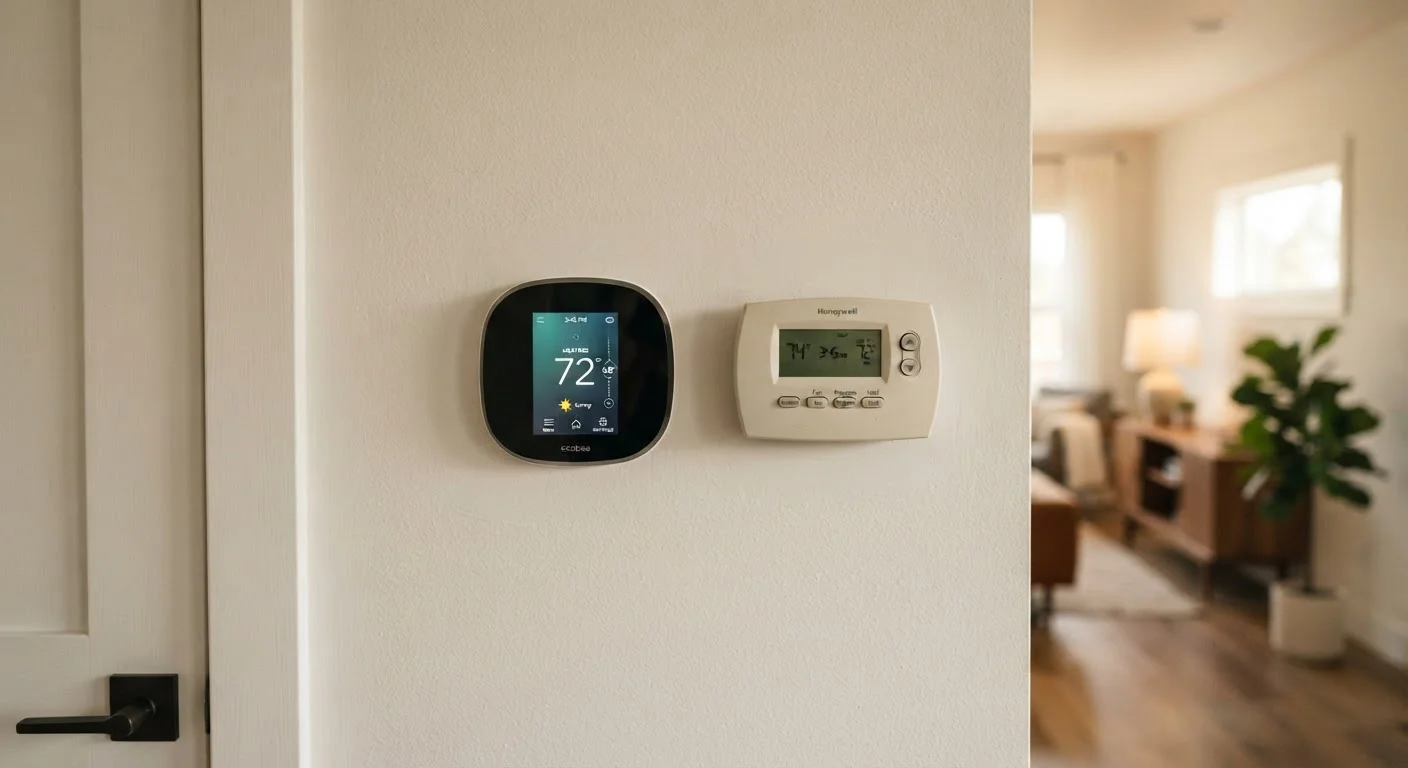
Option A
Smart Thermostat
The connected, adaptive option for hands-off comfort.
Best for: Households that want remote access, learning features, and integration with other connected home devices.
Option B
Programmable Thermostat
The reliable, set-it-and-forget-it scheduling choice.
Best for: Households with predictable routines who want scheduled temperature control without Wi-Fi dependency.
The Core Difference: Scheduled vs. Responsive
Both types of thermostat let you move beyond manually adjusting the temperature every time you leave or come home. But they handle that job in fundamentally different ways.
A programmable thermostat follows a schedule you enter yourself - for example, lowering the heat at 8 a.m. when everyone leaves and raising it again at 5:30 p.m. before they return. Once set, it repeats that pattern. It doesn't know whether you're actually home, whether your plans changed, or what the weather is like outside.
A smart thermostat connects to your home Wi-Fi and can do considerably more. It can be controlled remotely through a smartphone app, respond to voice commands if paired with a compatible assistant, and in many cases learn your patterns over time to adjust temperatures without you having to program anything manually. Some models also use sensors or phone location to detect whether anyone is home and modify settings accordingly.
That responsiveness is the defining gap. A programmable thermostat does what you tell it, on the schedule you set. A smart thermostat can react to what's actually happening. For a deeper look at what connected home devices can and can't do, see what 'smart home' really means.
| Criterion | Smart Thermostat | Programmable Thermostat |
|---|---|---|
| Remote control | Yes, via smartphone app | No |
| Learning capability | Yes, on many models | No |
| Wi-Fi required | Yes | No |
| Voice assistant support | Often supported | Not available |
| Typical upfront cost | Higher | Lower |
| Works during internet outage | Basic functions only | Full function |
| Setup complexity | Moderate (app, account, C-wire) | Low (manual programming) |
| Schedule flexibility | Automatic or manual | Manual only |
Cost, Setup, and Reliability
Programmable thermostats are generally less expensive to buy and straightforward to install - most follow a standard wiring setup compatible with common HVAC systems. They don't require an app, an account, or a Wi-Fi password. Once programmed, they work independently.
Smart thermostats typically cost more upfront. Setup involves connecting to Wi-Fi, creating an account with the manufacturer, and in some cases downloading an app. This also means they depend on cloud services to some degree - if the manufacturer discontinues support or a server goes down, some features may stop working. Understanding the difference between local and cloud-dependent devices matters here, especially if long-term reliability is a priority for you.
It's also worth noting that smart thermostats typically require a common wire (called a C-wire) to power their Wi-Fi radio and display continuously. Older homes may not have one, which can mean additional installation work or compatibility issues.
~45%
Share of home energy used for heating and cooling
The U.S. Department of Energy estimates that heating and cooling account for the largest portion of a typical home's energy bill.
42%
Programmable thermostat owners who rarely use scheduling
Research published in Energy and Buildings found that a significant share of programmable thermostat owners seldom or never use the scheduling function.
Energy Savings: What the Evidence Suggests
One common claim is that smart thermostats save meaningful amounts of energy compared to programmable ones. The picture is a bit more nuanced.
A programmable thermostat can absolutely reduce energy use - if people actually use it correctly. Studies have found that many households either never fully program their device or override the schedule so often that the savings are minimal. The thermostat's potential doesn't translate into real-world savings if the settings don't match how the home is actually used.
Smart thermostats close that gap somewhat by adapting to real behavior. Features like occupancy sensing and learning algorithms mean the device can make adjustments even when residents don't think to. That said, savings depend heavily on your existing habits, home size, climate, and how well the device is configured. No thermostat - smart or otherwise - guarantees specific energy or cost reductions.
If you're interested in how automation fits into a broader energy strategy at home, this look at where smart home tech genuinely helps vs. complicates offers a balanced perspective.
Check Compatibility Before You Buy
Not every thermostat works with every HVAC system. Heat pumps, multi-stage systems, and older wiring setups can limit which models are compatible. Before replacing any thermostat, check your current wiring configuration and review the compatibility specifications for the model you're considering. When in doubt, a licensed HVAC technician can advise on the right fit for your setup.
The content on this site is for informational purposes only and is not a substitute for professional advice. Always consult a qualified professional for guidance specific to your situation.