

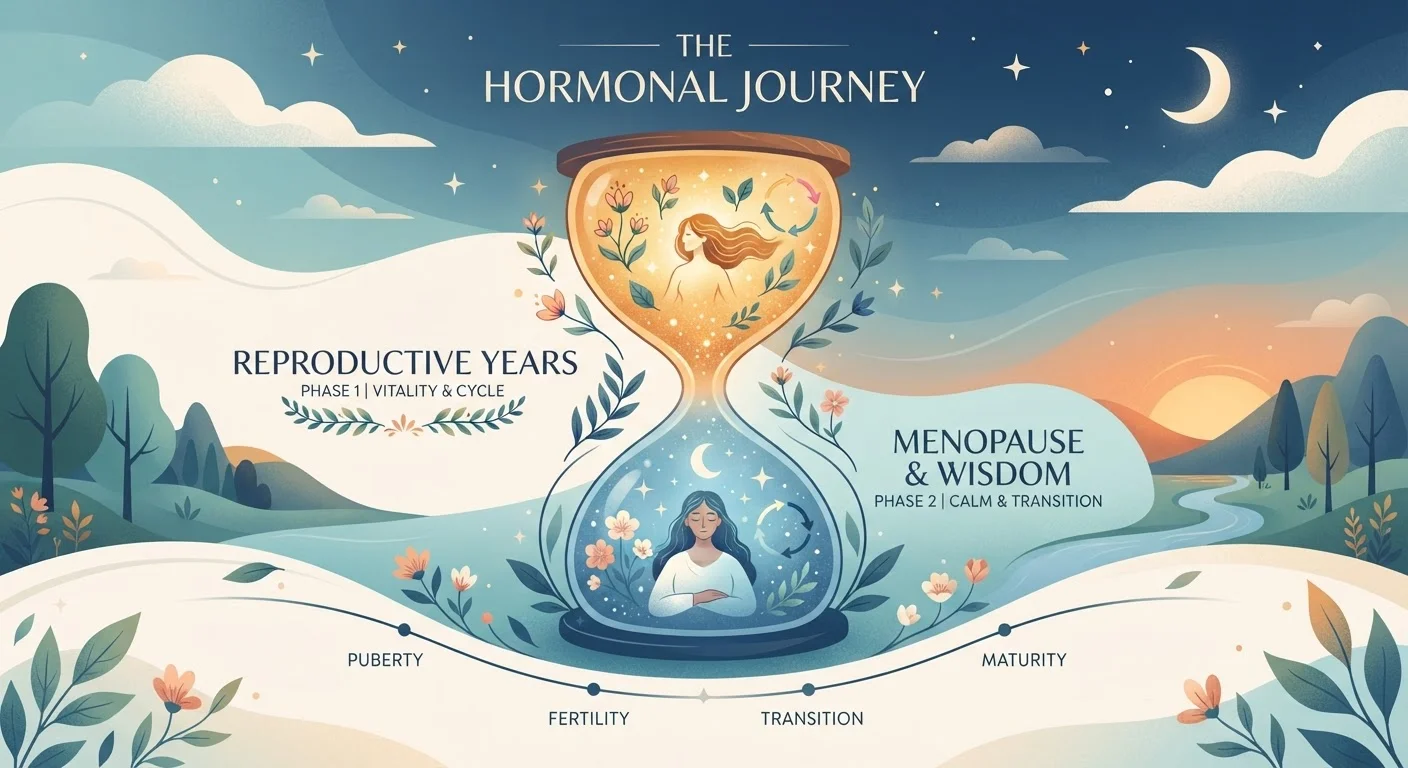
Option A
Perimenopause
The transitional runway leading up to menopause.
Best for: Understanding the years of hormonal fluctuation, irregular periods, and early symptoms before menstruation stops entirely.
Option B
Menopause
The definitive end of the menstrual cycle.
Best for: Recognizing the confirmed milestone when periods have ceased for 12 consecutive months and a new hormonal baseline is established.
What Is Perimenopause?
Perimenopause - sometimes called the menopausal transition - is the period leading up to menopause during which the ovaries gradually produce less estrogen. It typically begins in a woman's mid-to-late 40s, though it can start earlier, and lasts an average of four to eight years. Some women experience it for only a year or two; others navigate it for a decade.
The defining characteristic of perimenopause is hormonal unpredictability. Estrogen and progesterone levels don't decline in a straight line - they fluctuate, sometimes dramatically, from month to month. This is why periods may become irregular: shorter, longer, heavier, lighter, or skipped altogether. Crucially, menstruation has not stopped. Ovulation is still occurring, even if inconsistently, which means pregnancy is still possible.
Symptoms during this phase can include hot flashes, night sweats, sleep disturbances, vaginal dryness, mood changes, and brain fog. Because these symptoms overlap with many other conditions, perimenopause is often underrecognized. Understanding the phases of your menstrual cycle and how they shift during this time can help you and your provider identify what's happening. Hormone-related mood changes, discussed in the context of the premenstrual spectrum, can also intensify during perimenopause.
What Is Menopause?
Menopause is not a process - it is a single point in time, defined clinically as 12 consecutive months without a menstrual period. At that point, the ovaries have significantly reduced their production of estrogen and progesterone, and fertility effectively ends. The average age of menopause in the United States is around 51, though natural menopause can occur anywhere from the mid-40s to the late 50s.
Because menopause is only confirmed in retrospect, many people don't know they've reached it until well after the fact. Once that 12-month threshold has passed, everything that follows is technically described as postmenopause - the stage in which a new, lower hormonal baseline has settled in.
The symptoms of menopause are largely a continuation of what began during perimenopause, but for many women they gradually ease over time. Others continue to experience hot flashes, sleep disruption, or urogenital changes for years. Longer-term health considerations - particularly bone density and cardiovascular health - become more relevant after menopause, as consistently lower estrogen levels affect multiple body systems. Protecting bone health is an especially important consideration at this stage.
Key Differences at a Glance
While perimenopause and menopause are part of the same biological journey, they differ in significant and practical ways. Understanding which stage you're in affects everything from contraception decisions to how you and a provider might approach symptom management.
| Criterion | Perimenopause | Menopause |
|---|---|---|
| Definition | Transitional phase before menopause | 12 months without a period |
| Duration | Typically 4-8 years | A single point in time |
| Menstruation | Irregular but still occurring | Has fully stopped |
| Fertility | Reduced but possible | Effectively ended |
| Hormone levels | Fluctuating, unpredictable | Consistently lower, more stable |
| Typical age of onset | Mid-to-late 40s | Around 51 on average |
| Diagnosis method | Symptoms and cycle history | Confirmed retrospectively after 12 months |
It's also worth noting that induced menopause - from surgical removal of the ovaries or certain medical treatments - can occur at any age and often produces more abrupt symptoms than natural menopause, since the hormonal shift happens suddenly rather than gradually.
When to Talk to a Healthcare Provider
Neither perimenopause nor menopause requires a formal diagnosis to be real or significant, but a healthcare provider plays an important role in ruling out other causes of symptoms and guiding appropriate support. Heavy or very irregular bleeding, symptoms that significantly disrupt daily life, or menopause occurring before age 40 (known as premature ovarian insufficiency) all warrant professional evaluation.
Perimenopause Can Be Easy to Miss
Because perimenopausal symptoms overlap with conditions like thyroid disorders, depression, or simple aging, they're frequently attributed to other causes. Blood tests can check hormone levels, but these fluctuate so much during perimenopause that a single result is rarely definitive. Tracking your cycle and symptoms over time gives a provider much more useful information than a snapshot hormone panel alone.
Management options vary widely and depend on overall health, symptom severity, and personal preference. They may include lifestyle strategies, non-hormonal approaches, or hormone therapy - a topic that carries both potential benefits and risks that should be weighed individually with a provider. This article provides general health information only and is not a substitute for personalised medical advice.
This article is for informational purposes only and is not medical advice. Always consult a qualified healthcare professional regarding any symptoms or decisions about your health.
The content on this site is for informational purposes only and is not a substitute for professional advice. Always consult a qualified professional for guidance specific to your situation.