

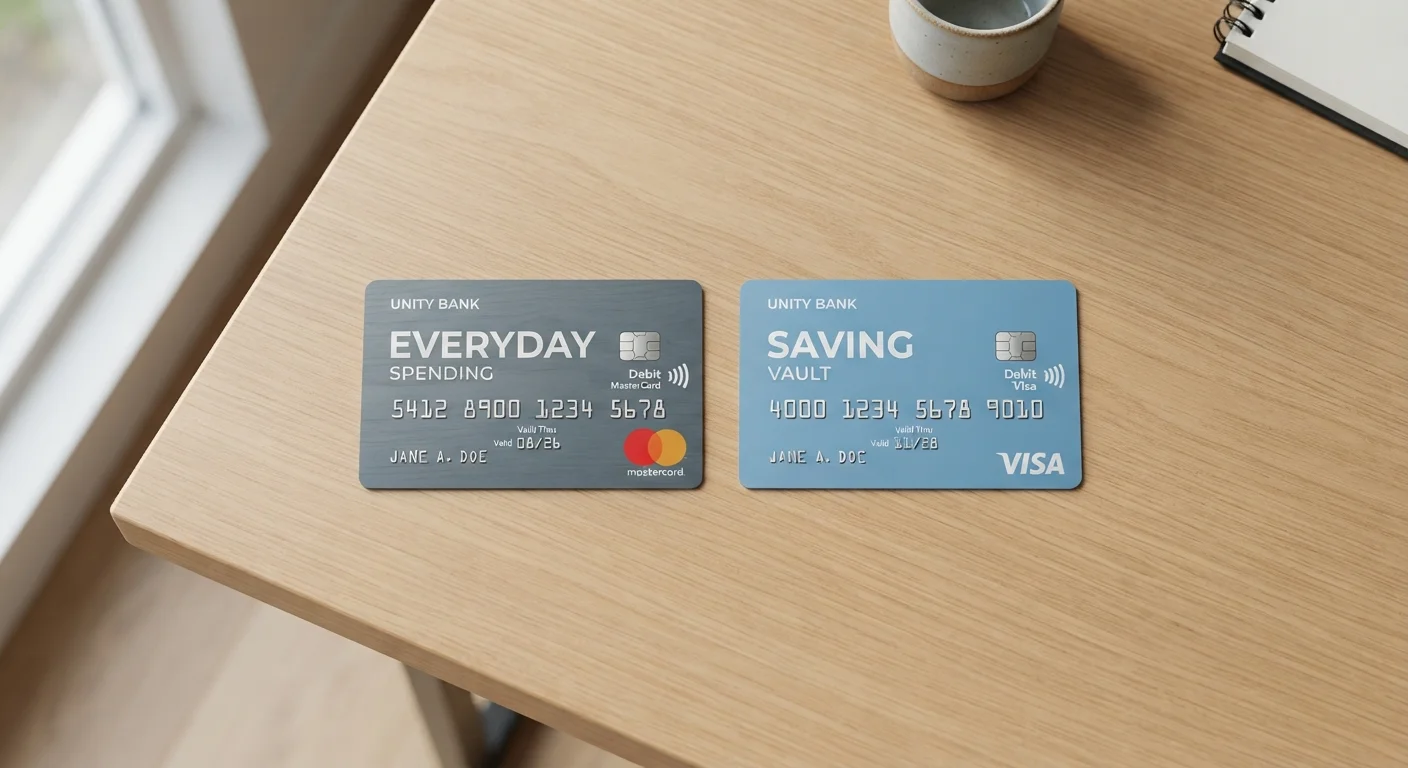
Option A
Checking Account
The everyday transaction hub
Best for: Anyone who needs frequent, flexible access to their money for daily purchases, bill payments, and direct deposits.
Option B
Savings Account
The dedicated holding place for money you're not spending yet
Best for: Anyone building an emergency fund, setting aside money for a goal, or wanting to earn modest interest on funds they don't need daily.
The Core Purpose of Each Account
A checking account is designed around movement — money flowing in and out regularly. It's where most people receive their paycheck, pay bills, and make everyday purchases with a debit card or checks. There's generally no limit on how many transactions you can make, which reflects its core purpose: frictionless daily access.
A savings account is built around accumulation. The idea is to deposit money and leave it there until you need it. Banks pay interest on savings balances — usually expressed as an APY — as an incentive to keep funds in the account rather than spend them immediately. The interest rate on standard savings accounts is modest, though high-yield savings accounts offered by some banks and credit unions can pay meaningfully more.
Understanding this fundamental difference in design helps explain almost every other way the two accounts diverge — from transaction limits to fee structures. For a deeper look at how the broader banking system tracks your financial behavior, see how credit reports and credit scores differ.
Access Rules and Transaction Limits
Checking accounts impose virtually no limits on how often you can withdraw, transfer, or pay. That flexibility is the point.
Savings accounts have historically operated under tighter restrictions. A federal rule called Regulation D once required banks to limit certain electronic withdrawals from savings accounts to six per month. The Federal Reserve suspended that requirement in 2020, but many banks still enforce their own version of this limit. Exceeding it can trigger fees or, at some institutions, result in the account being converted to a checking account.
This distinction matters when you're deciding where to park money. Funds you'll need to tap unpredictably belong in checking. Money you can leave alone — your emergency fund, a vacation fund, a home repair reserve — is a better fit for savings. If you want to understand how transactions appear on your statements afterward, reading a bank statement without getting lost is a useful next step.
| Criterion | Checking Account | Savings Account |
|---|---|---|
| Primary purpose | Daily transactions and spending | Holding and growing funds |
| Transaction limits | Unlimited | Often 6/month (varies by bank) |
| Earns interest | Rarely; some accounts do | Yes, typically |
| Debit card access | Standard | Uncommon |
| Common fees | Monthly maintenance, overdraft | Monthly maintenance, excess withdrawals |
| FDIC/NCUA insured | Yes, up to $250,000 | Yes, up to $250,000 |
Fee Structures and What Affects Them
Both account types can carry fees, but the specific charges differ.
Checking accounts commonly have monthly maintenance fees, though many banks waive these if you meet conditions like maintaining a minimum balance or setting up direct deposit. Overdraft fees — charged when you spend more than your available balance — are a significant source of costs for some checking account holders. For a full breakdown of how overdraft coverage works, see overdraft protection: how it works and what it costs.
Savings accounts may also charge monthly fees, sometimes waived with a minimum daily balance. Excess transaction fees apply at institutions that still limit withdrawals. Some savings accounts have no monthly fee at all, particularly at online banks and credit unions.
Neither account type guarantees fee-free banking — the specific terms depend entirely on the institution and the account agreement. Always review the fee schedule before opening an account.
$250,000
Federal deposit insurance limit per depositor
The FDIC insures deposits up to this amount per depositor, per FDIC-member institution, per ownership category.
6/month
Historical savings withdrawal limit under Regulation D
The Federal Reserve suspended this requirement in April 2020, but many banks still apply their own limits.
FDIC Insurance and Safety
Both checking and savings accounts at FDIC-member banks are insured up to $250,000 per depositor, per institution, per ownership category. Credit unions offer equivalent coverage through the NCUA. This means that if a bank fails, the federal government guarantees your deposits up to that limit — a protection that has been in place since the 1930s.
This insurance applies regardless of whether the funds are in checking or savings. The distinction matters more if you're holding very large balances at a single institution, in which case the ownership-category rules become important to understand.
Using Both Accounts Together
Many people find it practical to maintain both a checking and a savings account simultaneously — sometimes at the same institution, sometimes at different ones. A common approach is to keep a working balance in checking for regular expenses and transfer surplus funds to savings on a schedule. This separation makes it easier to track spending versus saving progress without mixing the two.
Once you have both account types working together, the next question is often how to actually grow what's in your savings account. Saving strategies compared: lump-sum, automated, and pay-yourself-first walks through three common approaches. You can also explore the broader Saving & Debt hub for more context.
This article is for general informational purposes only and does not constitute personalized financial or banking advice. Account terms, fees, and rates vary by institution. Consult a licensed financial professional or review your bank's account disclosures for guidance specific to your situation.
The content on this site is for informational purposes only and is not a substitute for professional advice. Always consult a qualified professional for guidance specific to your situation.