

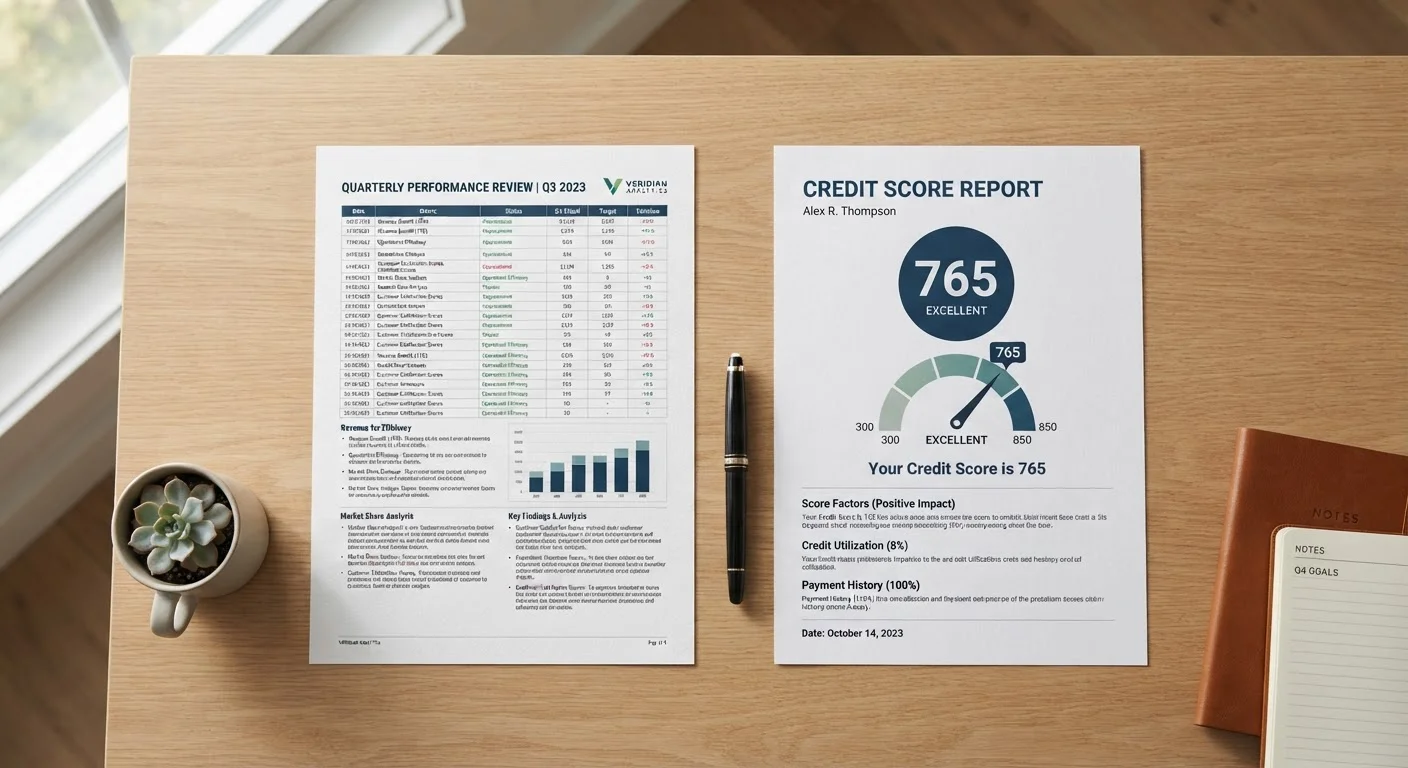
Two Terms, Two Different Things
Most people use "credit report" and "credit score" as if they mean the same thing. They don't — and the difference matters more than you might expect when you're applying for a loan, renting an apartment, or just trying to understand your financial standing.
Think of it this way: your credit report is the raw data, and your credit score is a calculation built from that data. One is a detailed history; the other is a summary number. Understanding both — and how they connect — gives you a clearer picture of how lenders see you. For a deeper look at what goes into the number itself, see our Credit Scores Decoded guide.
Myth
Your credit report and credit score are just two names for the same document.
Fact
They are distinct: a credit report is a detailed history file, while a credit score is a number calculated from that file.
A credit report contains pages of detailed account information — balances, payment dates, lender names, and more. A credit score condenses all of that into a single number using a mathematical model. The report is the source material; the score is a derived output. Neither one alone tells the full story.
Myth
You only have one credit score.
Fact
You have multiple credit scores, potentially dozens, depending on which bureau's data is used and which scoring model is applied.
FICO alone has released multiple scoring model versions, and lenders may use different versions for different types of credit. VantageScore is another common model. Because the three bureaus maintain separate files, the same model applied to different bureau data can still produce different numbers for the same person.
Myth
Checking your own credit report will hurt your credit score.
Fact
Checking your own credit report or score is a "soft inquiry" and has no effect on your score.
Only "hard inquiries" — those triggered when a lender reviews your file as part of an application for new credit — can affect your score, and even then the impact is typically small and temporary. Consumers checking their own files, or companies doing pre-approval screening, generate soft inquiries that are invisible to scoring models.
Myth
If you pay off a debt, it disappears from your credit report immediately.
Fact
Paid accounts typically remain on your credit report for up to seven years, though their status updates to reflect that they're paid.
Reporting timelines are governed by the Fair Credit Reporting Act (FCRA). Most negative information — such as late payments or collections — can remain for up to seven years from the date of the original delinquency. Paying off the account is reflected as a status change, which can improve your score over time, but the account record itself doesn't vanish right away.
Myth
Your income and bank account balances are factored into your credit score.
Fact
Standard credit scoring models do not consider income, savings balances, or net worth — only credit-related behavior reported to the bureaus.
Credit scores are built purely from data in your credit file: things like whether you pay on time, how much of your available credit you're using, how long your accounts have been open, and how many new accounts you've applied for. A high income doesn't raise your score; a low income doesn't lower it. Lenders may review income separately when deciding whether to approve a loan, but that's outside the scoring model itself.
What Your Credit Report Actually Contains
Your credit report is a file maintained by each of the three major credit bureaus — Equifax, Experian, and TransUnion. It records your history with credit over time. A typical report includes:
- Personal identifying information — your name, current and past addresses, Social Security number, and date of birth
- Account history — every credit card, loan, or line of credit you've opened, including payment history, balances, credit limits, and account status
- Public records — bankruptcies or similar legal financial events that meet reporting thresholds
- Inquiries — a log of who has requested your credit file and when
Because each bureau collects data independently, your three reports won't always be identical. A creditor that reports to only one bureau, for example, would appear on just that bureau's file. That's one reason your score can differ depending on which bureau a lender checks.
Under federal law, you're entitled to at least one free credit report from each bureau annually through AnnualCreditReport.com, the official source authorized by the Federal Trade Commission.
1 in 5
Americans with a credit report error
A Federal Trade Commission study found that about one in five consumers had an error on at least one of their three credit reports.
3
Separate credit bureau files per consumer
Equifax, Experian, and TransUnion each maintain independent credit files, meaning the same consumer can have three distinct credit reports at any given time.
What a Credit Score Is — and Isn't
A credit score is a three-digit number, typically ranging from 300 to 850, that a scoring model calculates using the information in your credit report. The most widely used models are developed by FICO and VantageScore, though lenders sometimes use proprietary variations.
Importantly, you don't have a single credit score — you have many. Each bureau can produce its own score using the data in its own file. Different scoring models weigh factors differently. A mortgage lender might use a different model than an auto lender. The score you see on a free credit monitoring app may not be the exact score a lender pulls. For a breakdown of what drives the number, our article on the five factors behind your credit score explains each element in plain terms.
One practical implication: if you're preparing to finance a vehicle, knowing how lenders use the score — not just what the number is — helps set realistic expectations. See how credit scores affect the car-buying process for context on that specific situation.
Your Score Depends on Which Report Is Pulled
Because the three bureaus collect data independently, a lender checking Experian may see a different score than one checking TransUnion — even on the same day. Before applying for a major loan, it's worth reviewing all three of your credit reports so you know what each file shows. Errors or missing positive accounts on one bureau's file won't automatically be reflected on the others.
Why Monitoring Both Matters
Because your score is derived from your report, errors in the report can lower your score without your knowledge. The Consumer Financial Protection Bureau (CFPB) notes that reviewing your credit reports regularly is one of the most practical steps you can take to catch inaccuracies before they cause harm — whether that's a wrongly reported late payment, an account you don't recognize, or a hard inquiry you didn't authorize.
If you find an error, each bureau has a dispute process that requires them to investigate and correct verifiable mistakes. Correcting a significant error can meaningfully affect the score that gets calculated from your report. For more on how certain activity shows up on your file, see our explainer on hard inquiries vs. soft inquiries.
Free Report Access Has an Official Source
AnnualCreditReport.com is the only federally authorized site for free credit report access from all three major bureaus. Many look-alike sites exist that may charge fees or collect personal data under misleading terms. The CFPB and FTC both direct consumers to the official site as the safe, no-cost option.
This article is for general informational purposes only and does not constitute financial or legal advice. For guidance specific to your situation, consult a qualified financial professional.
The content on this site is for informational purposes only and is not a substitute for professional advice. Always consult a qualified professional for guidance specific to your situation.