

Our Verdict
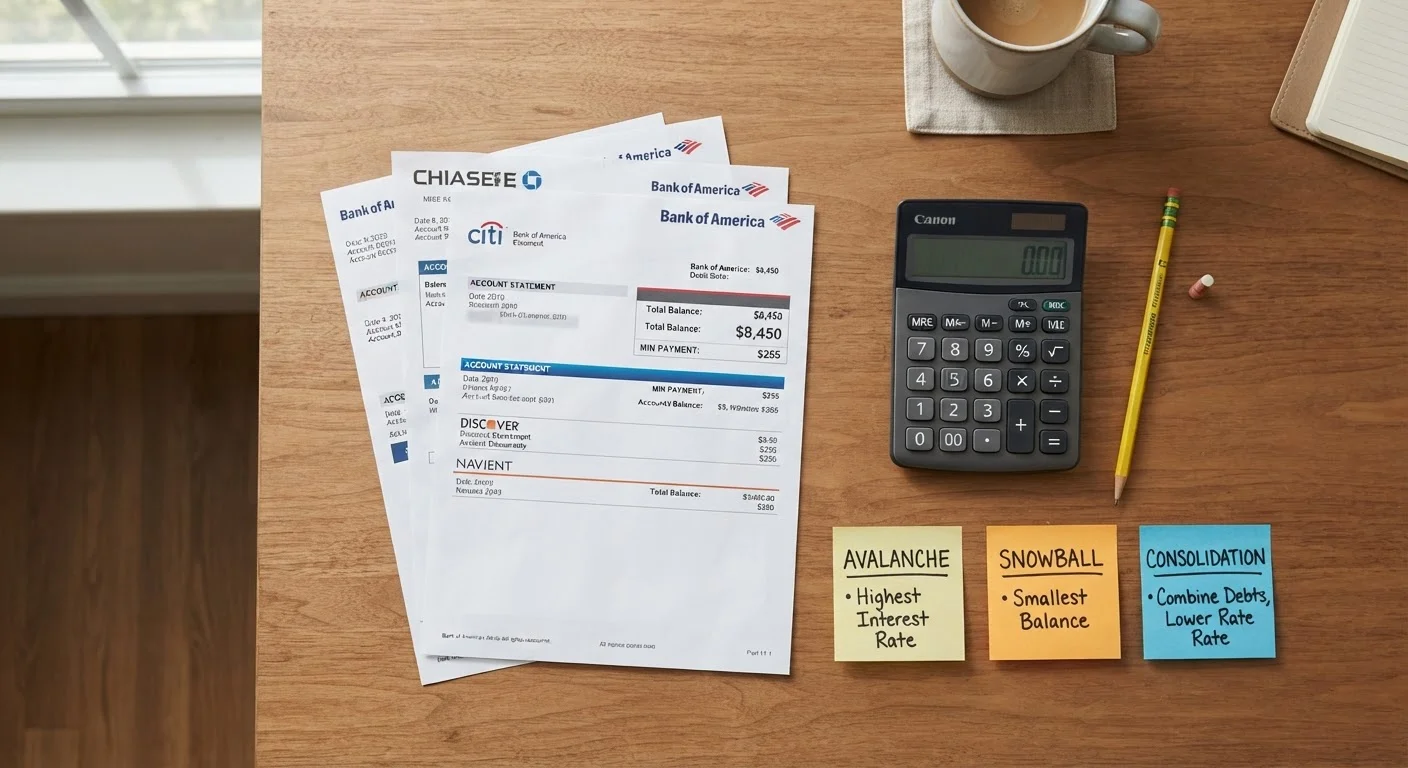
The avalanche method generally saves the most money in interest, but the snowball method can be more sustainable for people who need motivational milestones. Consolidation works best when it genuinely reduces your interest rate and doesn't extend your repayment timeline unnecessarily. Understanding the logic behind each approach helps you — ideally with a qualified financial adviser — choose what fits your income, debt mix, and habits.
| Best for | Recommended |
|---|---|
| Those who want to minimize total interest paid | Avalanche Method |
| Those who need early wins to stay motivated | Snowball Method |
| Those juggling multiple high-rate debts who qualify for a lower rate | Debt Consolidation |
How Each Method Works
Before comparing the three approaches, it helps to understand what each one actually does. If you're newer to debt concepts, our primer on personal debt types and terms covers the foundational vocabulary.
The Avalanche Method
With the avalanche, you rank your debts from highest annual percentage rate (APR) to lowest. You direct any extra payment money toward the highest-rate debt while making minimum payments on everything else. Once that debt is gone, you roll its payment into the next-highest-rate balance, and so on.
The Snowball Method
The snowball flips the priority: you rank debts from smallest balance to largest, regardless of interest rate. Extra funds go toward the smallest balance first. When it's paid off, you apply that freed-up payment to the next smallest — creating a growing "snowball" of payment capacity.
Debt Consolidation
Consolidation is a structural change rather than a payment strategy. You combine multiple debts — often credit cards or personal loans — into a single new loan or balance-transfer product, ideally at a lower interest rate. The goal is one monthly payment instead of several, and potentially reduced interest costs. Revolving and instalment debts behave very differently, so understanding what you're consolidating matters.
Comparing the Three Approaches
Each method involves real trade-offs. The table below lays out how they differ across several practical dimensions.
| Avalanche | Snowball | Consolidation | |
|---|---|---|---|
| Ordering logic | Highest interest rate first | Smallest balance first | All debts merged into one |
| Total interest paid | Typically lowest | Typically higher than avalanche | Varies by new rate and term |
| Motivational structure | Slower early wins | Faster early wins | Simplified single payment |
| Complexity | Low — reorder payments | Low — reorder payments | Moderate — requires new credit product |
| Requires new credit application | No | No | Usually yes |
| Best when | High-rate balances are the main burden | Multiple small accounts are discouraging | You qualify for a meaningfully lower rate |
| Main risk | Slow early progress may reduce adherence | Higher-rate debt lingers longer | Longer term or new debt habits can cost more |
One nuance worth noting: consolidation isn't mutually exclusive with avalanche or snowball. Someone might consolidate several credit cards into one personal loan and then apply snowball or avalanche logic to any remaining debts.
The Psychology and Math Behind Each Approach
Consistency Matters More Than Method Choice
Financial researchers generally agree that the method you'll actually stick to is more valuable than the one that looks best on a spreadsheet. Before choosing an approach, consider your past behavior: do you respond better to quick wins or to seeing a number shrink steadily? Honest self-assessment can guide you toward the strategy most likely to work in practice.
The avalanche method wins on pure math. By eliminating high-interest balances first, you reduce the amount of interest accruing on your total debt load faster. Over months or years, this typically means paying less overall compared to the snowball.
The snowball method trades some of that mathematical efficiency for psychological benefit. Paying off a small account entirely — even if it carries a lower rate — delivers a concrete sense of progress. Behavioral finance research has consistently shown that people are more likely to stick with a plan when they see tangible results early. A strategy you maintain beats a theoretically optimal one you abandon.
Consolidation's appeal is simplicity and, when the rate genuinely drops, interest savings. But the math can work against you if consolidating extends your repayment period significantly — paying a lower rate over many more months can still result in more total interest. It's also worth noting that qualifying for a favorable consolidation rate depends on creditworthiness, which varies by individual.
Not all debt is the same to begin with. Understanding how financial educators distinguish productive from costly debt can help you prioritize which balances deserve the most urgency.
Limitations and Common Pitfalls
Watch Out for These Common Missteps
With consolidation in particular, read the full loan terms before signing. A lower monthly payment that results from a much longer repayment period may cost you more overall. If you're considering using home equity to consolidate unsecured debt, understand that failure to repay could put your home at risk — a licensed financial adviser or HUD-approved credit counselor can help you evaluate whether this makes sense for your situation.
With the avalanche, the highest-rate debt may also be a large balance, which means it could take a long time before you fully pay off any single account. That wait can feel discouraging, especially early on.
With the snowball, you may leave high-interest balances accruing longer than necessary. For people carrying significant high-rate debt, this can add meaningful cost over time.
With consolidation, common pitfalls include: using a secured loan (like a home equity loan) to pay off unsecured credit card debt — which puts collateral at risk — and continuing to use credit cards after consolidating them, rebuilding the same balances. Fees, origination costs, and prepayment penalties on new loans can also erode the benefit.
All three methods share one requirement: you must continue making at least minimum payments on every account you're not actively targeting, or you risk late fees, penalty rates, and credit score damage.
For context on how saving and debt reduction fit together as complementary goals, see how common saving strategies compare.
This article is for general informational purposes only and does not constitute personalized financial, legal, or tax advice. Consult a licensed financial adviser or credit counselor for guidance specific to your situation.
The content on this site is for informational purposes only and is not a substitute for professional advice. Always consult a qualified professional for guidance specific to your situation.