

Where the "Good" and "Bad" Labels Come From
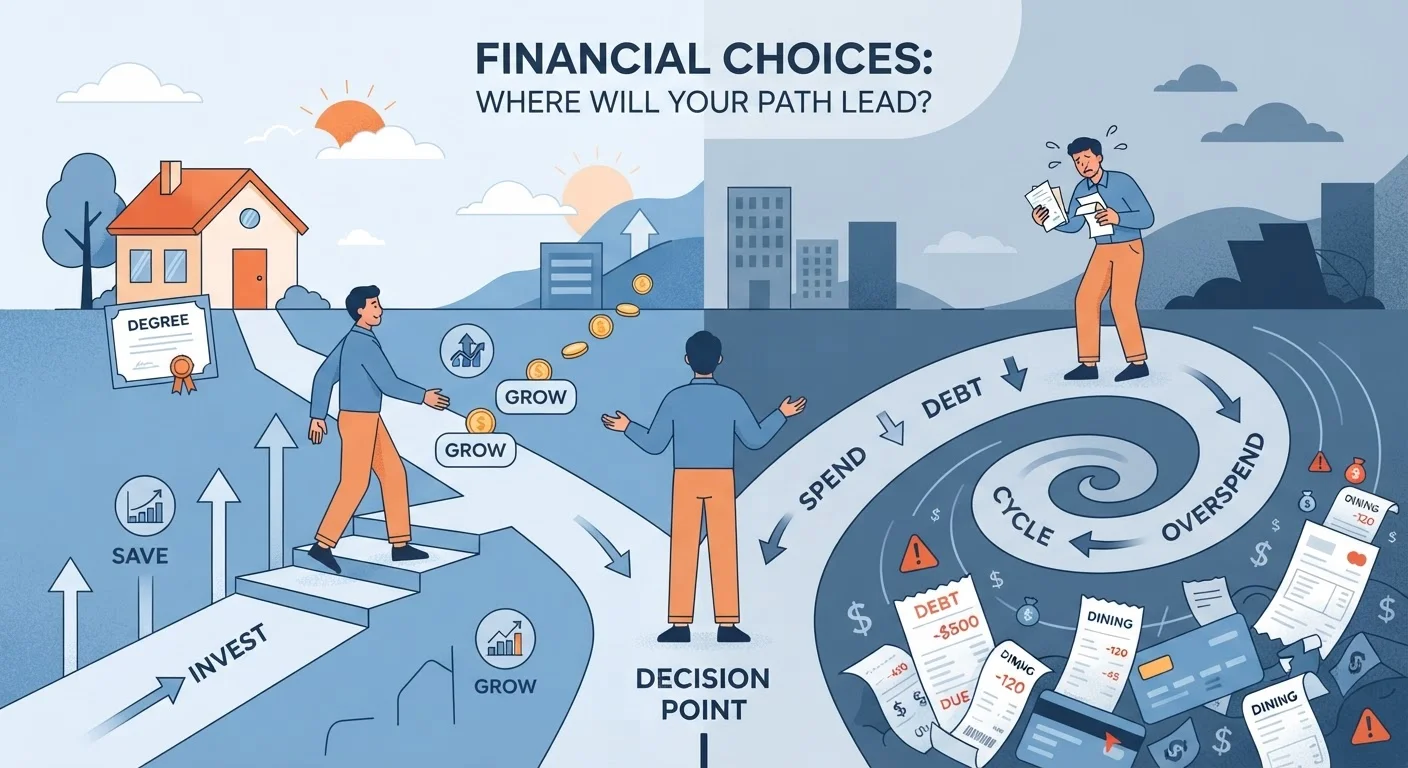
The idea that some debt is productive and some is harmful has been a staple of personal finance education for decades. At its core, the distinction is simple: debt used to acquire something that builds value — a home, a degree, a business — is framed as an investment in your financial future. Debt used to buy things that immediately lose value or fund everyday consumption is framed as a drag on your finances.
This framing holds up reasonably well as a starting point. A 30-year fixed-rate mortgage at a moderate interest rate, used to purchase a home in a stable market, is very different from a high-interest credit card balance carried month to month on routine purchases. The first borrows against something that may appreciate; the second typically costs more than whatever convenience or item it funded.
If you're new to thinking about debt terminology and types, a foundational overview of personal debt can help orient you before diving deeper.
$17.5T
Total US household debt
According to the Federal Reserve Bank of New York, total US household debt reached approximately $17.5 trillion as of late 2023, with mortgages making up the largest share.
~20%
Average credit card interest rate
The Federal Reserve has reported average credit card interest rates above 20% — among the highest on record — making carried balances particularly costly for consumers.
43%
Federal student loan borrowers in repayment
The US Department of Education has noted that a large share of federal student loan borrowers are actively in repayment, highlighting how common education debt is across American households.
When the Categories Get Complicated
The good/bad framework breaks down quickly when you examine real borrowing situations. Consider student loans — widely cited as the clearest example of good debt. A degree in a high-demand field, financed at a manageable interest rate, can reasonably be expected to pay off over a career. But borrowing heavily for a degree with a limited earning trajectory, or from an institution with poor graduation or employment rates, changes the calculus entirely. The loan type is the same; the outcome potential is not.
Auto loans are similarly contested. Vehicles depreciate — sometimes quickly — which traditionally places them in the bad debt category. Yet for someone who needs a car to commute to work, that loan is funding a practical necessity. The interest rate, the price paid, and how long the vehicle is kept all influence whether the borrowing made financial sense. Our overview of auto financing routes illustrates how much loan terms can vary depending on where you borrow.
How debt is structured also matters. Secured and unsecured debt carry different risks and interest rates, and revolving debt behaves very differently from instalment debt over time — understanding these mechanics matters as much as the good/bad label.
“Debt is not inherently good or bad. What matters is whether you're borrowing to build something or borrowing to consume something — and whether the terms of that borrowing are ones you can actually sustain.”
— Financial Literacy Education Commission, Federal advisory body on financial literacy in the United States
A More Useful Way to Evaluate Debt
Rather than sorting debt into fixed categories, a more practical approach looks at a few core factors:
- Interest rate vs. expected return: If the cost of borrowing is lower than the expected gain from what it funds, the math may support taking on the debt. If not, the case weakens considerably.
- Your ability to repay: Even low-interest debt becomes a problem if payments strain your monthly budget. Lenders assess this through your debt-to-income ratio — a useful benchmark for borrowers to understand as well.
- What happens if things go wrong: Secured debt — like a mortgage or auto loan — puts the underlying asset at risk if payments stop. Understanding what unpaid debt looks like in practice is part of evaluating any borrowing decision honestly.
Ask These Questions Before Borrowing
Before taking on any debt, it helps to ask: What is this loan actually funding? What is the total cost including interest over the loan's life? And what happens to my monthly budget if my income changes? These questions don't replace advice from a qualified financial professional, but they frame the decision more clearly than any label alone.
None of these questions produce a neat answer on their own, but together they give a clearer picture than a simple good/bad label.
This article is for general informational purposes only and does not constitute personalized financial, legal, or investment advice. For guidance specific to your situation, consider speaking with a qualified financial adviser.
Frequently Asked Questions
Good debt is generally defined as borrowing that funds something likely to grow in value or increase earning potential — such as a home or a college education. The interest rate relative to the expected benefit also matters: lower-rate debt used strategically is easier to justify than high-cost borrowing. That said, no debt is automatically good — terms, amounts, and repayment ability all influence the outcome.
Auto loans occupy a genuine grey area. Cars typically depreciate in value, which puts them in the "bad debt" column by traditional definitions. However, a vehicle may be essential for employment, making it a practical necessity. The interest rate, loan term, and whether the car was priced reasonably all affect whether that borrowing was wise. See our <a href="/cars-driving/buying-a-car/dealer-financing-vs-outside-lender-which-route-saves-you-more">guide to auto financing options</a> for more context.
Student loans are often cited as good debt because education can raise lifetime earning potential. But this depends heavily on the degree, the institution, the total borrowed, and the eventual salary in the chosen field. Borrowing far more than a future income can realistically support shifts any loan from productive to burdensome, regardless of category.
Not necessarily. Responsibly managing debt — making on-time payments and keeping credit utilization reasonable — can actually strengthen a credit history over time. The issue arises when debt balances grow relative to income or when payments are missed. Our <a href="/personal-finance/credit-and-banking">credit and banking overview</a> explains how credit works more broadly.
One common benchmark is your debt-to-income (DTI) ratio — the share of your gross monthly income going toward debt payments. Lenders generally prefer DTI ratios below certain thresholds, though the exact number varies by loan type. Understanding your DTI is a practical starting point for assessing your debt load.
Understanding what types of debt you carry and their interest rates is the first step. From there, structured repayment approaches exist — each with different logic and trade-offs. Our article on <a href="/personal-finance/saving-and-debt/debt-repayment-methods-avalanche-snowball-and-consolidation-side-by-side">debt repayment methods</a> walks through the main strategies side by side.
The content on this site is for informational purposes only and is not a substitute for professional advice. Always consult a qualified professional for guidance specific to your situation.