

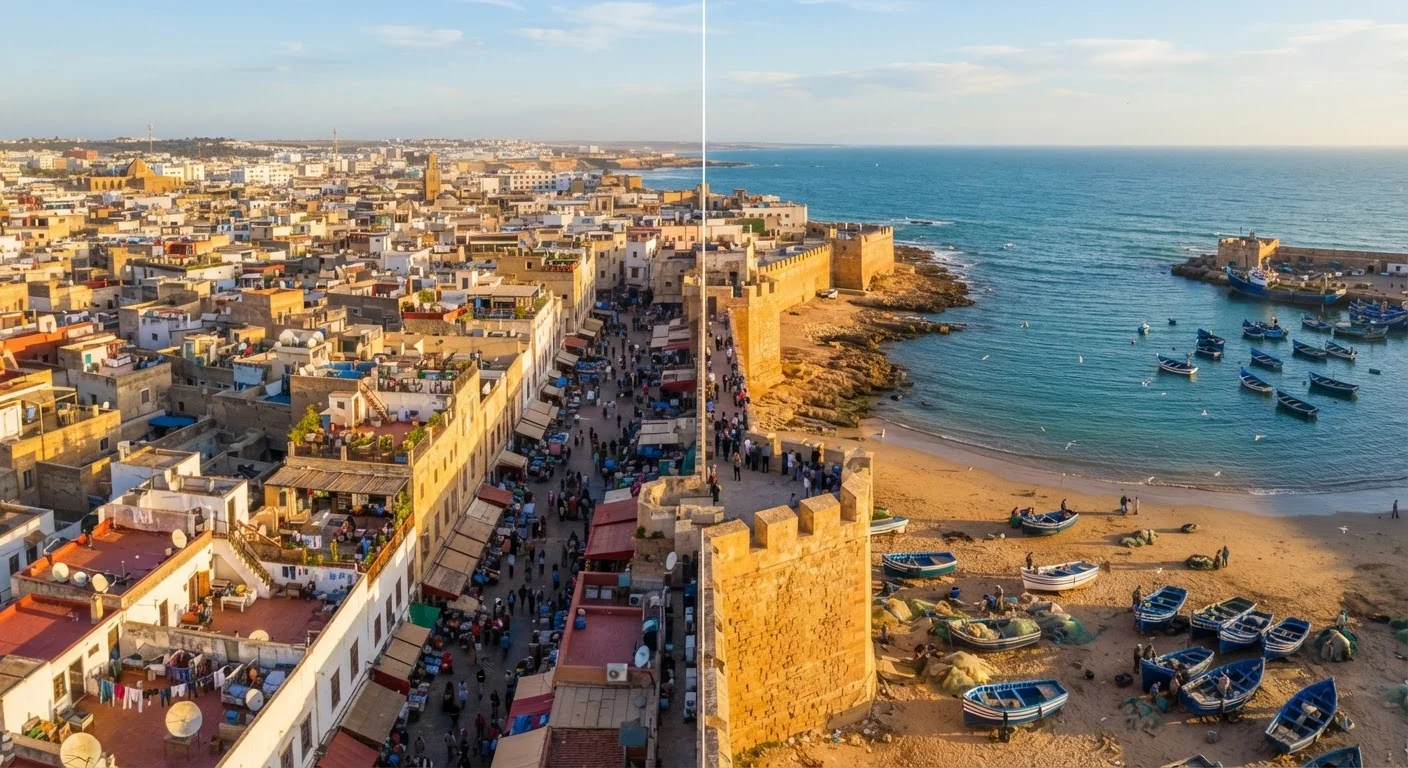
Option A
Morocco's Imperial Cities
The immersive, history-soaked heart of Morocco.
Best for: Travelers who crave deep cultural immersion, ornate architecture, and the sensory intensity of a traditional medina.
Option B
Morocco's Atlantic Coast
The breezy, laid-back edge of the kingdom.
Best for: Travelers who want ocean air, a slower pace, creative communities, and a gentler introduction to Moroccan life.
What Makes the Imperial Cities So Extraordinary
Morocco's four imperial cities — Fes, Marrakech, Meknes, and Rabat — served as royal capitals at different points in the country's history, and each still carries that weight. Walking into the medina of Fes el-Bali is genuinely disorienting in the best possible way: the streets narrow to the width of a donkey cart, the calls to prayer echo off 14th-century walls, and the air smells of cedar wood, spice, and leather dye from the famous tanneries.
Marrakech operates at a more theatrical pitch. The Djemaa el-Fna square — a UNESCO-recognized cultural space — transforms from a food market into a performance ground by evening, with storytellers, musicians, and acrobats filling the space. The city's riads (traditional courtyard guesthouses) offer a surprisingly tranquil retreat once you step inside, a contrast that feels almost architectural in its intention.
What unites these cities is a sense of continuous, living history. Craftspeople still work in medieval guild quarters. Madrasas (Islamic scholarly institutions) built centuries ago remain architectural masterpieces. If you're the kind of traveler who wants to feel genuinely transported — somewhere that doesn't look or feel like anywhere else on Earth — the imperial cities deliver that completely. For tips on moving through unfamiliar urban spaces with more confidence, this guide to avoiding the tourist trail is worth a read before you go.
| Criterion | Imperial Cities | Atlantic Coast |
|---|---|---|
| Primary draw | History, architecture, culture | Ocean scenery, relaxed pace |
| Pace | Intense, immersive | Laid-back, unhurried |
| Summer temperatures | Very hot inland (95–110°F) | Cooler, wind-moderated |
| Navigability for first-timers | Challenging but rewarding | Generally easier to orient |
| Architecture highlights | Medinas, madrasas, souks | Fortified ports, painted streets |
| Beach access | Limited or none in old cities | Central to the experience |
| Best season | Spring and autumn | Year-round, good in summer |
The Atlantic Coast: Slower, Breezier, and Surprisingly Distinct
The Moroccan Atlantic coast stretches from the Spanish enclave of Ceuta in the north to the Western Sahara in the south, but a handful of towns define what most travelers mean when they talk about this region. Essaouira — a walled port city with whitewashed walls and blue wooden doors — is arguably the crown jewel. It has a medina, but one that feels navigable rather than labyrinthine, and the constant Atlantic wind (which makes it a world-class kite-surfing destination) keeps the air cool even in July and August when inland cities can be punishingly hot.
Asilah, near Tangier in the north, is smaller and quieter, known for its painted murals and a fortified old town that feels almost Portuguese in character — which makes sense, given its history of Iberian occupation. Agadir, further south, is the most resort-oriented of the coastal cities, with a long sandy beach and a rebuilt modern center following a devastating 1960 earthquake.
The coast suits travelers who want to breathe more easily — literally and figuratively. The selling pressure in souks is generally lighter, the streets are less congested, and there's a creative, somewhat bohemian undercurrent in towns like Essaouira that has drawn artists and musicians for decades. If you've enjoyed exploring rural, off-the-beaten-path destinations in this part of the world, Portugal's Alentejo region offers a similarly unhurried atmosphere just across the water.
~1,200 km
Length of Morocco's Atlantic coastline
Morocco's Atlantic-facing coastline stretches roughly 1,200 kilometers, offering significant geographic and cultural variety from north to south.
4
UNESCO-recognized imperial cities
Fes, Marrakech, Meknes, and Rabat all hold UNESCO World Heritage designations for their historic medinas or urban sites.
~38°C / 100°F
Average summer highs in Marrakech
Marrakech regularly reaches or exceeds 38°C (100°F) in July and August, a key factor for travelers planning warm-weather visits to inland cities.
How to Decide — or Whether to Choose at All
The honest answer for most travelers is: you don't have to choose. A well-paced two-week Moroccan itinerary often combines both. A common structure is to begin in Marrakech or Fes — absorbing the history and cultural intensity while your energy is fresh — and then travel to the coast for the final few days as a deliberate wind-down. The contrast is striking and intentional; many travelers describe arriving in Essaouira after Marrakech as feeling like removing a weighted vest.
That said, if you're working with limited time or specific priorities, the choice becomes clearer. Photographers, history enthusiasts, and travelers with a high tolerance for sensory stimulation will likely find the imperial cities more rewarding. Families with young children, travelers sensitive to heat, or anyone who wants beach access alongside culture may find the coast a more comfortable base.
One practical note: Morocco's seasons matter. The imperial cities in summer can exceed 100°F (38°C) inland; spring (March–May) and autumn (September–November) are widely considered the most comfortable windows. The Atlantic coast, by contrast, remains relatively temperate year-round thanks to ocean influence. Always verify current entry requirements, local conditions, and travel advisories through your government's official travel advisory service before booking — conditions can change.
For travelers considering Morocco as part of a broader Mediterranean journey by sea, this overview of cruise destination regions provides useful context on how different parts of the Mediterranean and Atlantic compare as travel experiences.
The content on this site is for informational purposes only and is not a substitute for professional advice. Always consult a qualified professional for guidance specific to your situation.