

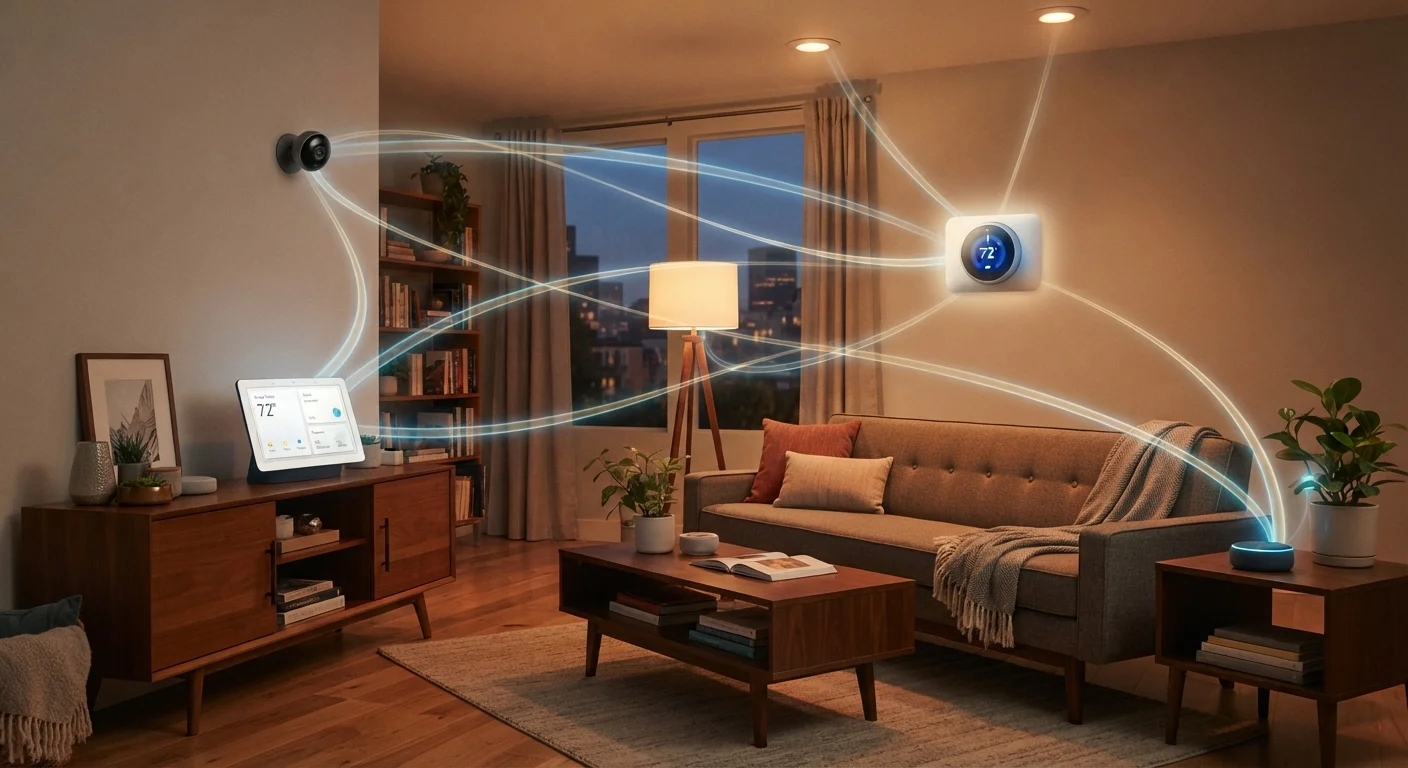
The Problem Matter Was Built to Solve
For years, buying a smart home device felt like picking sides. A bulb built for Google Home might not talk to an Amazon Alexa routine. An Apple HomeKit lock would ignore your non-Apple hub entirely. Each ecosystem had its own language, and devices only spoke one of them.
This fragmentation frustrated consumers and slowed adoption. If you chose the wrong brand early, you could end up with an expensive collection of devices that didn't cooperate. What 'smart home' actually means is already confusing enough - being locked into a single brand made it worse.
Matter was created to fix this at the protocol level. Instead of each company building its own communication system, Matter establishes a single shared language that any certified device can speak. The standard is maintained by the Connectivity Standards Alliance, whose members include Amazon, Apple, Google, Samsung, and hundreds of other manufacturers.
280+
Companies in the Connectivity Standards Alliance
The CSA, which maintains the Matter standard, counts over 280 member companies including Amazon, Apple, Google, and Samsung.
4,000+
Matter-certified devices available
The CSA's product registry has grown steadily since the standard launched in late 2022, reflecting broad manufacturer adoption.
What Matter Actually Does (and Doesn't Do)
Matter is not an app, a subscription, or a product. It's a specification - a detailed technical rulebook that device makers follow when building hardware and software. When a device is Matter-certified, it has passed testing to confirm it follows that rulebook.
In practice, this means a Matter-certified smart plug can be added directly to Apple Home, Google Home, or Amazon Alexa without proprietary bridges or workarounds. One device, multiple platforms - simultaneously if you want.
Matter also emphasizes local control. Unlike older smart home setups that route every command through a company's cloud servers, Matter devices can communicate directly on your home network. This has real benefits: faster response times, and basic functionality that survives an internet outage. For a deeper look at why this distinction matters, see local control vs. cloud-dependent smart home.
What Matter doesn't do is make every possible device work with every possible feature. Platform-specific automations, voice assistant quirks, and advanced integrations can still vary between ecosystems even when a device is Matter-certified.
Thread: The Network Behind Some Matter Devices
Some Matter devices - particularly sensors and smart locks - use a protocol called Thread rather than standard Wi-Fi. Thread creates a low-power mesh network that's efficient for battery-operated devices. To use Thread-based Matter devices, you need at least one Thread border router on your network, which is built into several modern smart home hubs and speakers. Check your existing hardware specs before assuming Thread devices will work out of the box.
Current Limitations Worth Knowing
Matter is promising, but it's still maturing. Device category coverage has expanded steadily since the standard launched, but some product types - certain robot vacuums, complex security systems, and specialty sensors - haven't been folded in yet.
Setup experience can also vary. While the goal is a simple scan-and-add process, real-world installation sometimes involves troubleshooting network requirements, especially with Thread-based devices that need a compatible border router (a device that bridges Thread to your Wi-Fi network).
Existing device owners may find their hardware doesn't qualify for a Matter update, even if it's from a brand that now supports the standard. Manufacturers make update decisions on a product-by-product basis, and older hardware sometimes lacks the processing power to run the updated firmware.
If you're building out a connected home and want to navigate these tradeoffs sensibly, setting up a smart home without the tech overwhelm is a useful companion read. And if you're weighing whether more automation is always better, where smart home tech falls short offers an honest perspective.
Should You Factor Matter Into Your Next Purchase?
If you're buying a new smart home device today, Matter certification is worth checking for - particularly if you already use multiple ecosystems (say, Apple Home for some things and Alexa for others). A Matter device will slot in more cleanly and give you more flexibility over time.
That said, Matter certification alone shouldn't override other practical considerations like price, build quality, or the specific features a device offers. A non-Matter device that does exactly what you need and works well within your existing setup may still be the right call.
For context on how Matter fits into the broader smart home landscape, a complete overview of smart home technology covers the full picture - from first device to a more complete setup.
“The promise of Matter is straightforward: a device should work because it's certified, not because you happened to pick the right brand at the right moment. Interoperability shouldn't be a premium feature.”
— Connectivity Standards Alliance, Industry body governing the Matter specification
Frequently Asked Questions
Not necessarily. Some existing devices from manufacturers like Amazon, Google, and others have received Matter support through software updates. However, many older devices will never get Matter compatibility, so check with your manufacturer.
No. Matter works alongside your existing platform - like Google Home, Amazon Alexa, or Apple Home. You still use those apps to control devices; Matter just removes the friction of getting them to recognize each other.
Yes, and this is one of Matter's most useful features. A single device can be added to multiple ecosystems simultaneously - for example, both Apple Home and Amazon Alexa - so different household members can use their preferred app.
As of the standard's current releases, Matter covers lighting, plugs, thermostats, locks, blinds, sensors, TVs, and certain security cameras. More categories are being added in ongoing updates to the specification.
For most basic functions, yes. Because Matter prioritizes local control, many operations - like turning on a light or adjusting a thermostat - can happen without a cloud server in the loop. This is a meaningful advantage over older cloud-dependent setups.
Look for the Matter logo on the product packaging or in the device's specification sheet. Retail listings and manufacturer websites typically list Matter certification under compatibility details.
The content on this site is for informational purposes only and is not a substitute for professional advice. Always consult a qualified professional for guidance specific to your situation.