

Our Verdict
Neither fertilizer type is universally superior. Organic options build healthier soil over time while synthetic options address acute nutrient deficiencies quickly. The right choice depends on your soil's current condition, your plants' needs, and how much time you can invest in building long-term fertility.
| Best for | Recommended |
|---|---|
| Gardeners focused on long-term soil health and sustainability | Organic fertilizers |
| Those needing rapid correction of a confirmed nutrient deficiency | Synthetic fertilizers |
| Most home gardeners wanting reliable, balanced results | A combined organic-and-synthetic approach |
What Separates Organic from Synthetic Fertilizers
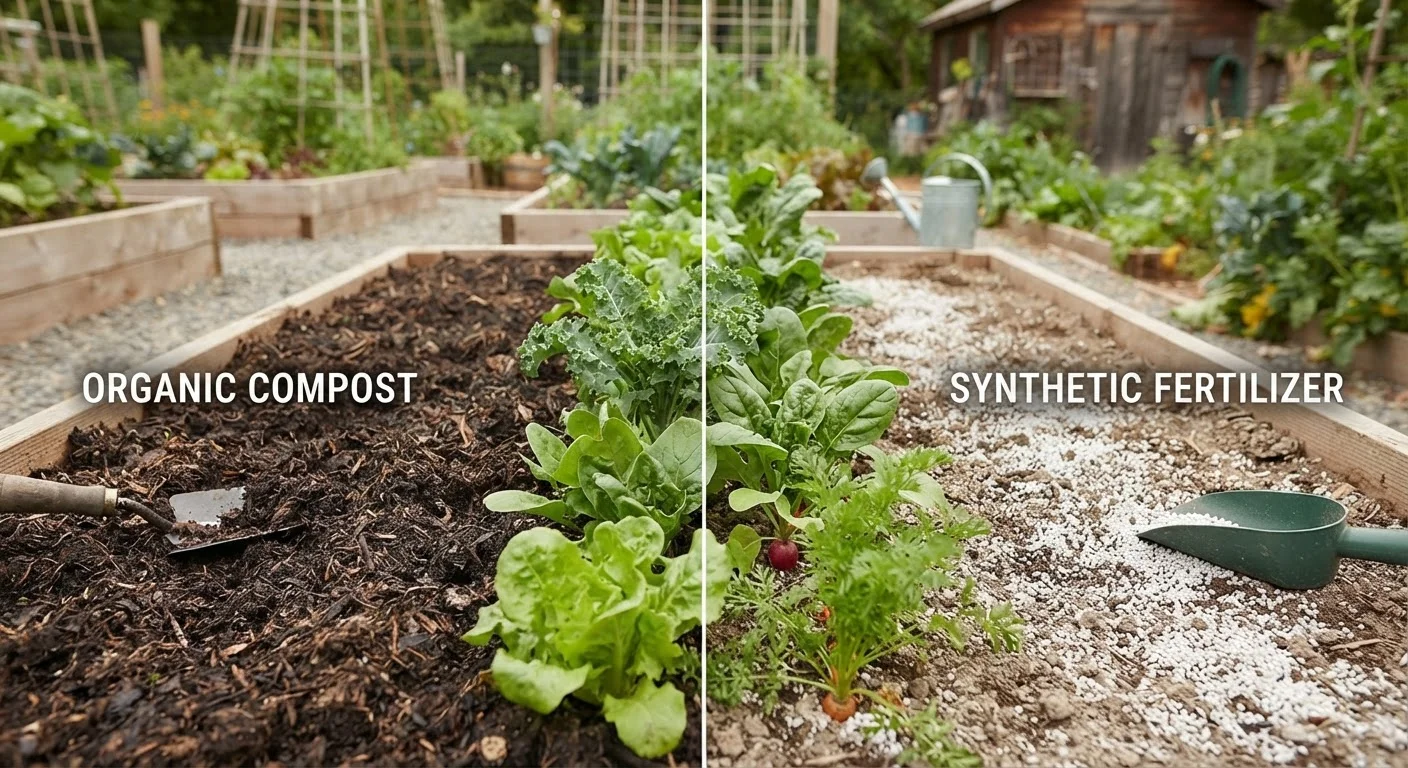
Fertilizers are classified by how their nutrients are derived and delivered. Organic fertilizers come from natural sources - composted manure, bone meal, kelp, worm castings, and similar materials. Their nutrients exist bound within organic compounds that soil microbes must first break down before plants can absorb them. Synthetic fertilizers (sometimes called inorganic or chemical fertilizers) are manufactured through industrial processes and formulated to release specific ratios of nitrogen (N), phosphorus (P), and potassium (K) in a water-soluble form plants can take up almost immediately.
This fundamental difference in nutrient availability drives almost every practical distinction between the two approaches - from how quickly you see results to what happens in your soil over years of use. Before choosing, it helps to understand your soil's pH, because pH affects how well plants access nutrients regardless of fertilizer type.
| Organic Fertilizers | Synthetic Fertilizers | |
|---|---|---|
| Nutrient source | Natural materials (manure, bone, kelp) | Manufactured via industrial chemistry |
| Speed of nutrient release | Slow - weeks to months | Fast - hours to days |
| Soil structure improvement | Yes - adds organic matter | No - no organic matter added |
| Microbial benefit | Feeds and boosts soil biology | Neutral to slightly suppressive at high rates |
| Risk of plant burn | Low | Higher if overapplied |
| Nutrient precision | Variable by product | Consistent and measurable |
| Cost per nutrient unit | Generally higher | Generally lower |
| Long-term soil impact | Builds fertility over seasons | Neutral without organic matter input |
How Each Type Affects Soil Health
Soil is not just a growing medium - it is a living system. Organic fertilizers act as food for that system. As soil bacteria and fungi decompose organic matter, they release nutrients gradually while also producing compounds that bind soil particles into aggregates. This improves soil structure, which means better drainage in wet conditions and better moisture retention during dry spells. Over several seasons, consistent organic feeding can measurably increase the population and diversity of beneficial soil microbes.
Synthetic fertilizers, applied correctly, do not directly harm soil biology in the short term. However, repeated heavy applications can increase soil salinity - a buildup of dissolved salts that stresses roots and suppresses microbial activity. Some nitrogen-heavy synthetics also contribute to gradual soil acidification. Because synthetics add no organic matter, they do nothing to repair compacted or depleted soil on their own.
Test Before You Fertilize
A basic soil test from your local cooperative extension service typically costs under $20 and tells you your existing nutrient levels and pH. This prevents you from adding nutrients your soil already has in abundance, saving money and protecting plants from imbalance. Retest every two to three seasons to track how your program is working.
If you are building a new bed or working with poor soil, pairing any fertilizer program with regular compost additions gives you the fastest path to genuinely productive ground. Our guide to home composting walks through the process step by step.
Nutrient Availability, Speed, and Precision
Speed is the clearest practical difference. A plant showing signs of nitrogen deficiency - pale, yellowing leaves - will respond to a synthetic nitrogen source within days. The same plant given a slow-release organic amendment may wait weeks before conditions allow enough microbial breakdown to deliver a meaningful dose.
Synthetics also allow more precise dosing. Labels state exact NPK percentages, so you can calculate how much to apply based on a soil test result. Organic fertilizers vary in nutrient content depending on their source and processing, making precision harder - though this matters less when the goal is gradual improvement rather than rapid correction.
~3-6 weeks
Typical wait for organic nutrients to become plant-available
Breakdown time depends on soil temperature, moisture, and microbial activity - warmer, moist soils speed up the process considerably.
24-72 hrs
Time for soluble synthetic nutrients to reach plant roots
Water-soluble synthetic fertilizers dissolve immediately upon irrigation, making them the standard tool for rapid deficiency correction.
Up to 30%
Synthetic nitrogen potentially lost to leaching per application
Studies from university extension programs note that soluble nitrogen can move below the root zone quickly in sandy or heavily irrigated soils.
For most vegetables and flowering plants grown in reasonably healthy soil, organic fertilizers applied at the start of the season provide adequate nutrition through the growing period. Fast-growing, heavy-feeding crops like sweet corn or pumpkins sometimes benefit from a mid-season synthetic top-dressing to sustain peak growth.
Practical Considerations for Home Gardeners
Cost, convenience, and garden type all play a role in your decision. Organic fertilizers can be bulky and may require larger quantities to match the nutrient density of synthetics, which raises the cost per pound of actual nitrogen delivered. However, their slow-release nature makes over-application less dangerous - the risk of burning plants is significantly lower than with soluble synthetics.
If you grow edibles, be aware that some gardeners prefer organic inputs for personal comfort reasons, though regulatory standards for certified organic produce are specific and go beyond fertilizer type alone. For ornamentals and lawns, the distinction may matter less to you.
Regardless of which type you choose, a soil test every two to three years is the single most useful step you can take. Applying fertilizer without knowing what your soil already contains can mean wasting money or inadvertently creating nutrient imbalances. The type of growing system you use - raised bed or in-ground - also influences how quickly nutrients leach and how often you may need to fertilize.
Avoid Over-Application of Synthetic Fertilizers
Applying more synthetic fertilizer than recommended does not accelerate growth - it risks burning roots through excess salt concentration and can leach nitrates into groundwater. Always follow label rates and water thoroughly after application. When in doubt, apply less than the maximum recommended amount.
The content on this site is for informational purposes only and is not a substitute for professional advice. Always consult a qualified professional for guidance specific to your situation.