

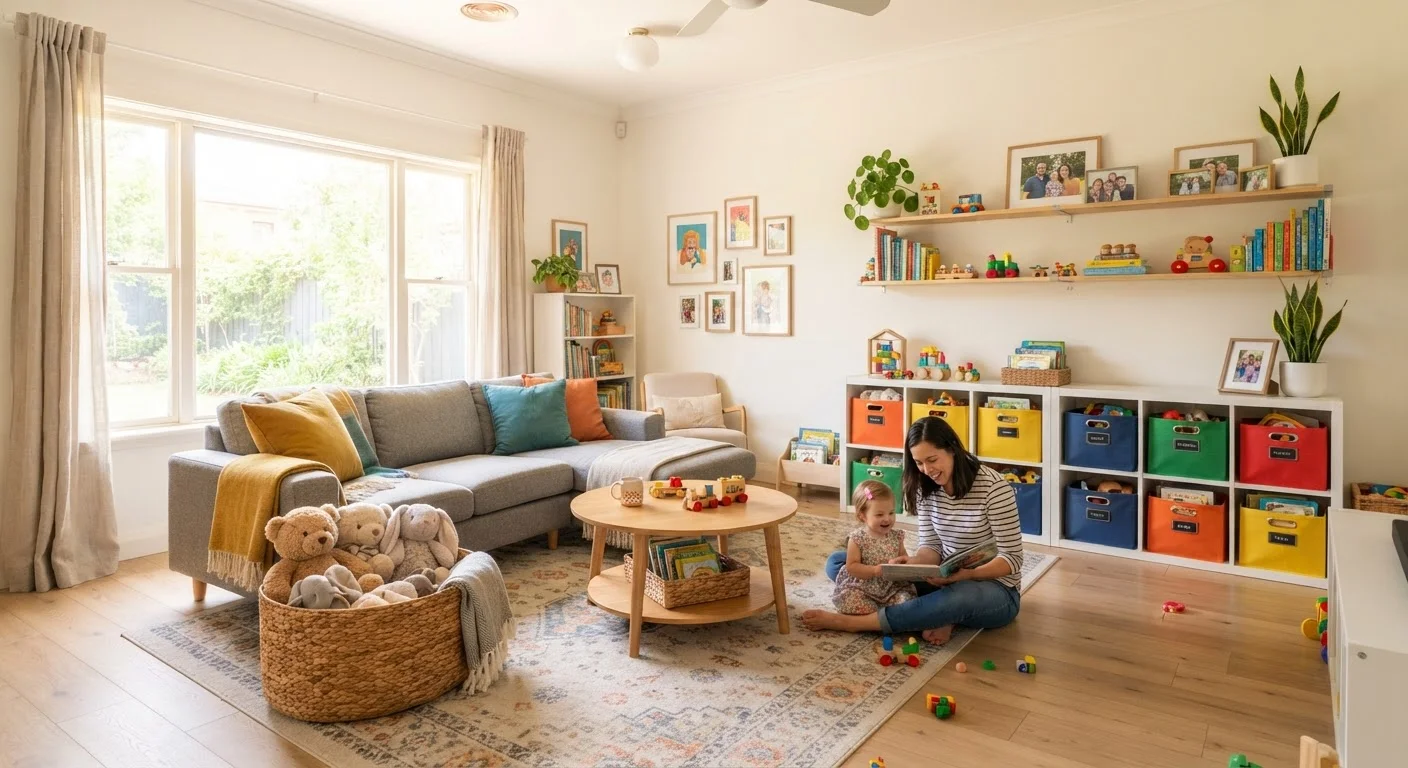
Why Most Family Organization Systems Fail
The most common reason organization breaks down in homes with children isn't laziness or lack of effort — it's that the systems were never designed for children in the first place. Adult-centric storage, overly complex sorting rules, and unrealistic tidiness expectations set the whole household up to fall short.
The goal isn't a showroom home. It's a home that functions well enough that daily life doesn't feel like a constant uphill battle. That requires rethinking what 'organized' actually means when young children share the space. For a broader look at what truly works (and what doesn't), see common organization myths debunked.
Organization Looks Different at Every Age
A system that works for a six-year-old will likely frustrate a toddler and bore a twelve-year-old. Revisit your storage and routine setups whenever a child hits a new developmental stage — roughly every one to two years. What feels like a broken system is often just an outgrown one.
Smarter Storage: Designing Systems Kids Can Actually Use
Effective family storage is built around one core principle: the person using the system should be able to operate it independently. For children, that means accessible heights, simple categories, and clear visual cues.
Design storage systems at the child's eye and arm level.
When children can reach their own belongings independently, they're far more likely to put things away without prompting. Adult-height shelving creates an invisible barrier — kids simply can't engage with a system that physically excludes them.
Use broad categories instead of hyper-specific sorting systems.
Detailed sorting — 'Lego bricks in this bin, Lego people in that one' — collapses quickly in a household with children. Fewer, broader categories reduce the decisions a child (and a tired parent) has to make at clean-up time.
Establish a short daily reset window rather than relying on deep tidying sessions.
Sporadic marathon clean-ups feel punishing and don't build lasting habits. A predictable 10–15 minute reset — tied to an existing routine like after dinner or before bath time — keeps clutter from compounding.
Involve children in designing their own organizational systems.
Children who have input into where things go and how things are labeled are measurably more likely to maintain those systems. Ownership drives follow-through.
Rotate toys rather than storing everything at once.
Fewer items in circulation means less visual clutter and, counterintuitively, more engaged play. Rotation also refreshes interest so children rediscover 'old' toys without requiring new purchases.
Create a dedicated drop zone near the entry point for school and activity gear.
Backpacks, shoes, and sports equipment that get dropped at the door cause immediate clutter. A designated landing spot stops those items from migrating deeper into the home.
If your home includes rooms that serve double duty — a playroom that's also a guest space, or a living room that doubles as a homework zone — organizing multi-use rooms offers targeted strategies for those competing demands.
Building Routines That Stick
Storage systems only work when paired with consistent habits. The best habit for families is a short daily reset — not a punishment, not a major project, but a brief, predictable window where everyone returns things to their place.
Label With Pictures, Not Just Words
For pre-readers and early readers, picture labels on storage bins are far more effective than text-only labels. Photograph the actual contents, print small images, and tape them to the front of each bin. Children as young as two can match objects to their picture labels, building independence early.
Tying the reset to an anchor already in your schedule (dinner, bath time, a favorite TV show ending) removes the need for willpower. It becomes automatic. Over time, children internalize the rhythm and begin participating with less prompting.
The same logic applies to high-traffic problem areas. If shoes and backpacks pile up at the door every afternoon, the solution isn't more reminders — it's a better system at the point of entry. A well-designed drop zone eliminates the decision entirely.
Realistic Expectations: What 'Organized' Looks Like With Kids
Organized in a family home means manageable, not magazine-perfect. It means you can find what you need in a reasonable amount of time, reset the space without enormous effort, and move through your day without constant friction.
“Children need order, but they need order that is accessible to them — not a system built by and for adults that they're expected to maintain.”
— Magda Gerber, Child development educator and founder of Resources for Infant Educarers (RIE)
Releasing the expectation of a perpetually tidy home isn't giving up — it's working smarter. A home that's organized for the people who live in it, including the youngest members, will stay more functional day-to-day than a rigid system imposed from above.
For further reading on how organization intersects with the broader household — including what happens when occupants have different tidiness standards — organizing a home with multiple occupants is a useful companion. And for a comprehensive room-by-room approach, the complete home organization guide covers the full picture.
10–15 min
Daily reset time that prevents chronic clutter buildup
Home organization researchers and professional organizers consistently note that short, daily maintenance windows outperform infrequent deep-cleaning sessions for family households.
~50%
Toy reduction recommended for more engaged play
Child development studies suggest that children play more creatively and for longer periods when presented with fewer toys at a time, supporting the case for toy rotation.
The content on this site is for informational purposes only and is not a substitute for professional advice. Always consult a qualified professional for guidance specific to your situation.