

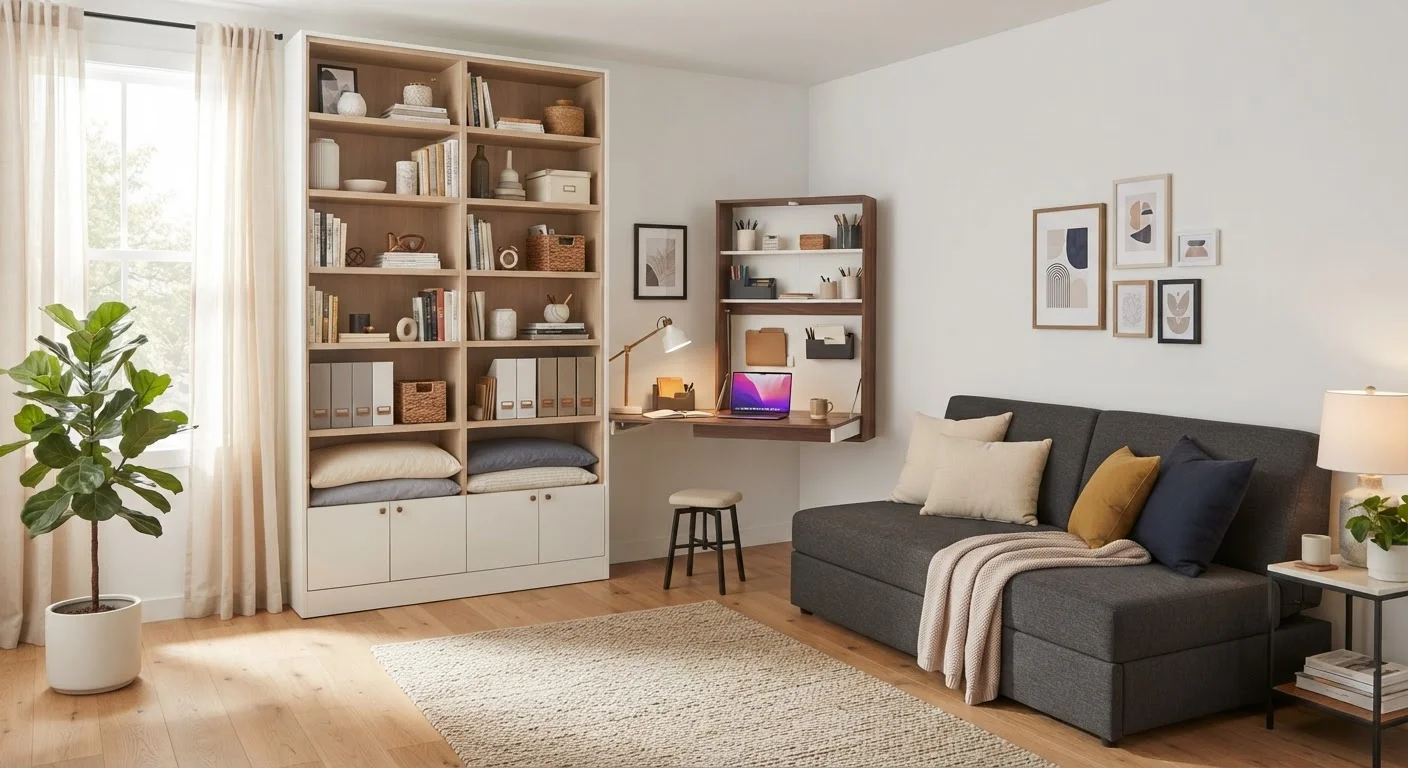
Why Multi-Use Rooms Fall Apart
Most multi-use rooms don't start as disasters — they evolve into them. A guest room gains a desk. A living room absorbs the kids' homework station. Before long, no single activity has a proper home, and everything competes for the same surfaces.
The core problem is that most rooms are set up for one purpose, and adding a second (or third) function without rethinking the layout and storage means each activity is always working against the others. Mail piles up on the craft table. Zoom calls happen in front of the unmade guest bed. Toys drift into the yoga zone.
Understanding this tension is the first step. A multi-use room isn't a compromise — it's a design challenge with real, practical solutions. For a broader look at how competing needs play out across a whole home, see our comprehensive home organization guide.
When One Room Truly Can't Do It All
Some activity combinations create unavoidable conflicts — a home gym and a baby's nursery, for instance, are difficult to share no matter how good the zoning. If a room's competing functions are genuinely incompatible, it may be worth reconsidering which function belongs there versus elsewhere in the home. Zoning works best when the activities can realistically coexist during different time windows.
The Zoning Principle: Give Every Function a Territory
Zoning means assigning a defined physical area to each activity — and keeping the tools, supplies, and furniture for that activity within its zone. It's the single most effective concept in multi-use room organization.
Zones don't require walls. You can create clear boundaries using:
- Area rugs — a rug anchors a seating or work area and visually signals a transition between functions.
- Furniture orientation — turning a desk to face a wall rather than the room's center creates a focused nook without any partition.
- Lighting — a dedicated task lamp over the desk and softer ambient lighting near the bed reinforce different modes in the same room.
- Open shelving as a divider — a bookcase placed perpendicular to the wall creates a partial wall that separates zones while adding storage.
Once zones are established, commit to keeping each function's items inside its territory. That discipline is what prevents the slow creep of clutter from one zone into another.
68%
Americans working from home at least part-time
According to Pew Research Center survey data, a significant majority of workers who can do their jobs remotely now do so at least some of the time, making home office space a genuine need in millions of households.
1 in 3
US homes using a bedroom as an office
Home design surveys consistently find that spare bedrooms and primary bedrooms are among the most common rooms to absorb a secondary function, particularly as remote work has expanded.
Storage Strategies That Serve Multiple Functions
In a multi-use room, the wrong storage makes the space feel more chaotic, not less. Open surfaces collect visual noise from multiple activities at once. The goal is storage that conceals — and that keeps each function's supplies separate and retrievable.
A few principles that consistently work:
- Closed storage over open shelving — cabinets with doors, lidded bins, and baskets keep the room looking like a single coherent space even when it holds supplies for three different activities.
- Labeled containers by function — when supplies for different activities are clearly labeled and stored together by category, the room resets faster and items stay where they belong.
- Vertical storage to preserve floor space — wall-mounted shelves, pegboards, and tall bookcases move storage off the floor, which is especially valuable when the room needs open floor space for different activities at different times. Our article on vertical vs. horizontal storage explores the trade-offs in detail.
Do a Function Audit Before Buying Storage
Before purchasing any bins, shelves, or furniture, spend a week noting exactly what activities happen in the room and what supplies each requires. Buying storage for the room you have — not the room you imagine — prevents wasted spending and better-fitting solutions.
Dual-Purpose Furniture: What Actually Earns Its Place
Not all convertible furniture delivers on its promise. A murphy bed that requires 20 minutes and two people to operate won't get used consistently. The test for any dual-purpose piece is whether both functions are easy enough to use daily — or at least without real friction.
Pieces that tend to earn their place in multi-use rooms:
- Daybed with storage drawers — functions as seating or a reading nook day-to-day; becomes a guest bed without any conversion process.
- Fold-down wall desk — folds flat when not in use, freeing the wall entirely; works especially well in rooms that need open floor space for exercise, play, or yoga.
- Storage ottoman — provides seating, a surface, and concealed storage for items belonging to a second activity (craft supplies, board games, extra linens).
- Room divider with built-in shelving — creates a zone boundary and adds storage simultaneously.
If your multi-use room involves children, see our guide on organizing with children in the house for age-appropriate storage ideas that hold up to daily use.
The Reset Routine: Keeping It Functional Day to Day
Even the best-organized multi-use room requires a maintenance habit. A brief reset — five to ten minutes at the end of each day, or before switching between activities — is what keeps the system from degrading over time.
A workable reset routine for most multi-use rooms includes:
- Return all items to their designated zone before leaving the room or ending an activity.
- Clear shared surfaces (tables, counters, the floor) of anything that doesn't belong to that zone's function.
- Do a quick scan: does the room look ready for its next use?
When multiple people share the space, agreeing on reset expectations matters as much as the physical setup. Our article on organizing shared spaces with different standards addresses how to navigate those conversations practically.
A well-maintained multi-use room isn't about perfection — it's about a system that's easy enough to actually maintain, so the room keeps working for you rather than against you.
“The goal of organizing a multi-use space isn't to make it look like it only has one purpose — it's to make switching between purposes feel effortless.”
— Julie Morgenstern, Professional organizer and author of books on organization and time management
Frequently Asked Questions
Place the desk perpendicular to or facing away from the bed to create a psychological break between work and rest. Use a bookshelf, curtain, or room divider as a visual barrier. Keeping work supplies fully out of sight when not in use reinforces the separation.
Look for pieces that serve more than one purpose without sacrificing either function — a daybed with storage drawers, a fold-down wall desk, or an ottoman with a removable lid. The goal is to minimize how much floor space each function claims while still meeting real needs.
Keep guest essentials in a dedicated closet zone or under-bed storage that's completely off-limits to toys. Use closed bins or cabinets for toys so the room reads as 'guest ready' after a quick reset. A murphy bed or sleeper sofa can free up substantial floor space during non-guest periods.
Most rooms can comfortably support two distinct functions with the right zoning. Three functions are possible in larger spaces but require very disciplined storage and clear boundaries. Beyond that, the competing demands typically result in a room that serves none of its purposes well.
Start by listing every activity that happens — or needs to happen — in that room. Then identify which activities conflict with each other and which can share resources. That inventory shapes your zoning plan before you buy a single storage item.
The content on this site is for informational purposes only and is not a substitute for professional advice. Always consult a qualified professional for guidance specific to your situation.