

Why Organization Terminology Matters
Home organization advice is everywhere — but the language used to describe it can feel like its own barrier to entry. Terms like negative space, decanting, and the zone method appear constantly in organizing guides without much explanation. This glossary cuts through that confusion with plain, direct definitions you can actually use.
Whether you're tackling a cluttered kitchen or rethinking your entire home layout, understanding the vocabulary helps you follow expert advice more confidently and build systems that stick. For a broader introduction to the fundamentals, see our beginner's guide to home organization.
Zone Method
A system that divides a room into distinct activity areas, each containing only the items used for that activity. For example, a kitchen might have a coffee zone, a baking zone, and a snack zone.
Negative Space
Empty, intentionally unoccupied surface or shelf area kept clear of objects. In organizing, it creates visual calm and makes spaces easier to clean and maintain.
Decanting
Moving products out of their original packaging into standardized containers. Common in pantries and bathrooms, it improves visibility and maximizes shelf space.
Prime Real Estate
The most accessible storage spots in any given space — typically eye-level and waist-level areas, or the front of a cabinet. Reserved for frequently used items.
One-In, One-Out Rule
A maintenance habit where one item is discarded or donated each time a new, comparable item is brought home. Helps prevent accumulation over time.
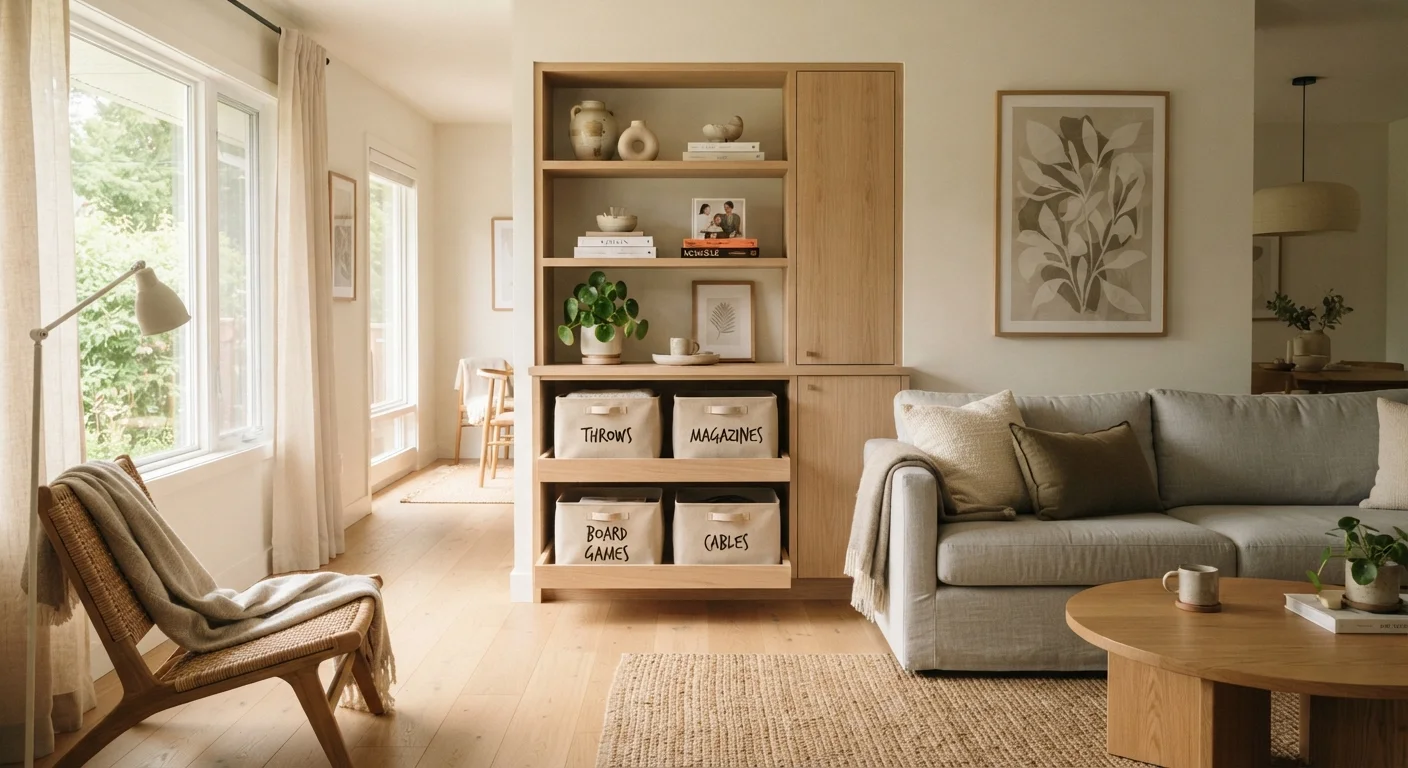
Anchor Piece
A large, central piece of furniture — such as a bookcase or wardrobe — around which the rest of a room's storage and layout is organized.
Capsule Wardrobe
A small, intentionally selected set of clothing items that coordinate well with each other, making daily outfit choices faster and reducing closet clutter.
Seasonal Rotation
The practice of moving out-of-season items to secondary storage and bringing current-season items to the forefront. Commonly applied to clothing and holiday décor.
Touch-It-Once Principle
The habit of returning an item directly to its designated storage location after use, rather than setting it down temporarily. Reduces pile-up and repeated tidying.
Containerizing
Grouping like items together inside a bin, basket, or drawer organizer to keep a category contained and easy to find. Part of the SPACE system's final steps.
Purge
The deliberate removal of items from a space — through discarding, donating, or relocating — to reduce the total volume before organizing begins.
Work Triangle
A kitchen layout principle that positions the sink, refrigerator, and stove at three points of a triangle. Items stored near each point support more efficient cooking.
Room-by-Room Concepts Explained
Many organization terms apply across the whole home, but some show up more often in specific rooms. Here's how several key ideas play out in practice:
Kitchen
- Decanting: Transferring pantry staples — flour, pasta, cereal — from their original packaging into uniform containers. This improves visibility, reduces wasted space, and makes it easier to see when you're running low.
- Work triangle: The traditional layout principle connecting the sink, refrigerator, and stove. Keeping items used at each point stored nearby reduces unnecessary movement during meal prep.
Living Room & Shared Spaces
- Negative space: Empty, unoccupied surface area that is kept deliberately clear. A coffee table with open space feels calmer than one covered in objects, and it's easier to clean.
- Anchor piece: A large, central piece of furniture — often a sofa or bookcase — around which the rest of the room's storage and layout is organized.
Bedroom & Closet
- Capsule wardrobe: A curated, limited set of clothing items that coordinate well together, reducing the number of decisions needed when getting dressed.
- Seasonal rotation: Moving off-season clothing to secondary storage (high shelves, under-bed bins) to keep daily-use items accessible.
Home Office & Multi-Use Rooms
- Dedicated zone: A clearly defined area assigned to a single activity — work, crafts, reading — even within a shared room. See how to organize multi-use rooms for strategies that balance competing demands.
| Most common organization system | Zone method — assigning areas by activity |
| Easiest maintenance habit | Touch-it-once — return items directly after use |
| Prime real estate storage height | Eye level to waist level |
| KonMari's core filter | Does the item spark joy? (Concept developed by Marie Kondo) |
| SPACE acronym | Sort, Purge, Assign, Containerize, Equalize |
| Best room to start decluttering | Often recommended: a single drawer or countertop (Commonly cited in professional organizing guidance) |
Common Decluttering Methods and What They Mean
Decluttering frameworks each come with their own terminology. Understanding what these terms actually mean makes it easier to choose a method that fits your household — and to apply it consistently.
No Single Method Works for Everyone
Decluttering frameworks are tools, not rules. A method that works well in a single-person apartment may not translate to a busy household with children or roommates. It's reasonable to borrow elements from multiple systems and adapt them to your space, schedule, and the people you share your home with. The goal is a system you can maintain — not one you perfect once and abandon.
The SPACE system breaks the process into five steps: Sort, Purge, Assign, Containerize, Equalize. The KonMari method, developed by organizing consultant Marie Kondo, organizes by category rather than room and uses the concept of sparking joy as the primary filter for keeping or discarding items. For a detailed comparison of these two frameworks, see KonMari vs. the SPACE system.
Other widely used terms include:
- One-in, one-out rule: For every new item brought into the home, one comparable item is removed. Commonly applied to clothing, toys, and kitchen gadgets.
- Touch-it-once principle: Returning an item directly to its designated home after use, rather than setting it down temporarily and moving it again later.
- Prime real estate: The storage space that is most accessible — at eye and waist level, in the front of drawers, closest to where the item is used. Reserved for the things used most frequently.
For a complete room-by-room breakdown using these methods in action, our comprehensive home organization guide walks through each area of the home in detail. If your household includes multiple people with different organizing habits, organizing a home with multiple occupants addresses those dynamics directly.
The content on this site is for informational purposes only and is not a substitute for professional advice. Always consult a qualified professional for guidance specific to your situation.