

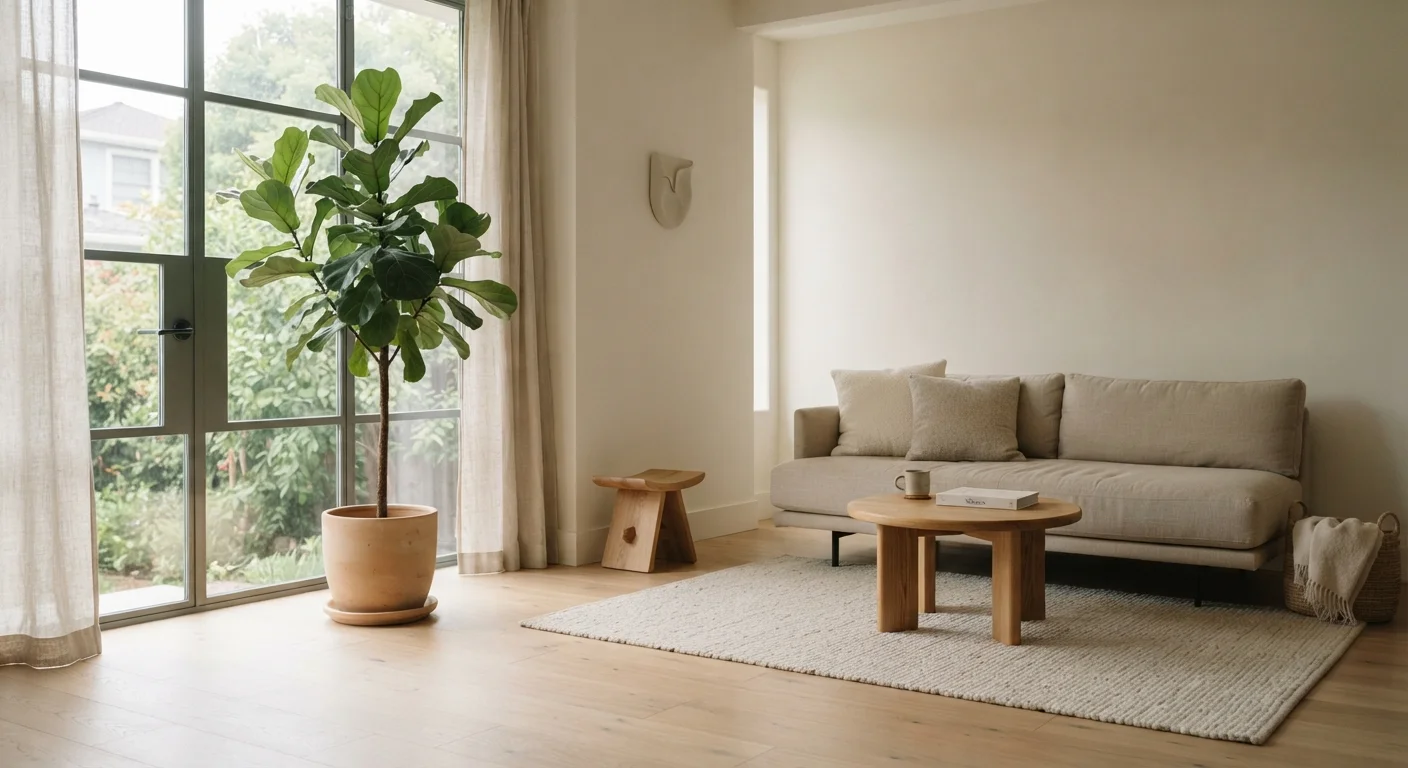
Our Verdict
Minimalism delivers real benefits — reduced clutter, easier cleaning, and a calmer visual environment — but it asks you to trade flexibility and spontaneity for simplicity. The results depend heavily on how strictly you apply it and whether your whole household is on board. It is not a universal solution, but thoughtfully adapted, it can meaningfully reduce household stress.
Best suited to individuals or households who feel overwhelmed by clutter, have stable storage needs, and are willing to be intentional about what they bring into their home.
What Minimalism Actually Means at Home
Home minimalism is not about owning the fewest possible possessions or living in an empty white room. At its core, it means keeping only what serves a clear purpose or brings genuine value — and being deliberate about what enters your space in the first place.
In practice, this plays out differently for every household. For some, it means decluttering closets and donating duplicates. For others, it means a full room-by-room edit over several months. The common thread is intentionality: choosing what stays, rather than letting accumulation happen by default.
If you share your home with others, those decisions get more complicated. Our guide on organizing a home with multiple occupants covers how to navigate different standards under one roof.
Easier daily cleaning and maintenance
Fewer objects mean fewer surfaces to dust, fewer items to move, and faster tidying. Households that have reduced clutter often report spending noticeably less time on routine cleaning.
Reduced visual stress in your environment
Research in environmental psychology suggests that cluttered spaces can elevate cortisol levels and make it harder to focus. A less visually busy home can support a calmer daily experience.
Easier to notice what you actually use
When you own less, the things you reach for every day become obvious — making it simpler to organize your space around real habits rather than aspirational ones.
Can reduce impulse purchasing over time
Maintaining a minimalist home creates a natural pause before buying: does this item have a clear place and purpose? That habit, applied consistently, can reduce unnecessary spending.
The Real Costs of Simplifying
Minimalism asks something concrete of you — and not just emotionally. The process of decluttering takes time, energy, and often money (donation runs, new storage systems, replacing items you later realize you need). There is also a social dimension: when your aesthetic preferences conflict with a partner's, a roommate's, or a child's, minimalism can create friction rather than calm.
Families with young children face a particular tension. Kids accumulate things quickly — toys, art supplies, sports gear — and imposing strict minimalism on a household with children often creates frustration on all sides. For a more realistic framework, see our article on organizing with children in the house.
Letting go of things you later need
One of the most practical risks of aggressive decluttering is parting with an item only to need it months later. Replacing possessions carries both cost and inconvenience.
Time-intensive initial process
A meaningful declutter of a typical home can take many hours spread across weeks. For busy households, the up-front time investment is a real barrier.
Can create conflict in shared households
When one person wants to minimize and another doesn't, decisions about shared possessions can become a source of friction rather than a path to calm.
Does not suit every lifestyle or life stage
Households with young children, creative hobbies, or frequent guests have legitimate storage needs that minimalism may not accommodate without regular compromise.
Where People Most Often Misjudge the Trade-Off
The most common mistake is treating minimalism as a one-time purge rather than an ongoing practice. Many households declutter aggressively in a burst of motivation, then find that things gradually creep back without a system to manage incoming items. The result is a cycle of periodic overwhelm — which defeats the original purpose.
A second misjudgment is assuming that fewer possessions automatically means lower spending. In reality, some people compensate for a stripped-back home by buying higher-cost versions of the few items they keep, or by repurchasing things they gave away. Minimalism and frugality are not the same thing — though they can complement each other. The principles in our overview of saving on a tight budget are useful context here.
1 in 4
US households report difficulty finding items due to clutter
According to surveys conducted by the National Association of Professional Organizers, clutter-related difficulty locating possessions is a widespread issue in American homes.
~40%
Of household items rarely or never used
Organizing professionals commonly cite estimates suggesting that a significant share of items in a typical home are seldom touched, though exact figures vary by household type and size.
Making It Work for Your Household
A realistic approach treats minimalism as a dial, not a switch. Start with the spaces that cause the most daily friction — an overloaded entryway, a junk drawer that never closes — rather than attempting a whole-home transformation at once. Small, sustainable edits are more durable than drastic overhauls.
It also helps to separate the aesthetic of minimalism (clean lines, neutral tones) from its underlying principle (using only what you need). You do not have to adopt a particular look to benefit from reducing excess. A home can be warm, personal, and full of color while still being organized around intentional ownership.
Minimalism is a spectrum, not a standard
There is no official definition of a 'minimalist home,' and no threshold of possessions you must meet. The term is used loosely to describe anything from a lightly decluttered space to an extremely sparse aesthetic. Focus on the underlying question — does this item earn its place? — rather than matching a particular look or count.
For those considering structural changes to support a simpler layout — like opening up a floor plan — it is worth understanding the trade-offs involved. Our piece on open-plan home renovations offers a grounded look at what those changes actually involve.
The content on this site is for informational purposes only and is not a substitute for professional advice. Always consult a qualified professional for guidance specific to your situation.