

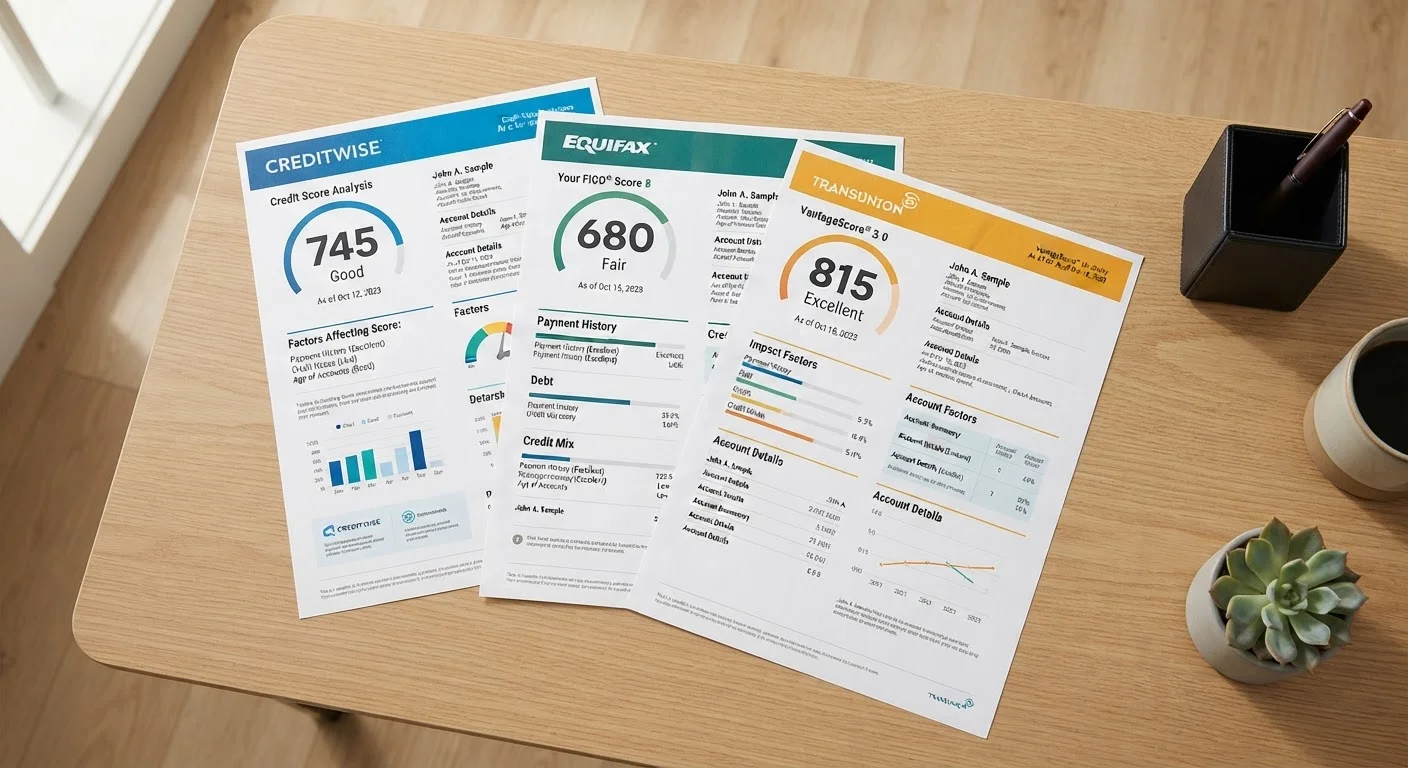
Three Bureaus, Three Separate Files
Most people assume there's one central credit database with a single score attached to their name. In reality, Equifax, Experian, and TransUnion are three separate, competing companies. They each collect data independently, maintain their own consumer files, and generate scores using their own processes.
Lenders — banks, credit card issuers, auto financiers — are not required to report your account activity to any bureau, let alone all three. Many do report to all three as a matter of standard practice, but some report to only one or two. A small number of creditors, particularly smaller institutions or certain types of lenders, don't report to any bureau at all.
The practical result is that your three credit files may contain different sets of accounts, different balances, and different payment histories. When a scoring model runs on each file, it works with whatever data that particular bureau has — which is why the outputs don't always match. To understand what goes into those calculations in the first place, see the five factors that shape your credit score.
Bureaus Don't Share Data With Each Other
Equifax, Experian, and TransUnion do not automatically share information. If a lender reports a late payment to one bureau, that entry won't automatically appear on the other two. Similarly, disputing and correcting an error on one bureau's file does not fix it on the others — you'd need to contact each bureau separately.
Scoring Models Add Another Layer of Variation
Even if two bureaus had identical data on you, they could still produce different scores depending on which scoring model they use. FICO and VantageScore are the two dominant scoring frameworks, and each has multiple versions in active use by lenders. FICO Score 8 remains widely used, but FICO Score 9 and industry-specific versions (like those built for auto or mortgage lending) are also common.
Each version weights factors slightly differently — for example, FICO Score 9 treats paid-off collections more favorably than FICO Score 8. A lender pulling a score based on one model may see a meaningfully different number than a lender using another, even when pulling from the same bureau on the same day.
This is also why the score you see through a free monitoring service may not match what a lender sees. Free consumer scores are often educational scores generated by a different model than the one your lender will actually use. For a deeper explanation of what these numbers are actually measuring, Credit Scores Decoded breaks it down clearly.
“Consumers are often surprised to learn there is no single, universal credit score. The number a lender sees depends on which bureau they pull from and which scoring model they apply — both of which can vary significantly.”
— Consumer Financial Protection Bureau, U.S. federal consumer financial watchdog agency
When Score Differences Signal a Real Problem
A gap of 10–30 points between bureaus is generally within the expected range of normal variation. But if one score is significantly lower than the others — by 50 points or more — it's worth digging into why.
Common culprits include:
- A derogatory mark (late payment, collection, charge-off) that appears on one bureau's file but not the others
- An error in one file — an account that isn't yours, a payment incorrectly reported as late, or a balance that wasn't updated after payoff
- A new credit inquiry or account that has reported to one bureau but hasn't yet propagated to the others
Errors on credit reports are more common than many consumers expect. The checklist for spotting errors on your credit report can help you systematically review each file and flag anything worth disputing.
It's also worth understanding how credit reports and credit scores differ — your report is the raw data; your score is what the model does with it. Fixing a report error can change your score, but only at the bureau where the fix is made.
1 in 5
Consumers with a credit report error
A Federal Trade Commission study found that approximately one in five consumers had an error on at least one of their three credit bureau reports.
3
Major bureaus maintaining independent files
Equifax, Experian, and TransUnion each independently collect and maintain consumer credit data — there is no shared central database among them.
What This Means Before You Apply for Credit
When you're preparing to apply for a mortgage, car loan, or any major credit product, knowing which bureau a lender is likely to pull from — and what that bureau's file says about you — can be genuinely useful. Mortgage lenders typically pull all three and use the middle score, so an outlier in either direction matters less. But many other lenders use just one bureau, and if that happens to be the one with a lower score, your terms could be affected.
Pulling your own reports from all three bureaus before applying gives you a clearer picture of your overall credit standing. If you're considering an auto loan, how credit scores affect the car-buying process explains how lenders typically use these numbers when evaluating applications.
Check All Three Reports Before Applying
You're entitled to a free credit report from each of the three major bureaus at AnnualCreditReport.com. Reviewing all three — not just one — before a major credit application helps you spot discrepancies, catch errors, and understand the full picture a lender might see.
This article is for general informational purposes only and does not constitute personalized financial or credit advice. Consider speaking with a licensed financial professional for guidance specific to your situation.
Frequently Asked Questions
The most likely reason is that one or more of your accounts report to Experian but not Equifax — or vice versa. If a positive account like a long-standing credit card only appears on one file, that file will reflect a stronger history. Different scoring models applied by each bureau can also contribute to the gap.
It depends on the lender and the type of credit. Mortgage lenders typically pull scores from all three bureaus and use the middle score for their decision. Auto and personal loan lenders may pull from just one or two bureaus, and their choice varies by institution.
It can, if the lender uses the bureau where your score happens to be lower. This is why it's worth reviewing all three reports before applying for significant credit, so you understand your position across the board.
You can request a free report from each of the three major bureaus at AnnualCreditReport.com, the official site authorized under federal law. Reviewing all three gives you the most complete picture of your credit standing.
You can dispute the error directly with the bureau where it appears. Each bureau has its own dispute process, and correcting an error on one file does not automatically fix it on the others — you'd need to file separately if the same error appears elsewhere.
A gap that large is less common but not unheard of. It often points to a significant account — such as a collection, late payment, or major credit line — that appears on one bureau's file but not another's. That kind of gap is worth investigating by pulling all three reports.
The content on this site is for informational purposes only and is not a substitute for professional advice. Always consult a qualified professional for guidance specific to your situation.