

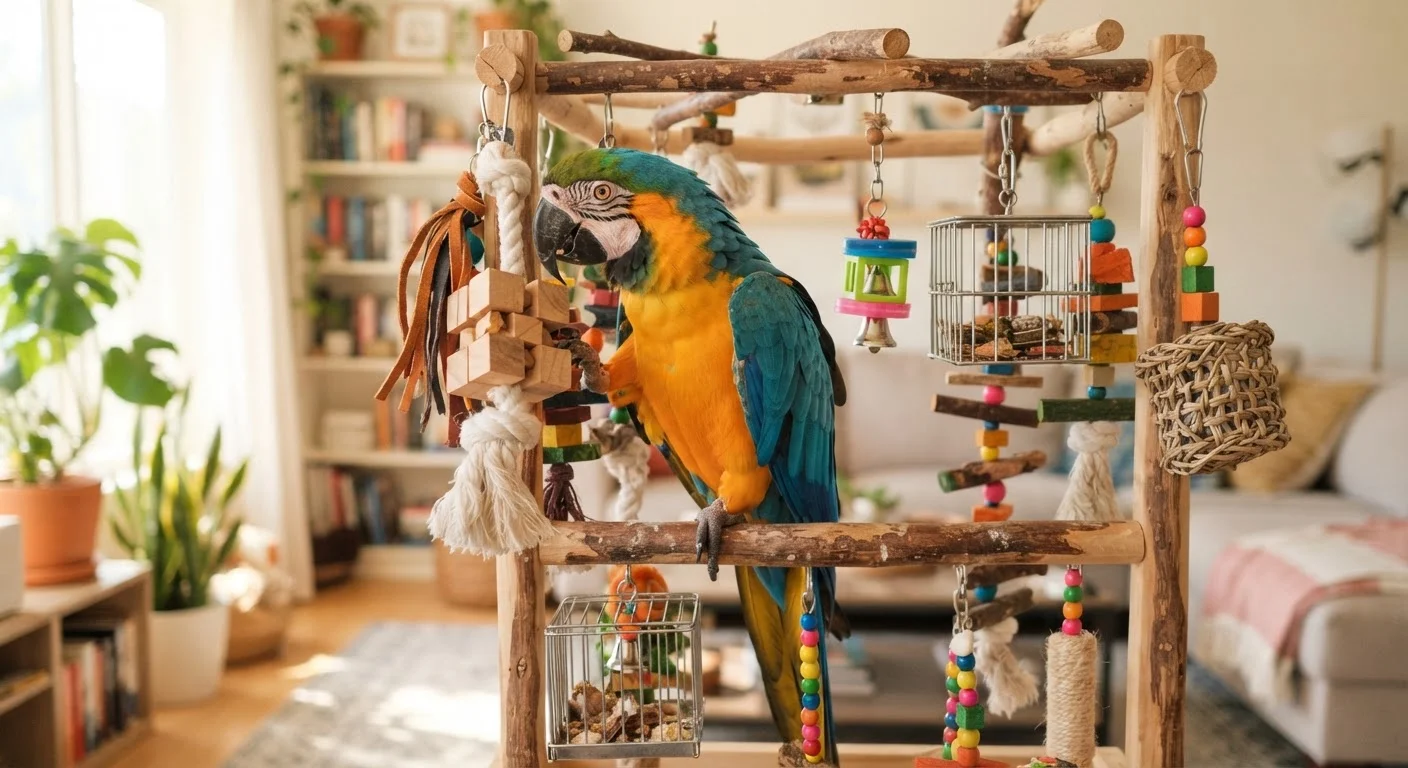
Why Parrots Have Such High Mental Needs
Wild parrots spend their days foraging across large territories, navigating complex social flocks, solving environmental puzzles, and vocalizing with companions. Their brains evolved for constant engagement. When a parrot enters a home environment, those cognitive drives don't disappear — they need an outlet.
This is what separates parrots from many other pet species. A parrot isn't content to simply perch and observe. Without adequate stimulation, the same intelligence that makes them so captivating can turn inward in destructive ways. Feather plucking, screaming, and biting are rarely "bad behavior" — they're often symptoms of unmet psychological needs.
If you're new to bird ownership, the practical first-owner overview for pet birds covers the foundational care context that supports everything discussed here.
~150
Word vocabulary some African Greys can learn
Research on African Grey parrots has documented individual birds learning and contextually using vocabularies comparable to a young child, according to studies by comparative psychologists.
Up to 80%
Feather-plucking cases with psychological component
Avian veterinary literature suggests the majority of feather-destructive behavior cases involve a behavioral or psychological component, often alongside or following medical evaluation.
2–4 hrs
Recommended daily out-of-cage time
Many avian welfare organizations recommend a minimum of two to four hours of out-of-cage time daily for most companion parrot species.
The Core Pillars of Parrot Mental Wellbeing
Parrot mental health rests on four interlocking pillars: social connection, cognitive enrichment, routine and predictability, and physical freedom. Neglecting any one of them creates stress that compounds over time.
Social Connection
Parrots are flock animals. In the wild, they are rarely alone. In a home setting, their human family becomes their flock — and they need meaningful interaction daily, not just passive proximity. Talking to your parrot, training with positive reinforcement, and simply spending time in the same room all contribute to their sense of belonging.
Cognitive Enrichment
Foraging is one of the most powerful enrichment tools available to parrot owners. Instead of placing food directly in a bowl, hiding food inside shreddable toys, paper cups, or puzzle feeders mirrors the mental effort parrots would naturally expend finding a meal. Rotating toys regularly prevents habituation — the same toy loses its novelty quickly.
Routine and Predictability
Parrots are highly attuned to their environment. Consistent wake times, feeding schedules, and interaction windows reduce background anxiety. Sudden, unpredictable changes — rearranged furniture, new pets, irregular sleep schedules — can trigger stress responses that build over days.
Physical Freedom
Out-of-cage time isn't optional. Parrots confined to a cage all day, regardless of how enriched that cage is, experience physical and psychological restriction that takes a toll. Safe, supervised free flight or exploration time supports both mental and physical health.
Rotate Enrichment Every Few Days
Parrots habituate quickly to familiar objects — a toy that captivated your bird this week may be completely ignored by next week. Keep a small rotation of toys and swap them out every few days to maintain novelty. You don't need to buy new items constantly; returning a previously removed toy after a week often resets the bird's interest.
Recognizing and Responding to Mental Distress
Behavioral changes are often the first indicator that a parrot's psychological needs aren't being met. Feather-destructive behavior — where a parrot chews or pulls out its own feathers — is one of the most visible warning signs, but it can also have underlying medical causes. An avian veterinarian should always evaluate the bird before assuming the cause is purely behavioral.
“Parrots are not decorative objects. They are sentient beings with complex emotional lives, and when their needs are ignored, they suffer in ways that are very visible to anyone paying attention.”
— Dr. Susan Friedman, Behavioral psychologist and avian behavior consultant, Utah State University
Other signs worth monitoring include increased aggression, prolonged screaming, stereotypic movements (repetitive pacing or head-bobbing with no clear purpose), and withdrawal from interaction. These behaviors exist on a spectrum, and catching them early makes a meaningful difference in outcomes.
For a broader look at health warning signs across small pets and birds, this guide to recognizing illness in small pets is a useful companion resource.
Enrichment approaches that work well for parrots share principles with other companion animals — though the application differs. For comparison, enrichment strategies for cats illustrates how the same core ideas translate across species.
This article is for general informational purposes only and does not constitute veterinary advice. If you have concerns about your parrot's behavior or health, consult a qualified avian veterinarian.
Frequently Asked Questions
Most parrot species benefit from at least two to four hours of active interaction and out-of-cage time per day. This doesn't all have to be hands-on — being near a family member while you go about your day counts as social time for many birds. The exact amount varies by species, age, and individual temperament.
Signs of psychological distress include feather plucking or chewing, repetitive rocking or pacing (called stereotypies), excessive screaming, aggression, and loss of appetite. These behaviors often signal boredom, loneliness, or chronic stress. If you notice any of them, a visit to an avian veterinarian is a good first step.
Yes, but it requires significant human commitment. A parrot without a bird companion will bond deeply to its human family and needs substantial daily interaction to thrive. Some species tolerate solitary living better than others, but no parrot does well with consistent isolation.
Foraging toys, shreddable items, puzzle feeders, and rotating novelty objects all support healthy mental stimulation. The key is variety and regular rotation — a toy that was exciting last week may be ignored by next week. Always choose materials appropriate for your parrot's size and beak strength.
Some vocalization is completely normal — parrots communicate through calls, especially at dawn and dusk. However, excessive or distressed screaming that persists throughout the day can indicate unmet social or mental needs. Evaluating the context and frequency helps distinguish natural communication from a sign of distress.
The content on this site is for informational purposes only and is not a substitute for professional advice. Always consult a qualified professional for guidance specific to your situation.