Why Region Shapes a Vehicle's Character
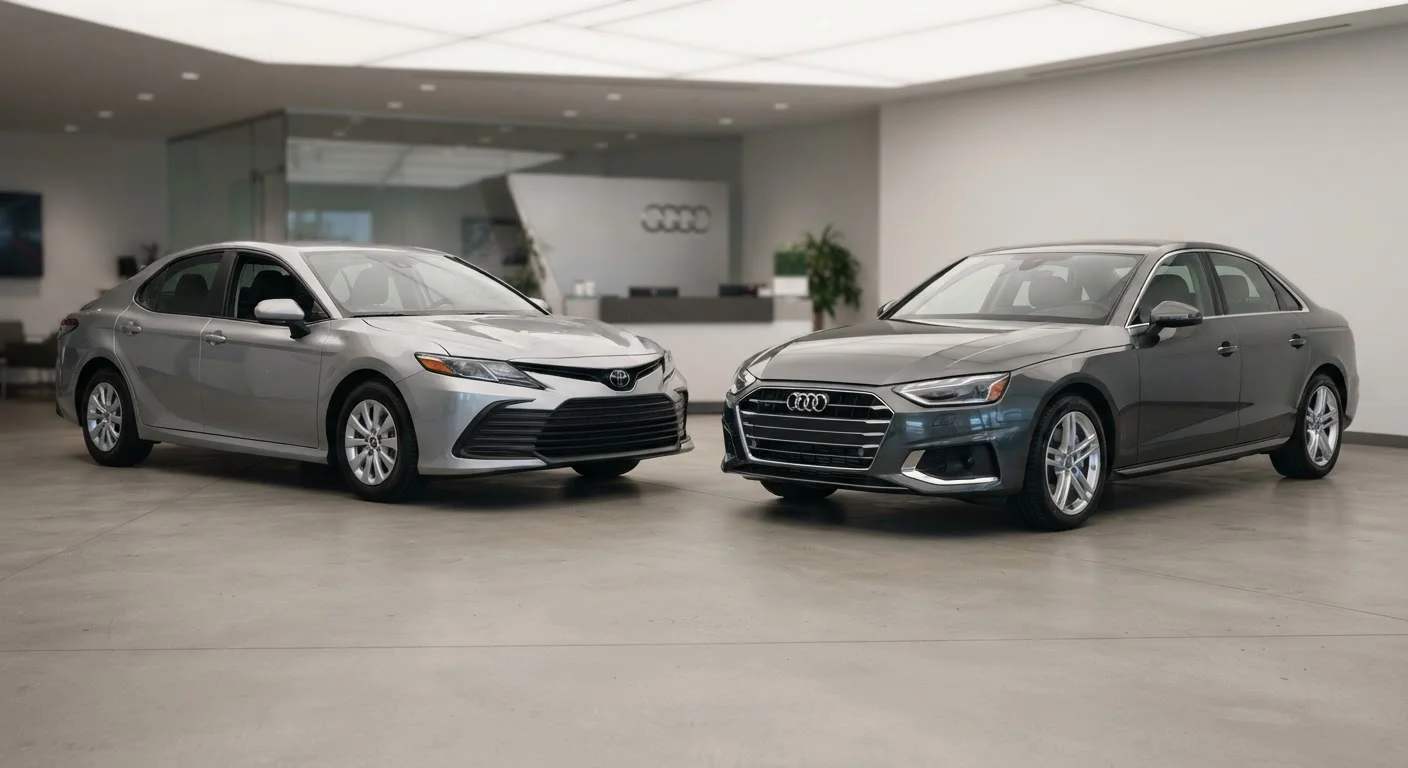
A car is never designed in a vacuum. The country or region where an automaker is headquartered influences everything from engine layout and suspension tuning to interior materials and styling cues. Those choices reflect local road conditions, consumer expectations, regulatory environments, and decades of accumulated engineering culture. Understanding those roots helps explain why vehicles from different parts of the world feel so distinct - even when they compete in the same market segment.
For a broader look at how these regional identities play out for everyday buyers, see our overview of domestic and import car brands.
The American Tradition: Scale, Power, and Practicality
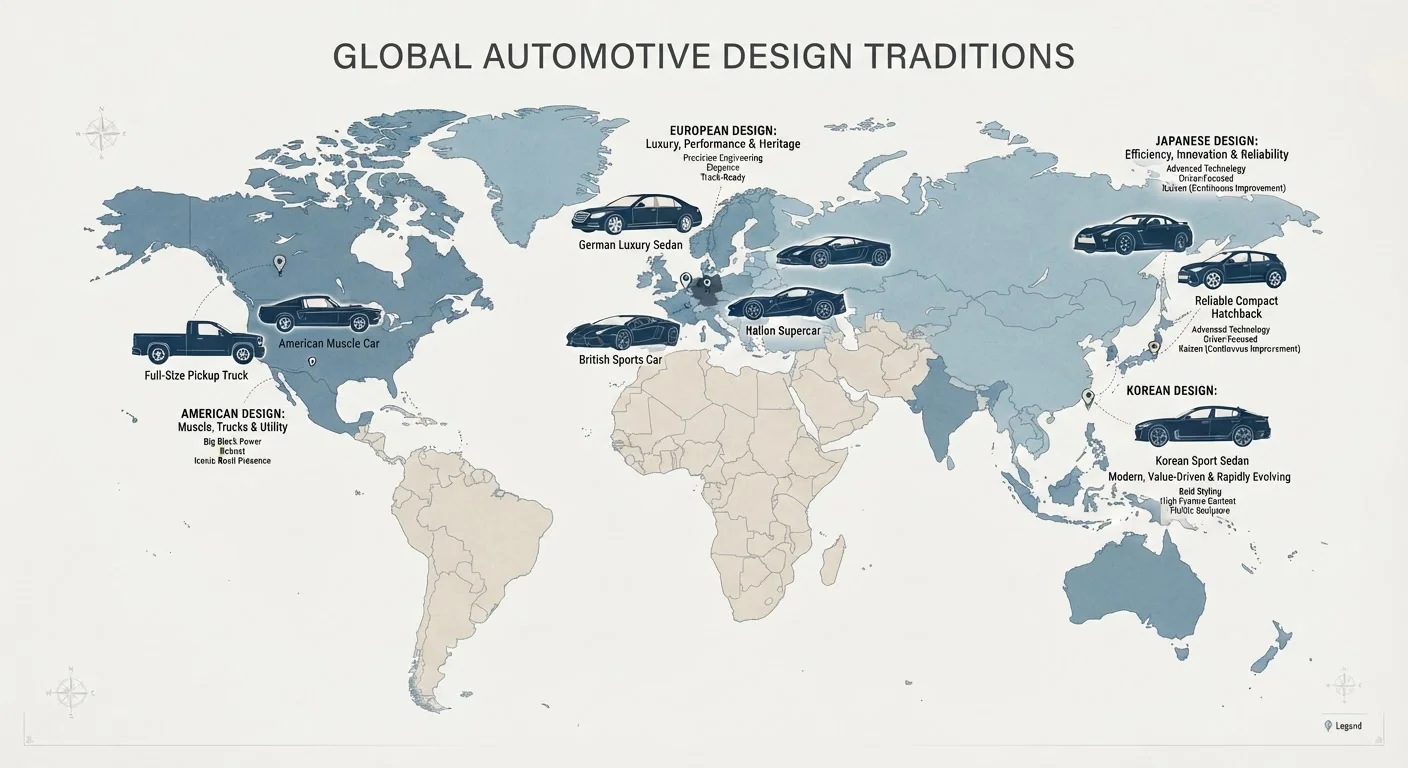
The U.S. auto industry took shape in the early twentieth century around a vast, largely flat country with cheap fuel and long distances between cities. Those conditions favored large-displacement engines, comfortable long-haul ride quality, and body styles suited to carrying families across states. Detroit's mass-production methods, pioneered in the early 1900s, also pushed automakers toward standardized, cost-efficient manufacturing at enormous scale.
That legacy still shows up in American vehicles' continued emphasis on trucks and SUVs, big powertrains, and spacious interiors. Fuel economy and handling agility were historically secondary concerns - though tightening federal emissions and fuel-economy standards have shifted priorities considerably in recent decades.
4
Distinct major automaking regions worldwide
The U.S., Europe, Japan, and South Korea each developed independent automotive industries with unique engineering traditions.
1908
Year Ford's Model T launched mass-market motoring
The Model T is widely cited as a turning point in making automobiles affordable and standardized for everyday consumers in the U.S.
1970s
Decade Japanese imports gained major U.S. market traction
Fuel crises of that era accelerated demand for smaller, more fuel-efficient vehicles, benefiting Japanese automakers significantly.
European Philosophies: Engineering Precision and Driver Engagement
Europe's automaking tradition is not monolithic - German, Italian, French, and British manufacturers each have distinct personalities - but a few common threads run through them. Narrower roads, varied terrain, and higher fuel taxes historically pushed European engineers toward smaller, more fuel-efficient engines, stiffer chassis, and sharper steering. Driver engagement and handling dynamics became defining values, particularly in German and British performance-oriented brands.
German manufacturers developed a reputation for systematic engineering rigor and durable construction. Italian design houses became influential worldwide, treating bodywork as sculpture. French automakers often prioritized ride comfort on rough rural roads and innovation in front-wheel-drive packaging. These different national emphases are part of why car naming conventions vary so widely across the continent.
Japanese and Korean Approaches: Reliability, Efficiency, and Rapid Evolution
Japan's postwar auto industry grew under strict resource constraints and a domestic culture that valued precision craftsmanship and continuous improvement. The result was a manufacturing philosophy - often described by the Japanese term kaizen (incremental, ongoing improvement) - that prioritized reliability, tight quality tolerances, and fuel efficiency. Japanese vehicles earned a strong reputation in the U.S. market during the fuel crises of the 1970s, when smaller, dependable cars gained widespread appeal.
South Korea's industry emerged somewhat later, accelerating rapidly from the 1980s onward. Korean automakers initially focused on value and affordability, then invested heavily in design studios and engineering talent to move upmarket. Today, Korean manufacturers are widely recognized for competitive feature content, strong warranty programs, and increasingly distinctive styling - a trajectory that illustrates how quickly a regional industry can redefine its identity.
Many of these manufacturers operate under larger corporate umbrellas. For context on how parent companies relate to the brands consumers actually see, see our article on parent automakers and their sub-brands.
Kaizen
A Japanese business philosophy centered on continuous, incremental improvement. In manufacturing, it drives ongoing refinements to quality, efficiency, and processes rather than waiting for large-scale overhauls.
Platform sharing
A strategy where multiple vehicle models share the same underlying engineering architecture - such as the chassis, floorpan, and suspension geometry - while having different bodies and features.
Design philosophy
The set of priorities - such as performance, reliability, comfort, or efficiency - that guide how engineers and designers approach building a vehicle. These priorities often reflect regional history and consumer expectations.
Mass production
A manufacturing method that produces large quantities of standardized goods using assembly-line techniques. Henry Ford's early twentieth-century factories are a foundational example in the auto industry.
How These Traditions Are Converging
Globalization, shared platforms, and the shift toward electric vehicles are blurring some of the sharpest regional distinctions. American automakers now design vehicles for global markets; Japanese manufacturers build trucks aimed squarely at U.S. preferences; European brands develop SUVs that would have seemed out of character a generation ago. The electrification wave is accelerating this convergence, since EV architecture - a flat battery floor, electric motors, and software-driven systems - is broadly similar regardless of where a vehicle is built.
Regional design philosophies are not disappearing, but they are evolving. Understanding where they came from helps consumers cut through marketing language and evaluate what a vehicle's origins actually mean for day-to-day ownership. If you are beginning to research a specific model, our guide to questions worth asking when researching a car model offers a practical framework. For how legacy brands are restructuring their lineups around EVs, see our piece on electric vehicle lineups.
The content on this site is for informational purposes only and is not a substitute for professional advice. Always consult a qualified professional for guidance specific to your situation.