

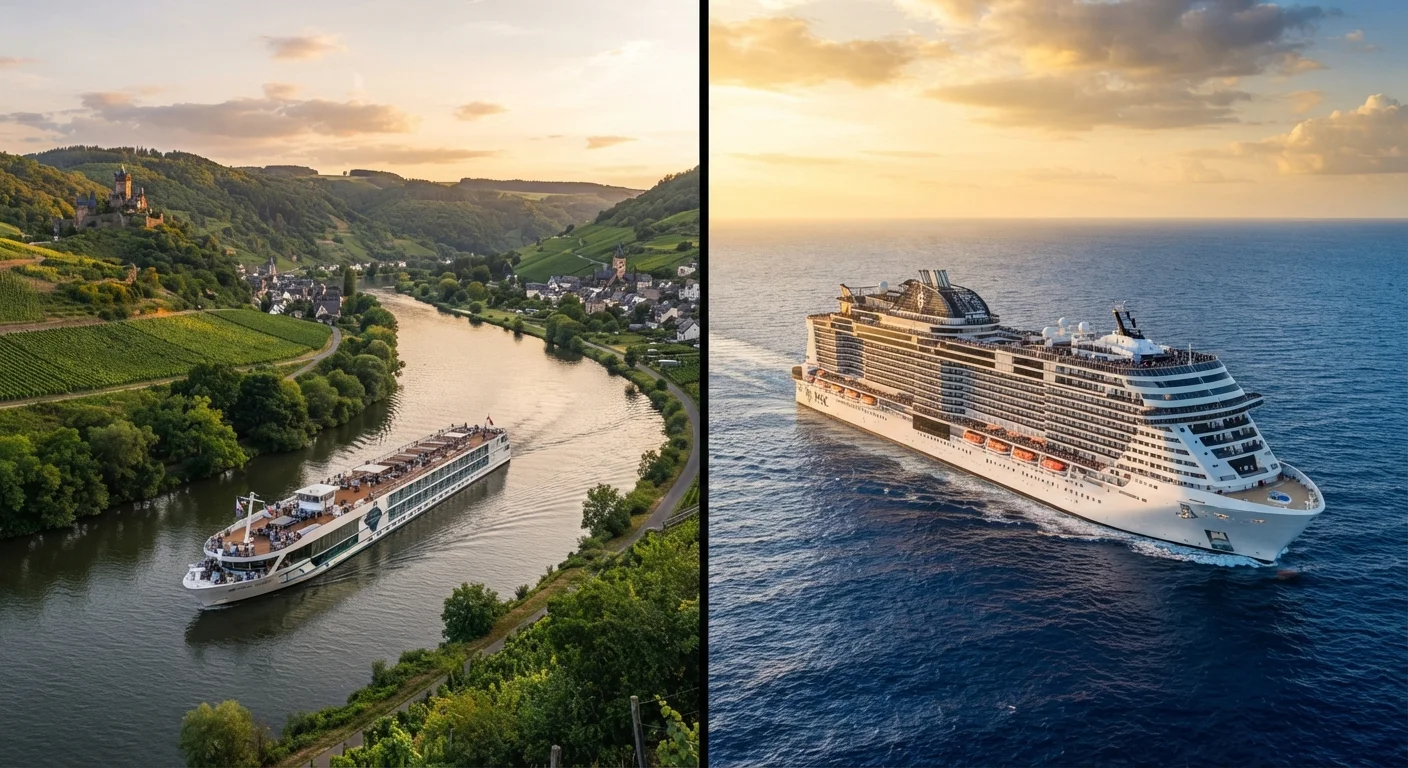
Option A
River Cruises
The intimate, destination-immersive choice.
Best for: Travelers who want to explore multiple cities up-close, with a slower pace and a smaller, more sociable ship.
Option B
Ocean Cruises
The go-big, amenity-packed adventure on open water.
Best for: Travelers who want resort-style onboard entertainment alongside visits to diverse ports across continents or islands.
The Ships Themselves: Size Changes Everything
The most immediate difference between river and ocean cruises isn't the scenery — it's the vessel you're standing on. River cruise ships are engineered to navigate narrow waterways and pass under low bridges, which means they're long, flat, and compact. Most carry between 100 and 200 passengers. Ocean cruise ships, by contrast, can carry anywhere from a few hundred guests on boutique expedition vessels to well over 5,000 on the largest resort-style ships afloat.
That size gap shapes absolutely everything: cabin styles, dining options, entertainment, and even how you feel during the voyage. On a river ship, you'll likely know your fellow travelers by name within a day. On a mega ocean ship, you might spend a week barely crossing paths with the same person twice.
If you're curious about what daily life actually looks like aboard either style of ship, our Cruise Travel 101 guide walks through the essentials from embarkation to disembarkation.
| Criterion | River Cruises | Ocean Cruises |
|---|---|---|
| Typical passenger count | 100–200 guests | 500–6,500+ guests |
| Where ships dock | City centers | Port terminals, often outside city |
| Motion / seasickness risk | Minimal — calm waterways | Moderate to significant on open sea |
| Onboard entertainment | Modest; destination-focused | Extensive; resort-style |
| Geographic range per trip | Single waterway corridor | Multiple regions or continents |
| Typical pricing structure | Often all-inclusive or near so | Variable; many add-ons possible |
| Dining variety | One or two venues | Many restaurants and options |
Destinations and Docking: How You Actually See the Places
Here's where the two cruise styles diverge most meaningfully for destination lovers. River cruise ships dock directly in the hearts of cities — think stepping off a gangplank in Bordeaux, Budapest, or Amsterdam and being steps from cathedral squares and local markets. That convenience is genuinely hard to overstate if cultural exploration is your priority.
Ocean cruise ports are often located outside city centers, sometimes requiring a 30–60 minute bus or shuttle ride to reach the highlights. That's not necessarily a drawback — port towns themselves can be charming — but it does reduce spontaneous wandering time. Whether you book excursions through the ship or explore independently becomes an especially meaningful decision on ocean itineraries.
River routes tend to concentrate on a single waterway — the Rhine, the Danube, the Mekong — giving voyages a clear narrative thread. Ocean itineraries can be enormously varied, from Caribbean island-hopping to trans-Atlantic crossings. For help thinking through which geographic region suits you, see our guide to choosing a cruise destination.
~180
Average river cruise passenger capacity
Most river vessels accommodate between 100 and 200 guests, contrasting sharply with ocean ship scale.
5,000+
Passengers on the world's largest ocean ships
The largest modern ocean cruise ships can carry more passengers than many small towns have residents.
~50
Ports of call per river cruise itinerary
A typical 7–14 day river cruise visits multiple cities, often docking in a new location every single day.
Onboard Experience: Entertainment, Dining, and the Art of Doing Nothing
Ocean ships are essentially floating resorts. Depending on the vessel, you might find multiple pools, a spa, a casino, theatrical shows, sports courts, specialty restaurants, and dozens of bars. Dining alone can be a rich experience, with options ranging from main dining rooms to chef-driven specialty venues. Our overview of how cruise ship dining is typically structured explains how these options generally work across different ship types.
River ships operate on a fundamentally different philosophy: the destination is the entertainment. Cabins are comfortable but typically more compact, and amenities are intentionally modest — a lounge, a sun deck, perhaps a small fitness area. Lectures, wine tastings, and local cultural performances often fill evening hours. The focus is outward, toward the riverbanks and the towns beyond them.
Cabin experience also differs. On ocean ships, cabin categories range widely, from windowless interior rooms to sprawling suites with private verandas. On river ships, most staterooms feature panoramic windows or French balconies, since the view outside is part of the product itself.
River Ship Cabins and Windows
Because river scenery is a core part of the experience, most river cruise cabins are designed with large panoramic windows or floor-to-ceiling sliding glass panels sometimes called French balconies. Traditional step-out balconies are uncommon due to the ship's low clearance under bridges, but the window design generally compensates well for the trade-off.
Pace, Pricing, and Who Each Style Suits
River cruises generally move at a contemplative pace — you dock somewhere new almost every day, but the ship itself moves slowly, letting you absorb the landscape as it drifts past. Ocean cruises include sea days between ports, which divide travelers: some love the unscheduled relaxation, others find them restless.
Pricing on river cruises tends to be all-in or nearly so, with many lines including excursions, beverages, and gratuities in the base fare. Ocean cruise pricing is more variable, with base fares sometimes excluding drinks packages, shore tours, and specialty dining. Neither format is inherently more or less expensive — it depends heavily on the line, the itinerary, and what's bundled.
River cruises tend to attract travelers who are 50-plus, culturally curious, and prefer a quieter social atmosphere. Ocean cruises draw a broader demographic mix, especially families and those celebrating milestones. That said, both formats have diversified meaningfully — expedition ocean cruises, for example, attract adventure-focused travelers, while some river lines now offer younger-skewing itineraries. Solo travelers should note that both formats have specific policies worth understanding; our guide on solo cruising covers what to expect.
The content on this site is for informational purposes only and is not a substitute for professional advice. Always consult a qualified professional for guidance specific to your situation.